The Population of the Renewed Earth
Where Do We Go? What Do We Become?
Everyone wants to know where they go when they die. But surprisingly few ask the follow-up question that makes the answer matter: how many people fit? The biblical promises of a physical land, physical bodies, and a physical city create a hard mathematical constraint that traditional readings often overlook. This study follows the evidence through four questions and arrives at a number — and that number confirms why the gate is narrow.
I. The Physical Premise — Mathematics and the Land
God promised Abraham a specific territory with defined borders:
This is not a metaphor. It is a land grant with geographical boundaries — a deed of real estate. Ezekiel 47–48 maps the same territory into tribal allotments with measured borders and a river flowing from the sanctuary. The Promised Land, at its traditional boundaries, covers roughly 300,000 square miles. The broader "Greater Israel" reading (from the Nile watershed to the Euphrates) reaches approximately 900,000 square miles.
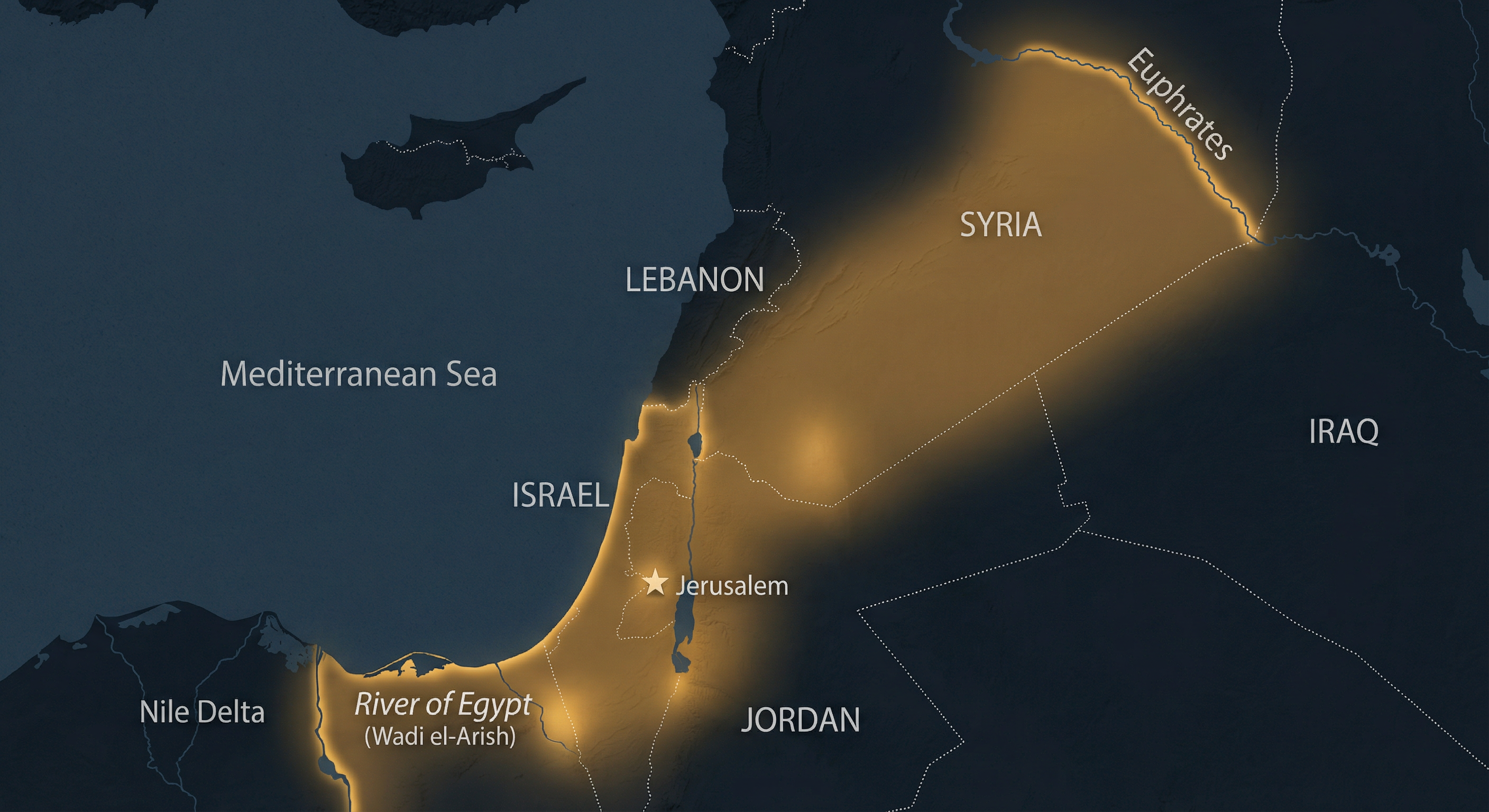
Traditional Promised Land boundaries (Gen 15:18) — approximately 300,000 square miles.
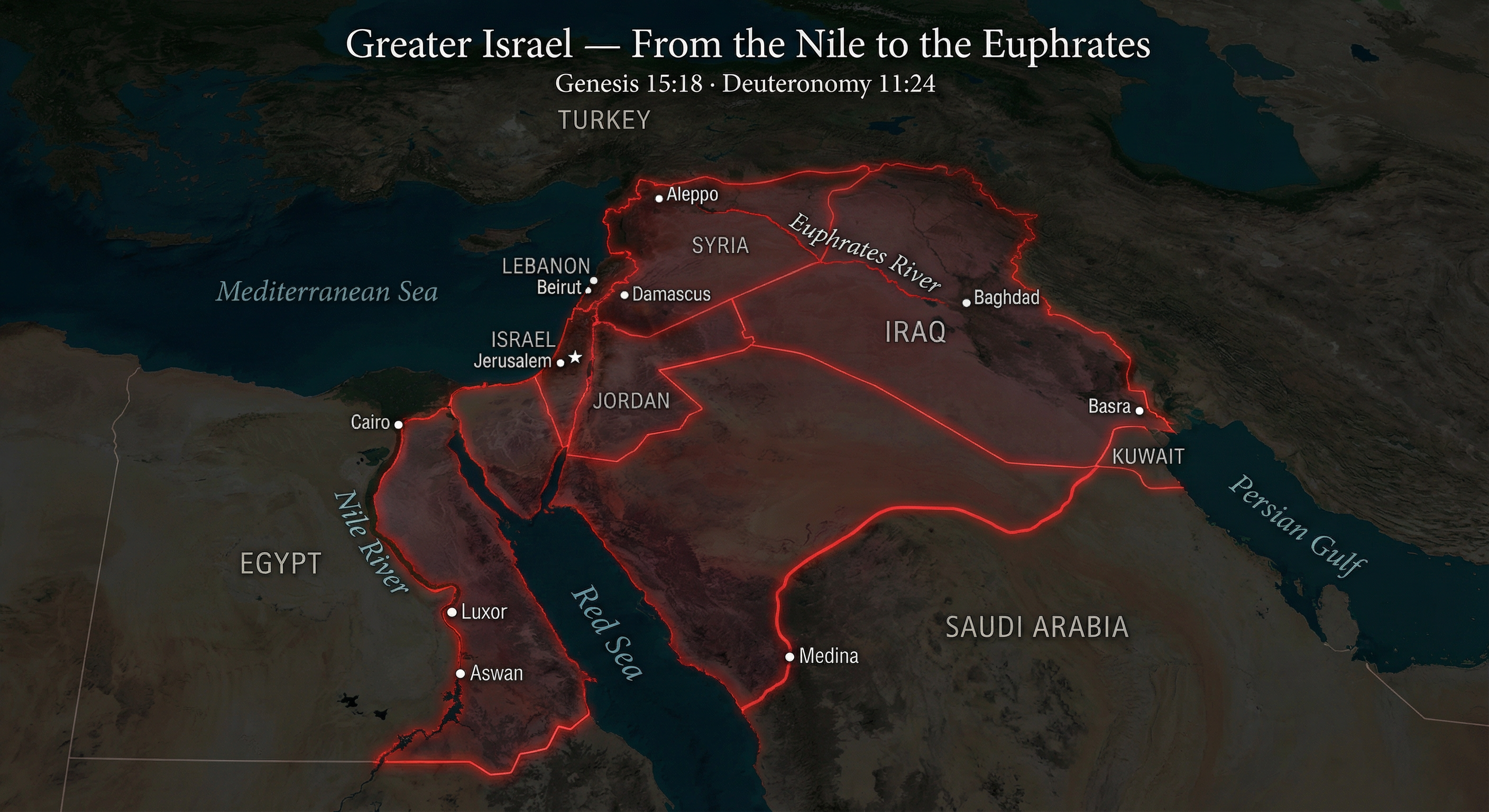
Greater Israel reading — including the Nile watershed, Mesopotamia, and Arabian territory — approximately 900,000 square miles.
The Hebrew word in Psalm 37 — where the righteous are promised inheritance five times (vv. 9, 11, 22, 29, 34) — is H776 erets. This word means both "earth" and "land." When Jesus says "the meek shall inherit the ge" (Mat 5:5), quoting Psalm 37:11, the context of the Psalm is inheritance of the land — the covenant territory — not the entire globe. The firstfruits inherit the Promised Land. The rest of the redeemed, as we will see, inherit the broader earth.
Here is the question surprisingly few ask: if the resurrected have physical bodies and the inheritance is physical land, how many people fit?
| Territory | Area | % of Earth's Land (~57M sq mi) |
|---|---|---|
| Traditional Promised Land | ~300,000 sq mi | ~0.5% |
| Greater Israel (Nile to Euphrates) | ~900,000 sq mi | ~1.6% |
| Renewed Earth (deserts bloom — Isa 35:1, 51:3) | ~57,500,000 sq mi | 100% |
The answer to that question depends entirely on the answers to four others: Where do the dead go? Where do the resurrected go? What kind of bodies do they have? Do they reproduce? Each answer constrains the number. Together, they converge on a density calculation that confirms why Jesus said "few there be that find it" (Mat 7:14).
II. The Physics of Sleep — Where Do the Dead Go?
The popular answer is: heaven. The righteous go up to be with God; the wicked go down to suffer. But the biblical evidence points overwhelmingly in a different direction: the dead are unconscious, sleeping in the dust, waiting for resurrection. This must be established first, because if the dead are already in heaven, population density is irrelevant — heaven is presumed to have unlimited capacity. Remove that assumption, and everything changes.
The Dead Have No Consciousness
Nine Old Testament passages describe death as the total cessation of conscious activity:
Five rhetorical questions in Psalm 88, all expecting the answer no. Hezekiah's stark contrast in Isaiah 38: only "the living, the living" can praise — the dead cannot praise, cannot celebrate, cannot even hope. The remaining passages complete the picture: "In death there is no remembrance of thee" (Ps 6:5). "The dead praise not the LORD" (Ps 115:17). "Man dieth, and wasteth away: yea, man giveth up the ghost, and where is he? As the waters fail from the sea… so man lieth down, and riseth not: till the heavens be no more" (Job 14:10–12).
Ecclesiastes 12:7 says "the spirit shall return unto God who gave it." But Psalm 146:4 says the person's thoughts perish at that same moment. The breath-of-life (H7307 ruach) goes back to its source — like electricity returning to the grid when you unplug a lamp. The lamp is off. And animals share the same ruach (Eccl 3:19, Gen 6:17). If ruach meant a conscious soul surviving death, animals would have conscious souls too.
The Physics of Consciousness
Genesis 2:7 gives the equation: God formed man from dust, breathed into his nostrils the breath (neshamah) of life, and man became a living being (nephesh chayah). The person is the COMBINATION of dust and breath — not one component. Reverse the equation (Eccl 12:7: dust returns to earth, breath returns to God) and the person ceases to be conscious. Neither component alone is "the person."
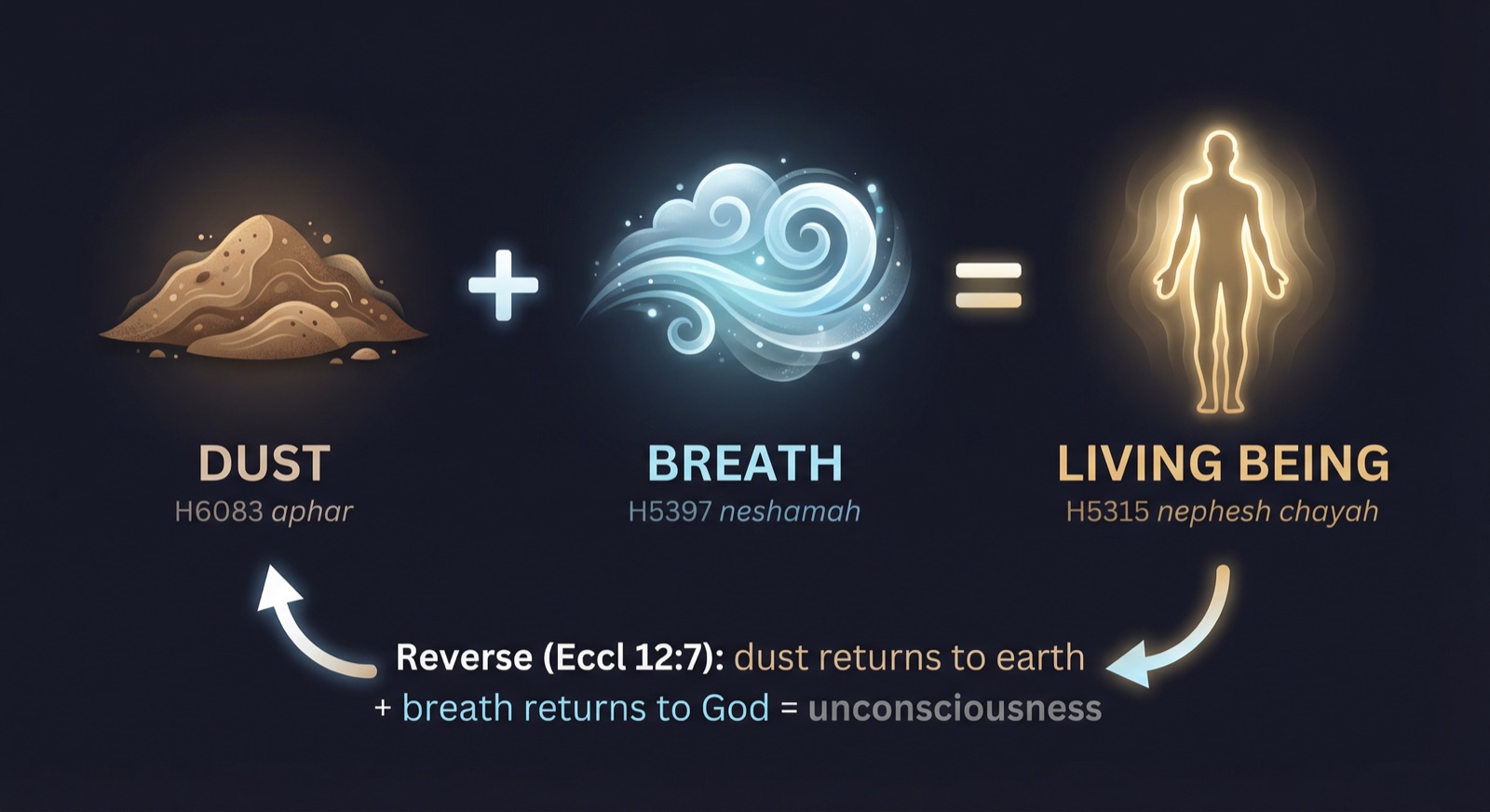
Genesis 2:7 — the equation of consciousness. Reverse it (Eccl 12:7) and consciousness ceases.
The Dead Come UP from Graves, Not DOWN from Heaven
The origin point is the grave. They come FORTH from the ground. If the righteous dead were consciously in heaven, Jesus would say "they shall come down" or "they shall return to their bodies." Instead: they are in the graves, they hear His voice, they come forth. Daniel 12:2: "Many of them that sleep in the dust of the earth shall awake." Isaiah 26:19: "The earth shall cast out the dead." Every resurrection text has the dead coming UP out of the ground, never DOWN from heaven.
No One Has Ascended
Peter says this at Pentecost — over 1,000 years after David's death. David, the man after God's own heart, is NOT in heaven. Yet David expected to see his dead child: "I shall go to him" (2 Sam 12:23). That reunion is resurrection-confidence, not "he's in heaven now" confidence.
Eight Resurrections — None Report Heaven
Scripture records eight individual resurrections before the eschatological harvest: the widow of Zarephath's son (1 Ki 17), the Shunammite's son (2 Ki 4), the man who touched Elisha's bones (2 Ki 13), the widow of Nain's son (Lk 7), Jairus's daughter (Lk 8), Lazarus (Jn 11), Tabitha (Acts 9), and Eutychus (Acts 20). Not one reports a heavenly experience. All use waking/sleeping language: eyes opened, sat up, sneezed, came forth.
Lazarus was dead four days. If he had spent four days conscious with God, the silence is striking — John records detailed conversations elsewhere, but four days of afterlife experience? Nothing. This tension resolves naturally if Lazarus was simply asleep with nothing to report.
Consider the logic: if the dead are in conscious heavenly bliss, then every resurrection in Scripture is a demotion — pulling someone out of paradise and stuffing them back into a mortal body. But every text treats resurrection as a gift, a mercy, a cause for rejoicing. That only makes sense if the dead are unconscious and the resurrection is their awakening.
Why Resurrection Is Essential
Paul stakes everything on it:
Not "they're still fine in heaven without resurrection." PERISHED. Paul's logic only works if the dead are unconscious and the resurrection is their only path back to life. If they were already conscious with God, "no resurrection" would not equal "perished."
The resurrection of the wicked confirms this from the other side. If the wicked are already suffering consciously (the traditional reading), the formal resurrection and judgment of Revelation 20:12–13 creates an apparent redundancy — why raise and judge those already being punished? This tension resolves if the dead are unconscious: they MUST be raised because you cannot render a verdict to someone who is asleep. The resurrection is necessary precisely because the dead are not yet conscious.
The Counter-Texts
Several passages appear to teach a conscious intermediate state. Each resolves on examination:
Luke 23:43 — "Today shalt thou be with me in paradise." The original Greek has no commas — punctuation was added by later editors. The placement of "today" is genuinely ambiguous: it could modify "you will be with me" OR "I say to you." In the Old Testament, "I say to you this day" is a known emphatic idiom for solemn declaration (Deut 30:18 — "I denounce unto you this day"; Deut 4:26, 8:19, 30:19). Since Jesus spoke Hebrew/Aramaic, His words likely carried this Semitic pattern: "Truly I say to you today — you will be with me in paradise." The thief's next conscious moment is the resurrection.
2 Corinthians 5:8 / Philippians 1:23 — "Absent from the body, present with the Lord" and "to depart, and to be with Christ." Neither specifies a time interval. They describe the certainty and desirability of being with the Lord, not the chronology. For the dead, no time passes — death and resurrection are the same moment experientially.
Luke 16:19–31 — The rich man and Lazarus. A parable (Lk 16:14–15 establishes the audience: Pharisees justifying themselves). Jesus uses Pharisaic afterlife imagery against the Pharisees. The point is the sufficiency of "Moses and the prophets" (v. 29), not afterlife architecture.
1 Samuel 28 — The Witch of Endor. Saul consults a medium who "brings up" Samuel, and the figure speaks. If the dead are unconscious and dust + breath = conscious person, how does Samuel talk without a body?
The practice itself is condemned with a death penalty (Lev 20:27), and Isaiah 8:19 calls necromancy futile: "Should not a people seek unto their God? For the living to the dead?" — futile BECAUSE the dead know nothing (Eccl 9:5). If the dead were conscious and knowledgeable, consulting them would be unauthorized but not futile. God calls it futile.
The key details: the woman herself is SHOCKED (v. 12) — whatever she normally conjures, THIS was different. The figure rises from the EARTH (v. 13), not descends from heaven. And the message is Samuel's own prophecy restated — the same judgment Samuel delivered while alive (1 Sam 15:26–28).
The most consistent resolution: God spoke THROUGH the event without Samuel being consciously present. The narrator calls the figure "Samuel" because the content IS Samuel's prophecy. God commandeered the medium's channel and delivered His own message in a form Saul would recognize — just as the narrator reports "these be thy gods, O Israel" (Exod 32:4) without endorsing the claim. The woman's shock confirms she did not produce this herself. God did not need to wake Samuel to repeat Samuel's words. 1 Chronicles 10:13–14 delivers the verdict: Saul died for this transgression — "for asking counsel of one that had a familiar spirit… and inquired NOT of the LORD." The act is condemned, not endorsed as a window into the afterlife.
The Transfiguration (Mat 17:1–3) — Moses and Elijah appear. Jesus calls the event a "vision" (G3705 horama) in Mat 17:9 — the same word used for Peter's rooftop vision (Acts 10:17), Paul's Macedonian vision (Acts 16:9), and Ananias's vision (Acts 9:10). None of those involved physically-present persons. Moses' body was buried secretly by God (Deut 34:5–6), the grave is unfindable, and Michael the archangel fought the devil for the body (Jude 9) — suggesting the body mattered, not that Moses was a disembodied soul. This is a singular miraculous event — not a window into the normal state of the dead.
Revelation 6:9–11 — "Souls under the altar" crying out. Often cited against soul sleep. But this is an apocalyptic vision under the fifth seal — John sees future martyrs in a heavenly tableau. Abel's blood "cried from the ground" (Gen 4:10) without Abel being consciously present. Blood can "cry out" symbolically. The command to "rest yet for a little season" (v. 11) is itself sleep language.
Hebrews 12:23 — "Spirits of the righteous made perfect." This is the New Jerusalem assembly described in v. 22: "ye are come unto mount Sion, and unto the city of the living God, the heavenly Jerusalem." Post-resurrection language — the completed community, not an intermediate state. "Made perfect" (G5048 teleioo) = brought to completion, the same word used of Christ's perfecting through suffering (Heb 2:10, 5:9).
1 Peter 3:19 — "He went and preached unto the spirits in prison." These are identified in context as those "disobedient… in the days of Noah" (v. 20) — specifically the flood generation. The "prison" parallels 2 Peter 2:4 (angels that sinned, cast into chains of darkness). This is a victory proclamation over imprisoned rebel spirits, not evangelism to conscious human souls in sheol.
1 Peter 4:6 — "The gospel was preached also to them that are dead." The verb tense is critical: "was preached" (aorist passive). They heard the gospel WHILE ALIVE, and are now dead. Peter is explaining why Christians who have since died are not lost — they heard the gospel while living. This is not posthumous evangelism.
Luke 20:38 — "He is not a God of the dead, but of the living: for all live unto him." Jesus argues this AGAINST the Sadducees, who denied the resurrection entirely. His point: God calls Himself "the God of Abraham, Isaac, and Jacob" (present tense) after they died — therefore they MUST rise. "All live unto him" means God regards them as His living ones — their resurrection is certain from His perspective. A sleeping child "lives unto" its parent without being conscious. If Abraham were already alive in heaven, the resurrection Jesus is arguing FOR would be unnecessary — and His logic would prove too much.
Jonah 2:2 — "Out of the belly of sheol cried I, and thou heardest my voice." If Jonah was dead inside the fish (as the Yeshua-type parallel in Mat 12:40 suggests), how is he crying from sheol? The answer follows the same pattern as every other "cry from death" in Scripture: the cry goes up from the MOMENT of being swallowed, not from a conscious state within. Abel's blood cries from the ground (Gen 4:10) — Abel is not conscious; the blood cries. Yeshua cries out "My God, my God, why hast thou forsaken me?" (Mat 27:46) — the last conscious act BEFORE death, then He yields up His spirit. Jonah cries "out of the belly of sheol" as sheol is swallowing him — the cry at the threshold of death, the last conscious moment before the demanding place takes him. In each case, the cry is associated with the moment of dying, not with conscious existence after it. Jonah's prayer in chapter 2 is composed after his revival inside the fish, recounting the drowning retrospectively — "thou HADST cast me into the deep… thou BROUGHT UP my life from corruption" (past tenses, looking back).
The Saints at the Crucifixion
Every detail confirms the framework: they "slept" (death-as-sleep language), their BODIES arose (not souls descending from heaven), they came OUT OF the graves (direction: up from the ground), and they "appeared unto many" (physical, visible, recognizable). This happened "after his resurrection" — Christ is the firstfruits (1 Cor 15:20, 23), rising first. These saints, like Lazarus, were raised in mortal bodies as a sign — and eventually returned to death-sleep to await the glorified first resurrection.
Two Kinds of Raised Bodies
Scripture describes two distinct types of resurrection. Every pre-cross resurrection (the widow's son, Lazarus, Jairus's daughter, the Mat 27 saints) was a restoration to a MORTAL body — flesh-and-blood, capable of dying again. The eschatological resurrection is a transformation to a GLORIFIED body — flesh-and-bones, Spirit-animated, incorruptible (1 Cor 15:42–44). Christ is the firstfruits of the glorified type. The pre-cross resurrections demonstrate that the person was in the grave, unconscious, and was awakened — but into the old body, not the new one.
The demotion argument applies specifically to the pre-cross resurrections: if Lazarus was in conscious heavenly bliss for four days, pulling him back into a mortal body to eventually die again is a punishment, not a gift. Christ's return, by contrast, is NOT a demotion — He retains His glorified body (Acts 1:11), His descent IS heaven arriving on earth (Rev 21:2–3), and the direction is the characteristic downward motion of grace.
Historical Pedigree
The unconscious-sleep position is not a modern invention. The pre-Constantine church affirmed it: Justin Martyr (Dialogue with Trypho 80) taught bodily resurrection to a renewed earth. Irenaeus (Against Heresies 5.31) wrote that souls "go away into the invisible place allotted to them by God, and there remain until the resurrection, awaiting that event." The conscious-heaven-at-death view entered Christianity through Origen's Platonic dualism and was cemented by Augustine. The sleep position is broadly representative of the pre-Nicene consensus, though not universal — Tertullian leaned toward a conscious intermediate state. The dominant shift came through Origen and Augustine.
III. The Gathering — Where Do the Resurrected Go?
If the dead are not in heaven, where do the resurrected go? The answer is not up. It is down — heaven comes to earth.
The goal of Scripture is not for people to ascend to heaven. It is for heaven to descend to earth. The gap between God's domain and humanity's domain closes — not by man climbing, but by God coming down. The meek inherit the erets — the land (Mat 5:5). Creation itself waits for deliverance, not escape (Rom 8:19–23). The inheritance is "the redemption of our body" — the body is not the prison, it is the inheritance.
Verses That Seem to Promise Heaven
John 14:2–3 — "I go to prepare a place for you… I will come again, and receive you unto myself." The sequence: (1) I go, (2) I come AGAIN, (3) I receive you. The gathering happens when He RETURNS — at the Parousia, on earth. He comes to where they are.
Hebrews 11:13–16 — The faithful "desire a better country, that is, an heavenly." But v.16 continues: "God hath prepared for them a city" — the New Jerusalem that descends. And v.39–40: "These all… received NOT the promise… that they without us should not be made perfect." The OT faithful have NOT received the promise yet. They are waiting.
Elijah and Enoch — Spirit-Transport, Not Ascension
Two apparent exceptions to "no man hath ascended" (Jn 3:13): Elijah taken up by a whirlwind (2 Ki 2:11) and Enoch translated (Gen 5:24, Heb 11:5). But neither "ascended" in the sense of self-initiated approach to God's throne. Both were TAKEN — passive, by God's initiative. And Spirit-transport is a documented biblical category. Every instance follows the same pattern: God seizes a person and relocates them — never described as ascending to God's throne permanently.
- Elijah — Spirit-transported routinely. Obadiah feared: "the Spirit of the LORD shall carry thee whither I know not" (1 Ki 18:12). The whirlwind of 2 Ki 2:11 is the most dramatic instance, but the sons of the prophets expected geographic relocation, not heavenly ascension: "lest the Spirit of the LORD hath taken him up, and cast him upon some mountain, or into some valley" (2 Ki 2:16). Most decisively: a letter from Elijah arrived for King Jehoram of Judah (2 Chr 21:12) condemning sins Jehoram committed AFTER becoming king — but Jehoram wasn't even king yet when the whirlwind occurred (his father Jehoshaphat was still alive). The letter addresses specific acts — killing his brothers (2 Chr 21:4), building high places (v. 11) — that happened after Jehoshaphat's death. Elijah responded to events that postdate the whirlwind. While some scholars see chronological overlap via co-regency or a pre-written prophetic letter, the pattern of Spirit-transport across Scripture offers a consistent alternative: Elijah was relocated and remained active on earth.
- Philip — "the Spirit of the Lord caught away Philip" (Acts 8:39). He vanished from the Gaza road and appeared 30 miles away at Azotus. The verb G726 harpazo ("caught away") is the SAME verb used for Paul's experience (2 Cor 12:2, 4) and the rapture gathering (1 Th 4:17). Philip was relocated, not ascended to God's throne. Nobody claims Philip went to heaven. The verb means "seize and carry off" — the destination depends on context, not the verb.
- Ezekiel — Spirit-transported seven times: to hear the glory of the LORD (Ezek 3:12, 14), "between the earth and the heaven" to see visions of God in Jerusalem (Ezek 8:3), to the east gate (Ezek 11:1), to Chaldea (Ezek 11:24), to the valley of dry bones (Ezek 37:1), to the temple complex (Ezek 40:2, 43:5). Each time the Spirit lifts him, moves him, and sets him down at a specific location for a specific purpose.
- Paul — "caught up (G726 harpazo) to the third heaven… caught up into paradise" (2 Cor 12:2, 4). Paul himself doesn't know if this was bodily or visionary: "whether in the body, I cannot tell." Even at its most dramatic, this is a temporary visionary experience — Paul returned to earth. He was not permanently relocated to God's throne.
- Enoch — "God took him" (Gen 5:24, H3947 laqach = to take). Hebrews 11:5: "translated" (G3346 metatithemi = to transfer, transport) "that he should not see death." The text is explicit — Enoch did NOT die. He may be a prototype of the rapture: taken without dying, transformed, relocated — just as 1 Cor 15:51–52 promises for the living saints. Speculatively: if translation involves movement through space and time, Enoch could have been transported directly to the resurrection event itself, arriving at the destination without passing through the intervening millennia. We do not need to know the details. What we know is sufficient: he was TAKEN by God. He did not ASCEND to God's throne on his own initiative. John 3:13 stands.
The Septuagint tradition adds another instance: an angel seizes Habakkuk by the hair in Judea and carries him bodily to Babylon to deliver food to Daniel in the lions' den, then returns him (Bel and the Dragon 33–39). Though not in the Protestant canon, this text is in the Septuagint — the Greek translation the apostles quoted extensively — and confirms that Second Temple Judaism understood Spirit-transport as a physical, bodily reality, not a metaphor.
The pattern is uniform across all instances: God relocates a person for a purpose. The destination is always either another earthly location (Philip → Azotus, Ezekiel → valley/temple/Chaldea, Elijah → another mountain or valley, Habakkuk → Babylon and back) or a temporary visionary experience (Paul → paradise and back). No one arrives at God's throne permanently. No one stays.
Both Elijah and Enoch currently await the resurrection like everyone else: "These all, having obtained a good report through faith, received NOT the promise: God having provided some better thing for us, that they without us should not be made perfect" (Heb 11:39–40).
The Gathering Sequence
The gathering is not a trip to God's throne room. It is an evacuation — cloud-chariots extracting the remnant before judgment falls.
Two critical words: G529 apantesis ("meet") is the technical term for a civic escort — citizens go OUT from their city to formally receive an arriving dignitary, then escort him BACK to his destination. The direction is always toward the dignitary's destination, not away from it. G109 aer ("air") is the atmosphere — not G3772 ouranos (heaven/God's throne). We meet Him in the atmosphere, not at God's throne.
The islands — sanctified peoples set apart from the sea of nations — are "moved out of their places" (Rev 6:14) and "fled away" (Rev 16:20). They are gathered, relocated, hidden. Isaiah 26:20: "Come, my people, enter thou into thy chambers, and shut thy doors about thee: hide thyself as it were for a little moment, until the indignation be overpast." The pattern runs through Scripture: Noah in the ark, Lot from Sodom, Rahab in the house, Israel behind the blood-covered door at Passover.
Why the Traditional 1,380-Mile Cube Cannot Be Literal
The popular reading of Revelation 21:16 treats the New Jerusalem as a perfect cube 12,000 stadia (~1,380 miles) on each side. Taken physically, this creates insurmountable problems for anyone who believes the renewed earth is a real, physical place:
- The roof sits 1,380 miles above the surface — deep in the vacuum of space, far above the atmosphere (~60 miles) and the International Space Station (~250 miles).
- The top 99% of the structure would be uninhabitable: no air, temperatures around −100°C, lethal radiation.
- The volume (~2.6 billion cubic miles) and mass would be enough to disrupt Earth's tides and crack the crust on landing.
- Scripture never describes planetary catastrophe when the city "comes down." It describes a bride adorned, gates open, a river flowing, trees bearing fruit — a livable city, not an astrophysical event.
The Hebrew text of Revelation 21:16 sidesteps this entirely: the measurement is in קִבְרוֹת הַשָּׂדֶה (grave-plots of the field) — a population architecture (144 clan-territories), not a physical distance. And Ezekiel 48 gives the coherent, human-scale alternative: a 4,500-reed walled city (~9 × 9 miles) nested inside the 25,000-reed holy oblation (~50 × 50 miles). This is a city scaled for the earth — a livable structure that can descend and house millions at reasonable density, without requiring a structure that extends into outer space.
Cloud-Chariots and the Wilderness — The Evacuation
Where do the gathered saints go during the judgment? Not to a hovering city. To the wilderness — a physical, prepared location on earth. The pattern is consistent across every precedent: the righteous are not removed from the planet. They are extracted to safety and protected through the judgment.
The clouds are the transport — divine chariots (Ps 104:3: "who maketh the clouds his chariot"). Every cloud in Scripture is a vehicle, not weather: the cloud-pillar leads Israel, a cloud receives Jesus at ascension, the Son of Man comes WITH clouds, the Two Witnesses ascend IN a cloud. The harpazo ("caught up") of 1 Thessalonians 4:17 is the same verb used for Philip's Spirit-transport to Azotus (Acts 8:39) — a 30-mile physical relocation on earth. The clouds pick up the remnant and deposit them in the prepared place.
The extraction is mandatory before judgment — and this is not optional theology. It is a covenantal constraint: "Haste thee, escape thither; for I cannot do any thing till thou be come thither" (Gen 19:22). The angel literally cannot begin the destruction until Lot is clear. Same pattern every time: Noah in the ark BEFORE the flood. Lot out BEFORE the fire. Blood on the door BEFORE the destroyer. Rahab in the house BEFORE Jericho falls. The extraction and the destruction are sequenced.
And the furnace pattern tells us the righteous don't merely flee — they walk through the judgment unharmed. Shadrach, Meshach, and Abednego walked in the fire with a fourth figure beside them, and "the fire had no power upon their bodies, nor was an hair of their head singed" (Dan 3:27). Isaiah states the principle: "When thou walkest through the fire, thou shalt not be burned" (Isa 43:2). Then Malachi shows the aftermath: "Ye shall tread down the wicked; for they shall be ashes under the soles of your feet" (Mal 4:3). Physical feet. Physical ashes. On the ground.
What are they being evacuated from? The Hebrew of Joel 2:30 describes תִּימָרוֹת (timarot) of smoke — the word derives from תָּמָר (tamar), palm tree. Palm-tree-shaped pillars of smoke: a narrow column rising to a spreading canopy. Zechariah 5:1-4 describes a "flying roll" 20 × 10 cubits that consumes both timber and stones — stone does not burn at normal temperatures. 2 Peter 3:10 says the stoicheion (fundamental elements of matter) are luō (dissolved/disintegrated) with kausoō (extreme heat) accompanied by rhoizēdon (a rushing, whizzing crash). Revelation 18 says the great city is destroyed in one hour. Matthew 24:22 says if the days were not cut short, no flesh would survive. (See the full weapons analysis in Timarot — Palm Trees of Smoke.)
The cloud-chariots extract the remnant. The timarot fall on everything else. The survivors emerge and walk through the ashes. The New Jerusalem descends later — after the millennium, after Gog/Magog, after the final judgment, onto the renewed earth (Rev 21:1-2). The "beloved city" that Gog/Magog surrounds (Rev 20:9) is earthly Jerusalem — called "beloved" throughout the OT (Ps 78:68, 87:2, Jer 12:7). The New Jerusalem arrives once, at the end, for the final state.

Ezekiel 48:8–20, 30–35 — The holy oblation: a perfect square, ~50 × 50 miles. The sanctuary is centered in the priests' portion. The 9-mile walled city sits in the southern strip with 12 gates (3 per side). This is the millennial structure on the ground — not a floating city.
The Bridegroom's Year
Torah says a newly married man stays home with his bride for one year before going to war. If the marriage of the Lamb occurs (Rev 19:7–9), the Bridegroom follows His own Torah. He stays with His bride — in the chambers, in the prepared place, in the wilderness — before riding out to war (Rev 19:11–21).
This explains an otherwise puzzling tension: the beast makes war on the saints and OVERCOMES them (Dan 7:21, Rev 13:7). How? Because the Bridegroom is not yet fighting. He is home with His bride. The saints being overcome are not the hidden bride — they are the "remnant of her seed" (Rev 12:17), tribulation believers still on earth. Revelation 12 names both groups in the same chapter: the woman (hidden, protected, nourished in the wilderness) and the remnant of her seed (on earth, whom the dragon makes war against).
The Jacob typology sharpens this: Leah, the first bride, was hidden under a veil (Gen 29:23–25). Rachel, the second bride, was gathered after seven years of labor. Two brides, two gatherings, one hidden — both becoming one household. The firstfruits are gathered and hidden at the beginning. The tribulation martyrs are gathered through suffering during the week. Both join in the completed bride before the marriage supper.
IV. The Physics of Immortality — Resurrection Bodies
Flesh and Bones, Not Flesh and Blood
Jesus deliberately says "flesh and bones" — not "flesh and blood." Every occurrence of "flesh and blood" in Scripture (Mat 16:17, 1 Cor 15:50, Gal 1:16, Eph 6:12, Heb 2:14) denotes mortal, death-capable human existence. It is a mortality marker. But Lk 24:39 uses "flesh and bones" — the phrase that denotes physical substance WITHOUT the mortality marker.
Why? Because blood is the life-medium of corruptible flesh: "The life of the flesh is in the blood" (Lev 17:11). Resurrection bodies have flesh and bones but are sustained by a different life-source — the Spirit directly. This is why "flesh and blood cannot inherit the kingdom of God" (1 Cor 15:50) but flesh and bones can and do.
Spirit-Governed, Not Spirit-Substance
Paul calls the resurrection body a "spiritual body" (G4152 pneumatikos + G4983 soma) in 1 Corinthians 15:44. But pneumatikos does not mean "made of spirit." The same adjective describes "spiritual food" (1 Cor 10:3) — which was physical manna — and "spiritual rock" (1 Cor 10:4) — which was a physical stone. Pneumatikos means "governed by the Spirit." A pneumatikos body is a physical body animated by the Spirit instead of by blood.
Extraordinary Capabilities of Movement
Post-resurrection Jesus appears in a locked room without opening the door (Jn 20:19, 26). He vanishes mid-conversation (Lk 24:31). He appears suddenly (Lk 24:36). He eats broiled fish (Lk 24:42–43). He cooks breakfast on the beach (Jn 21:12–13). He is touched by Thomas (Jn 20:27). He ascends vertically (Acts 1:9). Physical and tangible when present — with capabilities of movement beyond what mortal bodies possess.
Angels exhibit the same capabilities: they eat with Abraham (Gen 18:8), vanish (Judg 6:21), ascend in flame (Judg 13:20), physically pull Lot inside (Gen 19:10). These capabilities explain how glorified bodies MOVE — through barriers, across distances, between locations — but not how much space they need. When present, they are fully physical: they eat, they are touched, they occupy space at a table, on a beach, in a room. "We shall be like him" (1 Jn 3:2). "Conformed to the body of his glory" (Phil 3:21). The resurrection body has extraordinary capabilities of movement — but when it is present, it is bodily present. It takes up space. It sits, eats, and dwells. This is why population density remains a real constraint.
The Living Saints
Three routes to the glorified state: the dead sleep then rise, the wicked dead sleep then rise to judgment, and the living saints are transformed instantly — bypassing death entirely. The living are changed where they are. No one ascends to God's throne.
V. The Millennial Ecosystem — Marriage, Reproduction, and the Temple
Marriage Ceases — Fulfilled, Not Fallen
The Sadducees posed a riddle: a woman married seven brothers in succession under the levirate law. "In the resurrection, whose wife shall she be?" Jesus demolished the premise:
Marriage belongs to THIS age because death belongs to this age. Marriage replenishes what death takes. Remove death, remove the need. The levirate law itself proves the point: it exists to carry on the name of the dead (Deut 25:5–6). If no one dies, no name needs carrying on.
This is not a condemnation of marriage — it is NOT a Gnostic view of biology. Reproduction was pre-fall, commanded, and good (Gen 1:28, 2:24). It is the COMPLETION of its mandate. "Be fruitful, and multiply, and fill the earth" is a command with a completion point. Once the earth is filled, the scaffolding comes down. THE marriage — the Lamb and His bride (Rev 19:7) — is the one marriage all earthly marriages were shadows of (Eph 5:32).
Adam and Eve — The Pre-Fall Prototype
If the final state is a restoration to Adam's pre-fall condition, Adam's pre-fall state is the prototype. Scripture records no reproduction before the fall — Cain is conceived after expulsion (Gen 4:1). Three lines confirm the fall happened quickly: Adam's 930-year lifespan has no pre/post-fall distinction (Gen 5:5), and Jesus places Abel's blood "from the foundation of the world" (Lk 11:50–51). No children before the fall is the plain fact.
Genesis 3:16 adds a critical detail: "I will greatly multiply thy sorrow and thy conception." The verb is Hiphil of H7235 rabah — a causative form: "I will CAUSE TO INCREASE thy conception." You cannot cause-to-increase something from zero. There was a pre-fall conception baseline — and God raised it, along with adding pain. The curse MULTIPLIED conception. The curse reversal (Rev 22:3 — "there shall be no more curse") unmultiplies it. Every element of Genesis 3 is explicitly reversed in Revelation's final chapters: no death (Rev 21:4 reverses Gen 3:19), no pain (reverses Gen 3:16a), no cursed ground (Rev 22:3 reverses Gen 3:17–18), no multiplied conception (reverses Gen 3:16b).
The Priestly State and Ritual Uncleanness
The resurrected saints are permanently "priests of God and of Christ" (Rev 20:6). Under Torah, reproduction creates ritual uncleanness (Lev 15:16–18) — not sin, but incompatibility with priestly service. A priest could not serve in the tabernacle while unclean. David's men could not eat the showbread unless they had "kept themselves from women" (1 Sam 21:4–5) — not because women are defiling, but because the sacred service required a state of cleanness. If the entire resurrected community has permanent priestly status, reproduction is structurally incompatible — not because it is sinful, but because the priestly calling supersedes it. The permanent priestly state requires permanent cleanness.
Eating Continues
Revelation 7:16 promises "they shall hunger no more, neither thirst any more." This abolishes deprivation, not eating. The tree of life bears twelve fruits (Rev 22:2). The marriage supper is a real supper (Rev 19:9). Isaiah's mountain feast celebrates death's defeat alongside "fat things" and "wines on the lees" (Isa 25:6–8). Jesus promises to eat and drink with His disciples in the kingdom (Lk 22:30, Mat 26:29). Pre-fall work included agriculture (Gen 2:15). In the renewed earth, food is for fellowship and joy, not biological necessity.
Two Populations
During the millennium, two populations coexist. The resurrected saints — immortal, priestly, reigning — and the mortal nations who survive the tribulation. The mortal nations still reproduce (Isa 65:23), still die at greatly extended ages (Isa 65:20), still sin, and still need instruction (Zech 14:16–19).
The math of mortal population growth explains Gog and Magog. Even a small starting population — perhaps tens of thousands of tribulation survivors entering the Promised Land — growing for 1,000 years without war, with extended lifespans, and on supernaturally fertile land, produces enormous numbers. At a modest 0.5% annual growth rate, 50,000 people become over 7 million in a millennium. At 0.7%, they reach 55 million. At 1% (comparable to Israel's growth in Egypt), they exceed a billion. Revelation 20:8 describes the rebel army as "the number of whom is as the sand of the sea" — an army that size requires exactly this kind of exponential millennial growth. A generation born into paradise under immortal rulers, having never personally suffered for the covenant, eventually resents the governance they inherited rather than chose.
The Levitical-City Model
How are the immortal firstfruits distributed across the land? The Levitical pattern provides the answer. Under Torah, the Levites received NO territorial inheritance — "the LORD is their inheritance" (Deut 18:1–2). Instead they received 48 cities scattered throughout all 12 tribal territories (Num 35:1–8), tithes from the farming population (Num 18:21–24), and portions of the sacrifices. They served at the central sanctuary in rotations (1 Chr 24 — David organized 24 courses of service) and between rotations lived among the people, teaching Torah (Deut 33:10, 2 Chr 17:7–9).
The immortal firstfruits follow the same pattern. They are permanently "priests of God and of Christ" (Rev 20:6). Their inheritance is the LORD Himself — the covenant relationship, the tree of life — not personal farmland. They are sustained by the tree of life (in the city, Rev 22:2) and by tithes from the mortal farming population, just as the Levites were. They rotate through the central sanctuary for tree-of-life access (twelve fruits, one per month) and serve across the land in governance cities — teaching, judging, administering. The mortal population farms the tribal allotments around them, exactly as Israel farmed around the Levitical cities.
The Ezekiel Temple
If God's holy presence is on earth and mortal nations are reproducing, generating Levitical uncleanness, there must be a mediating system. This is what Ezekiel 40–48 provides: a functioning temple with purification rituals that allow holy presence and mortal uncleanness to coexist on the same earth. The sacrifices are not for atonement — Christ accomplished that — but for ritual purification.
This connects directly to the priestly-state argument: the immortal firstfruits are permanently clean (priestly status). The mortal nations are continuously generating uncleanness (reproduction, death, sin). The Ezekiel Temple mediates between these two conditions on the same earth — purification sacrifices maintaining the cleanness boundary so the mortal population is not consumed by the holiness they live near.
When reproduction and death cease at the end of the millennium (Rev 20:14), uncleanness ceases. This is why Revelation 21:22 says "I saw no temple therein: for the Lord God Almighty and the Lamb are the temple." No temple is needed because there is nothing left to purify. The entire city IS the Holy of Holies. The absence of the temple in the final state is not a puzzle — it is the logical conclusion: when the condition the temple managed (mortal uncleanness) no longer exists, the management system retires.
Saints as Judges
The resurrected are not only priests but rulers and judges: "the saints shall judge the world… we shall judge angels" (1 Cor 6:2–3). "We shall reign on the earth" (Rev 5:10). This explains why mortal nations flow to Zion for instruction (Isa 2:3, Mic 4:2) even after 1,000 years — the immortal saints are the judiciary and administration, teaching Torah and governing in righteousness.
VI. The Two Harvests — First Fruits and Final Ingathering
The agricultural feast cycle (Lev 23) maps directly onto the resurrection timeline — and this is the spatial key that makes the population math work.
| Feast | Resurrection | Who | Inheritance |
|---|---|---|---|
| Firstfruits (Lev 23:10) | Christ's resurrection | Christ alone — "the firstfruits" (1 Cor 15:20) | Rose from a tomb in Jerusalem |
| The Harvest | First resurrection (Rev 20:4–6) | The bride/priests — the few | The Promised Land |
| Ingathering (Tabernacles) | Second resurrection (Rev 20:12–13) | The redeemed nations — the final harvest | The whole renewed earth |
The first resurrection is small, exact, and dedicated — covenant-faithful martyrs and those who refused the beast (Rev 20:4). "Blessed and holy is he that hath part in the first resurrection: on such the second death hath no power" (Rev 20:6). They reign as immortal priests for 1,000 years.
The second resurrection is the massive final harvest: "the rest of the dead lived not again until the thousand years were finished" (Rev 20:5). All remaining dead are raised and judged by works and the book of life (Rev 20:12–13). The redeemed from this harvest inherit the whole earth — death gone, sea gone, no more uncleanness (Rev 21:1–4).
The sheep and goats judgment (Mat 25:31–46) sorts the LIVING nations at Christ's return. The sheep — mortal survivors — enter the millennium alive, forming the mortal population alongside the immortal firstfruits.
The Full Sequence
- Christ returns — sheep/goats separation of living nations
- First resurrection — immortal priests reign in the Promised Land
- 1,000 years — mortal nations reproduce, some rebel (Gog/Magog)
- Second resurrection — all remaining dead raised and judged
- Death and Sheol destroyed (Rev 20:14) — the fires of Sheol consume Sheol itself (see below)
- Final state — new heaven, new earth, no death, no sea, no temple (Rev 21:1–4, 22)
"There was no more sea" (Rev 21:1). Scripture identifies the sea as "peoples, and multitudes, and nations, and tongues" (Rev 17:15) — the restless, uncovenanted mass of humanity. "The wicked are like the troubled sea, when it cannot rest" (Isa 57:20). When the second resurrection brings the final harvest into the covenant and the wicked are destroyed, the "sea" of rebellious nations ceases to exist. Every human remaining is in covenant. The turbulence is gone. And with it, the island — the set-apart people distinguished FROM the sea — also dissolves as a category (Rev 16:20), because there is no longer anything to be set apart from. Everyone is holy ground.
The Fires of Sheol
The Hebrew Revelation tradition renders the Greek "lake of fire" (G3041 limne + G4442 pyr) as the fires of Sheol — connecting directly to Deuteronomy 32:22: "A fire is kindled in mine anger, and shall burn unto the lowest hell (H7585 sheol)." The "lake of fire" is not a separate location from Sheol. It IS Sheol's own fire — God's holiness kindled within the demanding place, consuming it from within.
"Death and hell were cast into the lake of fire" (Rev 20:14) reads, in the Hebrew, as a divine implosion: Sheol is not moved from point A to point B. God kindles fire WITHIN Sheol (Deut 32:22), and Sheol collapses in on itself — consumed by the holy standard of the God it demanded from. The demanding place self-destructs. Death eats itself.
This follows the same Hebrew→Greek translation-loss pattern as the New Jerusalem measurements: קִבְרוֹת הַשָּׂדֶה (grave-plots of the field) became σταδίων (stadia), and אֲלָפִים (clans) became χιλιάδες (thousands). In each case, the Hebrew carries theological specificity that the Greek flattens. The Greek reader sees a "lake of fire" as an exotic new location. The Hebrew reader sees Deuteronomy 32:22 fulfilled.
VII. The Convergence — Population Density
Every premise is now in place. The math speaks.
The Logic Chain
- The dead sleep unconsciously until resurrection — they are not in heaven
- The resurrected go to earth — heaven descends
- Resurrection bodies are physical and occupy space
- No reproduction for the resurrected — the population is fixed
- Two populations during the millennium; one population after the second resurrection
- Physical bodies on physical land = calculable density
The Numbers
The commonly cited figure is ~117 billion total humans ever born (Population Reference Bureau), but this assumes 200,000 years of human history. On a biblical timeline, the covenant-accessible population — from Abraham forward — is closer to ~49 billion (estimated using historical population data and crude birth rates by era). Since Christ, when the covenant opened to all nations, ~43 billion. The remnant ratio of Jeremiah 3:14 — "one from a city, two from a family" — suggests approximately 0.2%. This is an illustrative application of the "one from a city" principle, not a strict statistical claim; the precise ratio is known only to God. Applied to the current generation of 8 billion, that is just 16 million. Applied to all births since Christ, approximately 86 million.
Sample calculation: Greater Israel (~900,000 sq mi) × 640 acres per sq mi = 576 million acres. At 86 million firstfruits: 576M ÷ 86M ≈ 6.7 acres per person. At 16 million: 576M ÷ 16M = 36 acres per person. Solomon's benchmark: ~5.5 million people in ~15,000 sq mi of settled territory = 367/sq mi = 1.7 acres per person.
Sensitivity analysis: The conclusion does not depend on the ratio being exactly 0.2%. Even at 0.1% (half as many firstfruits), the density is more sparse — closer to the conquest era of Exodus 23:29. At 0.5% (2.5× as many), it reaches ~215 million, still well within Greater Israel's Solomon-era capacity of ~330 million. The "all children saved" model (~55 billion) fails at every ratio because it exceeds the land's capacity by orders of magnitude. The conclusion holds across the plausible range: the firstfruits are few, and they fit.
| Model | Total | Promised Land (~300K sq mi) | Greater Israel (~900K sq mi) |
|---|---|---|---|
| All children saved | ~55 billion | ~150 sq ft per person (a small bedroom) | ~450 sq ft per person (a studio apartment) |
| Household model (~0.2%) | ~16-86 million | ~2-12 acres per person (a homestead) | ~6-36 acres per person (a farm) |
The "all children saved" model gives each person a bedroom-sized plot in a territory described as having vineyards, fig trees, tribal allotments, and agricultural life. The household model produces spacious homesteads consistent with every prophetic description: "every man under his vine and under his fig tree" (Mic 4:4).
God Himself confirmed that the land was sized for a specific population capacity — and that Israel was too small to fill it:
God gave the land incrementally — "by little and little" — because Israel didn't have enough people to fill it yet. If they conquered it all at once, the land would become desolate and wild animals would overrun the empty territory. The land has a CAPACITY. Too few people and it goes wild. The right number and it flourishes.
The historical population data confirms this. At the conquest (~1406 BC), Israel had roughly 2–3 million people settling ~15,000 square miles — leaving the vast majority of the Promised Land empty. By Solomon's golden age (~970 BC), the population had grown to roughly 5–6 million, and the density in the core settled territory was approximately 1.6 acres per person. This is the era Scripture describes as "every man under his vine and under his fig tree" (1 Ki 4:25) — the first occurrence of that phrase, the picture of prosperous, spacious, agricultural life.
Now apply Solomon's golden-age density to the full Promised Land:
| Territory | At Solomon-era density (~1.7 acres/person) | Capacity |
|---|---|---|
| Traditional Promised Land (~300K sq mi) | ~110 million | Full "vine and fig tree" density |
| Greater Israel (~900K sq mi) | ~330 million | Full "vine and fig tree" density |
The firstfruits alone — whether 16 million (of the current generation) or 86 million (of all post-Christ births) — start well below this capacity. The land begins sparse, just as it did at the conquest when God said "I will not drive them out in one year, lest the land become desolate" (Exod 23:29). The mortal population grows into the agricultural space over the millennium. By year 1,000, the combined population (immortal firstfruits + mortal growth) approaches the Solomon-era "vine and fig tree" density — the same density that produced 1 Ki 4:25, promised again in Micah 4:4.
The common objection is: "God wants to save everyone — He can make space." But the dimensions of the New Jerusalem were given in advance. The borders of the Promised Land were drawn in advance. The tribal allotments of Ezekiel 48 were measured in advance. God did not describe a territory and then discover it was too small. He knew exactly how many would inherit it — and He sized the inheritance accordingly. The measurements ARE the population constraint. The 144 clan-territories, the 12 gates, the defined borders from the river of Egypt to the Euphrates — these are not placeholders waiting to be expanded. They are the architecture of a kingdom designed for a specific number of people.
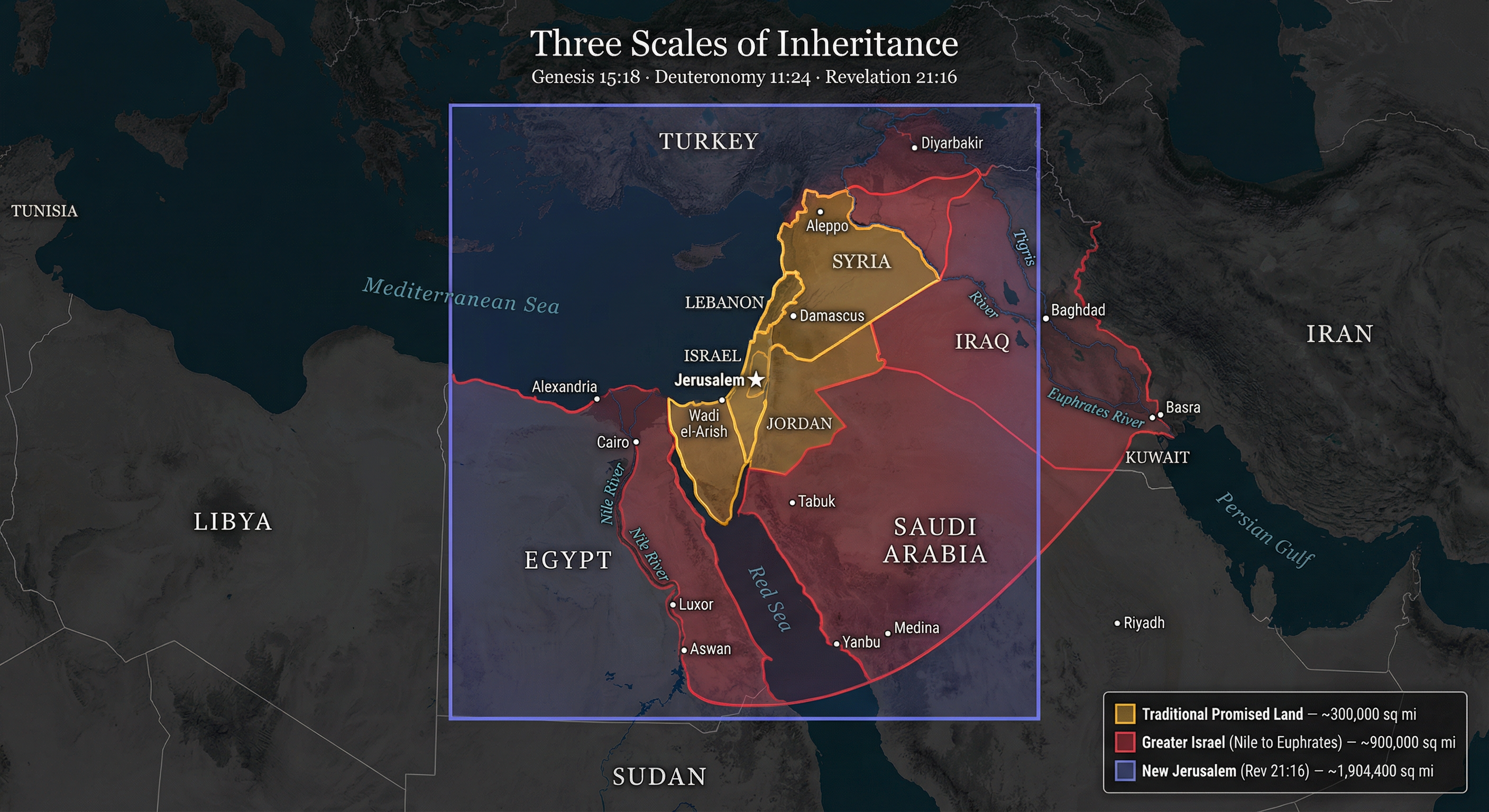
All three scales compared. Even at the most generous reading, the "all children saved" model produces densities incompatible with the agricultural, spacious vision of the prophets.
The Hebrew Revelation Measurements
The Hebrew text of Revelation 21:16 measures the New Jerusalem in קִבְרוֹת הַשָּׂדֶה (kivrot ha-sadeh) — "grave-plots of the field" — not Greek stadia. This unit echoes Abraham's first land purchase: the field (sadeh) with a burial possession (achuzzat qever) in Genesis 23. The city of the resurrection is dimensioned in the vocabulary of burial and inheritance.
Two readings of the measurement per side — שְׁנֵים עָשָׂר אֶלֶף (twelve eleph) — both produce the covenant number: if eleph = thousand, the base yields 144 million plots. If eleph = clan, the base yields 144 clan-territories (12 tribes × 12 clans). Both produce the covenant number 144.
The directionality is one-way: Hebrew → Greek. A Hebrew author writes קִבְרוֹת הַשָּׂדֶה — a Hebrew agricultural term. The Greek translator sees שָׂדֶה (field), recognizes the field-measurement concept, and reaches for σταδίων — the closest Greek field-length unit. But no back-translator working from Greek would produce "grave-plots of the field" from σταδίων. The standard Hebrew equivalent of a stadion is רִיס (ris), used throughout rabbinic literature. To produce קִבְרוֹת הַשָּׂדֶה from σταδίων requires ignoring every standard option and inventing a novel compound that appears nowhere else in Hebrew literature as a measurement unit. Translators simplify; they do not coin cryptic neologisms. The Hebrew is the source language. The translation arrow points one direction.
The Parembole Structure
When Gog and Magog surround the saints in Revelation 20:9, the text says they "compassed the G3925 parembole (camp) of the saints about, and the beloved city." Parembole is the exact word the Septuagint uses for the wilderness camp of Israel surrounding the Tabernacle. The Greek text itself identifies the final earthly arrangement as the wilderness camp made permanent:
- Tabernacle (center) → the New Jerusalem / "the beloved city"
- Priestly camp / parembole (inner ring) → the resurrected saints
- Tribal camps (surrounding) → the nations (Ezek 48 allotments)
- The wilderness beyond → the broader renewed earth
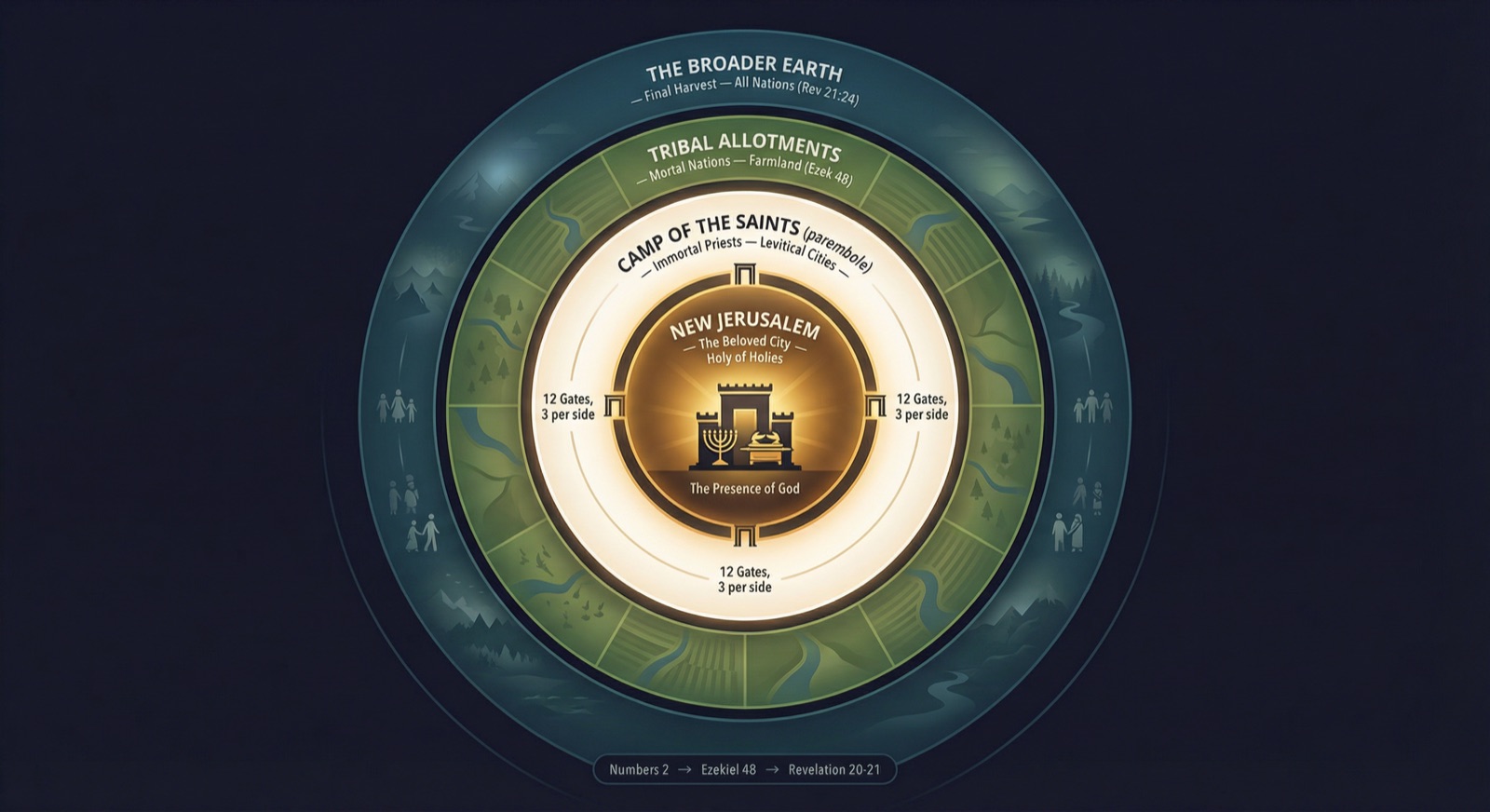
The wilderness camp made permanent: Numbers 2 → Ezekiel 48 → Revelation 20–21.
The Chronological Math of the Millennium
The numbers do not just verify spatial constraints — they reveal the chronological narrative of the entire 1,000-year reign. Ezekiel's measurements combined with the remnant ratio map onto three stages:
Stage 1 — The Gathering (the wedding feast). During the indignation, the firstfruits are gathered into the 50 × 50 mile holy oblation surrounding the 9-mile city. At 16–86 million, the density inside this district ranges from ~6,400 to ~34,800 per square mile — comparable to Los Angeles at the low end or Paris at the high end. A bustling, communal, urban environment. This is the marriage supper of the Lamb (Rev 19:9) — and for 7 years, it looks like a city feast, not a rural homestead.
Stage 2 — The Landing (the sparse inheritance). When the wrath concludes and the city lands, the saints step out to inherit Greater Israel (~900,000 sq mi). The density drops instantly to 18–96 per square mile (6.7 to 36 acres per person). The land is vast and open. This matches exactly the condition God described at the original conquest: "I will not drive them out in one year; lest the land become desolate" (Exod 23:29). The firstfruits alone cannot fill the territory. The mortal survivors are needed — just as God told Israel they would grow into the land "little by little."
Stage 3 — The Millennial Growth (the Solomon benchmark). Over 1,000 years, the mortal survivors of the tribulation reproduce without the hindrance of war or famine, on supernaturally fertile land. The population slowly fills the empty territory. By the end of the millennium, the combined population (immortal firstfruits + mortal descendants) approaches ~330 million — the capacity of Greater Israel at Solomon-era density: ~367 per square mile, 1.7 acres per person. This is the density that produced the first "every man under his vine and under his fig tree" (1 Ki 4:25). Micah 4:4 promises the same picture for the messianic age. The math arrives at exactly the right density at exactly the right time.
The Proportions
The firstfruits (~0.2% of the covenant-accessible population) inherit the Promised Land (~0.5–1.6% of the renewed earth's land). A tiny percentage of humanity inherits a proportional slice of the earth as their priestly heartland. The final harvest inherits the whole globe after the second resurrection — and in the renewed earth, every desert blooms (Isa 35:1, 51:3), so the entire ~57 million square miles of land is habitable. Both promises are fulfilled. The Promised Land is to the globe what the tabernacle camp was to the wilderness: the sacred center, not the totality.
VIII. The Picture That Emerges
The renewed earth is not a cloud-city of disembodied spirits. It is:
- Physical — tangible bodies on real land
- Agricultural — vines, fig trees, vineyards, twelve-fruit orchards
- Communal — feasts, tables, the marriage supper of the Lamb
- Tribal — twelve gates, twelve tribes, 144 clan-territories
- Structured — city as central tabernacle, land as inheritance, nations bringing their glory in
- Governed directly — God tabernacles with men; He is the temple
- Spacious — "few" means the land is not overcrowded
- Immortal — no death, no decay, no aging; every element of the Genesis 3 curse reversed
- Joyful — eating, drinking, fellowship, celebration, music, creativity
- Extraordinary mobility — resurrected bodies can move through barriers, vanish, and appear — but when present, they are bodily present and occupy space
This is Eden restored and expanded. The tree of life is accessible (Rev 22:2). The river flows from the throne (Rev 22:1). The curse is removed (Rev 22:3). Humanity is back in the garden — but this time, the garden is a city, the city is a mountain, the mountain is a tabernacle, and the tabernacle fills the whole earth (Dan 2:35).
The density conclusion is not speculation. It is the necessary outworking of the texts. Physical bodies on physical land, a fixed resurrected population, tribal allotments, agricultural inheritance — these produce a real, calculable number. And only the "few" model produces numbers compatible with the pastoral, spacious, feast-filled vision that every prophetic text describes.
"Few there be that find it" is not a metaphor. It is a spatial constraint. The gate is narrow because the real estate is finite and the calling is priestly. The question is not whether you believe in heaven. The question is whether you are fighting to be part of the firstfruits.
What Is New Here
The individual scriptural arguments for unconscious sleep are well-established — Justin Martyr and Irenaeus held them before the Nicene Council. What is new in this study is the convergence. No prior treatment connects the sleep framework to the physical land promise, the population density math, the Hebrew Revelation measurements (grave-plots of the field), the Solomon-era density benchmark, the Levitical-city distribution model, the Ezekiel Temple as an uncleanness management system, the Bridegroom's Torah-exemption from war, or the Jacob/Leah/Rachel two-bride typology. The individual bricks are known. The architecture that connects them — from "where do we go when we die" to "how many acres per person in the Promised Land" — is original to this research.