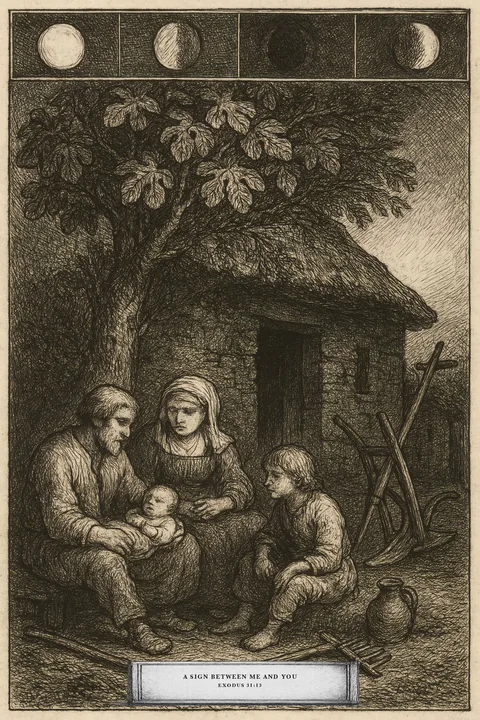
When is the Sabbath?
Earlier chapters identified a core problem with identifying where a calendar day begins and the impossibility of establishing a fixed international dateline without speed-of-light communication or advanced computer-aided calculations. Even something as simple as establishing your longitude or timezone was beyond known human ability until less than 400 years ago.
In the chapter on "Where Does the Day Start," we introduced the idea that the first "time zone" to see the sign of the new month establishes the dateline for that month. With this method, everyone, everywhere, regardless of how primitive their mathematical and astronomical skills, had the ability to obey the commands as given in Torah. But every time we solve one problem, we introduce another: if starting a new month moves the "dateline," then every couple of months, your home location will move to the other side of a dateline.
There is a well-known solution to this problem, which many know as a "Lunar Sabbath," where the Sabbaths are kept on the 8th, 15th, 22nd, and 29th day of each month. The theory of a Lunar Sabbath is strongly supported by independent evidence that this chapter will present, but what is unique to this book is the first-principles, physics-based approach that demonstrates why a Lunar Sabbath is the only practically observable approach throughout the ages.
Nature of the Sabbath
All of that said, we must first establish the true nature of the Sabbath. Is it a command each individual follows to work six days and rest on the seventh, or is it a holy, set-apart time with rules about what people are allowed to do during this set-apart time? It is more than just a set-apart time; it is set-apart "space-time" for everyone who follows a Sabbath based upon their local time.
Anyone passionate about "Saturday Sabbath" will go to great lengths to argue against those keeping "Sunday" and think "Lunar Sabbath" folks are downright crazy.
The Sabbath was changed from Saturday to Sunday not by any biblical command or apostolic authority, but by the Roman Catholic Church centuries later. No man, no pope, no council has the authority to alter what God Himself established and declared holy from the foundation of the world. The seventh day remains the Sabbath—man cannot move what God has fixed.
Passion for Truth Ministries
We’ve all been told that the Sabbath is now on Sunday. But how many of us have truly tested that? … The Scriptures never authorize a change from the seventh-day Sabbath established at creation and commanded in the Torah. No apostolic writing, no word from Jesus, transfers or abolishes this perpetual sign. Man-made tradition cannot override what God declared holy forever.
The Sabbath was not instituted for the Jews alone; it was made for man. … It is the sign of God’s power to create and to redeem. … No man can change it.
The Sabbath was established by God at creation as the seventh day, declared holy forever, and commanded in the Torah as a perpetual covenant sign. Jesus never changed it, the apostles never transferred it to Sunday—no Scripture gives any man, church, or council the authority to move what Yahweh Himself fixed and sanctified. The change to Sunday came from human tradition and ecclesiastical power, not from the Word of God. We must return to the biblical Sabbath, for no one has the right to override the Creator’s command.
The primary argument for this type of position is that God blessed the Day and made the Day holy. The holiness of the day pre-dates the command to respect the day’s holiness.
And on the seventh day God finished his work that he had done, and he rested on the seventh day from all his work that he had done. So God blessed the seventh day and made it holy, because on it God rested from all his work that he had done in creation.
Remember the Sabbath day, to keep it holy. Six days you shall labor, and do all your work, but the seventh day is a Sabbath to the LORD your God. On it you shall not do any work… For in six days the LORD made the heavens and the earth, the sea, and all that is in them, and rested on the seventh day. Therefore the LORD blessed the Sabbath day and made it holy.
If the day is holy, then no man can change the day; we can only discover it, remember it, and honor it by resting as the LORD did. Scripture goes on to say that the Sabbath is a sign that He is our God and that they are an appointed time:
You are to speak to the people of Israel and say, 'Above all you shall keep my Sabbaths, for this is a sign between me and you throughout your generations, that you may know that I, the LORD, sanctify you.'…Therefore the people of Israel shall keep the Sabbath, observing the Sabbath throughout their generations, as a perpetual covenant. It is a sign forever between me and the people of Israel that in six days the LORD made heaven and earth, and on the seventh day he rested and was refreshed.
Moreover, I gave them my Sabbaths, as a sign between me and them, that they might know that I am the LORD who sanctifies them.
And keep my Sabbaths holy and make them holy, that they may be a sign between me and you, that you may know that I am the LORD your God.
Speak to the people of Israel and say to them, These are the appointed feasts [mo’adei] of the LORD that you shall proclaim as holy convocations; they are my appointed feasts [mo’adai]. Six days shall work be done, but on the seventh day is a Sabbath of solemn rest, a holy convocation. You shall do no work. It is a Sabbath to the LORD in all your dwelling places.
And God said, 'Let there be lights in the vault of the sky to separate the day from the night, and let them serve as signs to mark sacred times, and days and years,'
There is no way around the fact that the Sabbath day qualifies for 3 of the 4 purposes of the lights in the heavens: it is a sign, an appointed time, and a type of day. This connects closely to the idea that months are a larger unit of time which are divided into weeks called Sabbaths which are subdivided into days.
From renewed moon to renewed moon, and from Sabbath to Sabbath, all flesh shall come to worship before me, declares the LORD.
The different classification of days is defined by Ezekiel:
This is what the Lord GOD says: 'The gate of the inner courtyard facing east shall be shut for the six working days; but it shall be opened on the Sabbath day and opened on the day of the renewed moon.'
NASB
There is a logical contradiction in the instruction if it is possible for a Renewed Moon day to fall on a workday, as the gate cannot be open and shut at the same time. You would have to assign a priority to renewed moon day over work days, but that is not found in the text.
So now the full nature of the Sabbath comes into view: it is a sign, an appointed time, a week-long structure, and a day of rest, separate from Renewed Moon days. It is objective and exists outside any individual person, having started before man was created. All of these properties are why those who care about the Sabbath argue so strongly against any person taking it upon themselves to change or redefine it.
The common problem with all the passionate arguments for Saturday is that they never define the dateline, and depending upon the dateline one chooses, the sanctified time might fall on a different day of the Gregorian week. And if the dateline is celestial and moves every month then that could change everything!
The temporal mechanics of the traveling across the international dateline are enough to cause most people’s heads to spin, so I will save that argument until the end of this chapter. I will first present to you how I originally proved the Lunar Sabbath to myself before I grasped the deeper underlying issue baked into the structure of creation that forced it.
Recall the principle of the Terrain vs Map from the chapter on "Principles of Evaluation". I pointed out that if you have 100 maps, you cannot prove which map is true by comparing them to each other; you must go out into the real world to known events, find the "ground truth," and then see which maps align with reality. This is exactly how I went about proving the Lunar Sabbath.
32 AD Sabbath Implications
In the chapter titled "Proving 32 AD Resurrection" I detailed many fully independent proofs to show that John the Baptist started his ministry at the start of the 15th year of Tiberius which is universally understood to be fall of 28 AD when he turned 30 years old. Jesus was baptized just before Passover 29 AD shortly before his 30th birthday and then went immediately into the wilderness and thus no documented Passover activity in 29 AD. That year also happened to be the seventh year of the Sabbath cycle, which started at the 1406 BC Jordan River crossing and was confirmed by Josephus when Herod the Great took Jerusalem. This means that Jesus declared the Year of the Lord’s Favor at the end of the 7th year as commanded by Torah and by this we precisely identify Luke chapter 4 near the start of his ministry in fall 29 AD. Six months later at Passover 30 AD we are told the temple has taken 46 years to build which lines up exactly with the timeline Josephus gives us. This is the first Passover of 3 mentioned, which makes 31 AD the second and 32 AD the year of the cross. Finally, 32 AD happens to be the 490th year from the order to restore and rebuild Jerusalem, which aligns perfectly with the prophecy given to Daniel.
The evidence for this is overwhelming if you allow the plain reading of the text and historical accounts to speak for itself without otherwise irrational twisted interpretations to support an unchallengeable assumption that Saturday was the Sabbath of the time. So for the sake of this discussion, trust that 32 AD is the year of the cross and then verify it later. In 32 AD, the traditional calendar puts Passover on Monday or Tuesday, which makes resurrection on the first day of the week 6 or 7 inclusive days and is totally incompatible with Jesus being raised on the third day, even if you use the most extreme interpretations of a full 72 hours in the tomb.
If, on the other hand, a Lunar Sabbath calendar was being used by the Jewish faction in charge of the temple, then Passover would always be on the 6th day of the week. This would then line up with abundant evidence that First Fruits was always on the 16th of the month (see the chapter on "When is First Fruits?"). All the evidence pointing to 32 AD and First Fruits always on the 16th is therefore compatible with Lunar Sabbath but incompatible with all other known calendars.
Testing Known Weekly Sabbaths
Once we know that 1406 BC was the year of the Jordan River crossing — established ahead, in the 32 AD Resurrection chapter, where the Jubilee cycle is anchored — we can determine that 1446 BC is the year of the Exodus. From this, we can determine where Saturday fell in the first, second, and third months. We know that the 8th, 15th, and 22nd of the second month were Sabbaths from the story of the manna. They arrived on the 15th grumbling; that same night, they got quail, and the next morning was their first serving of manna. They received manna for 6 days and got a double portion on the 21st in preparation for the Sabbath on the 22nd. If the 22nd is a Sabbath, then the 15th must be a Sabbath, considering that the Sabbath has been established since creation and was not created at Mt. Sinai.
For the sake of this experiment, we will consider two traditional calendar theories: one that starts the month at the first sunset after the dark conjunction and another that starts the month on the first evening a visible crescent can plausibly be seen with the naked eye. The year will start the first "New Moon" after the spring equinox. We will then look at the day of the week on the continuous cycle for the 15th of the second month. This will tell us what calendars, if any, are compatible with a continuous weekly cycle and the Exodus narrative.
The results show that the first visible crescent seen by two witnesses would make the 15th of the second month a Friday which is entirely incompatible with the Exodus narrative. Some would be tempted to claim that they just couldn’t see it, but that evening the moon age was 1.5 days with 2.4% illuminated which is considered easily visible by any standard. This leaves only calendars that rely on calculation of the dark conjunction, a sign without any light, as potentially compatible with a weekly sabbath. This in turn contradicts the recorded oral tradition of two human witnesses making an observation and undermines the credibility of the Rabbinic Jews for faithfully transmitting the true calendar. Their modern calendar is closer in operation to a dark conjunction, but is built on top of a calculated "molad" which is accurate on average but individual months can differ by up to 12 hours from the real dark conjunction.
| Calendar | Julian Date | Lunar Date | Day of Week |
|---|---|---|---|
Dark |
5/23/1446 BC |
2/15 |
Saturday |
Visible |
5/24/1446 BC |
2/15 |
Friday |
Full |
6/6/1446 BC |
2/15 |
Saturday |
…you shall bring a sheaf of the firstfruits of your harvest to the priest. He shall wave the sheaf before the LORD, to be accepted on your behalf; on the day after the Sabbath the priest shall wave it.
We know that Jesus was raised on First Fruits and that he was raised on the first day of the week.
But now Christ is risen from the dead, and has become the firstfruits of those who have fallen asleep….But each one in his own order: Christ the firstfruits, afterward.
So now we can go to the story of Joshua where we are shown they ate first fruits on the 16th of the month.
Now the children of Israel camped in Gilgal, and kept the Passover on the 14th day of the month at twilight on the plains of Jericho. And they ate of the stored produce (from prior year) of the land on the day after the Passover (15th), unleavened bread and parched grain, on the very same day. Then the manna ceased on the day after they had eaten the stored produce of the land (day after 15th is 16th); and the children of Israel no longer had manna, but they ate the food of the land of Canaan that year.
NKJV
From this text we can clearly establish that the 16th is the first day of the week (being first fruits) because they could not eat of the produce of the land that year (1406 BC) until after first fruits. This means the 15th had to be a weekly sabbath. We can now calculate a table showing the day of week on each of the calendars:
| Calendar | Julian Date | Lunar Date | Day of Week |
|---|---|---|---|
Dark |
5/2/1406 BC |
1/15 |
Sunday |
Visible |
5/3/1406 BC |
1/15 |
Monday |
Full |
6/6/1406 BC |
1/15 |
Sunday |
What we discover is that none of the calendars have Saturday on the 15th of the 1st month in 1406 BC. So we now have three witnesses that prove the visible crescent wasn’t in use in 1446 BC (1406 BC, and 32 AD) and two witnesses that the Dark Conjunction or Molad were not in use (1406 BC and 32 AD). The terrain is simply not compatible with the Saturday sabbath map.
We can now establish another First Fruits witness from the Exodus. Recall from the chapter on "When does the Day Start?" that they journeyed from Rameses and camped in Succoth. This is approximately 20 miles (or less in some estimates) and is about 1 day’s travel.
And the children of Israel removed from Rameses, and pitched in Succoth.
The Israelites journeyed from Rameses to Succoth, about six hundred thousand men on foot, besides women and children…Consecrate to me all the firstborn. Whatever is the first to open the womb among the people of Israel, both of man and of beast, is mine.
Here we see the introduction of the typology of "first fruits" when they camped after a day’s journey. A later chapter will provide the evidence that first fruits is always on the 16th of the month, and that aligns perfectly with them leaving the night of the 15th, traveling all night and into the day on the 16th where they set up camp just in time for the narrative to mention first fruits. Since First Fruits is always on the first day of the week, this means that the 15th was a weekly Sabbath in the first month.
The implications of this are huge because the scriptural narrative naturally suggests that the 15th of both the 1st and 2nd month are weekly sabbaths and yet that is mathematically impossible because a month has 29 or 30 days, neither of which are divisible by 7. What is powerful about this witness is that it is entirely independent of the actual year of the Exodus.
The First Fruits Paradox
The debate over the timing of first fruits goes back over 2000 years and this debate tells us far more than most people realize. Let’s explore what we can conclude from the debate itself, independently of which side you end up on.
So what is the debate? The Septuagint, Josephus, Philo, and examples in the Bible (Joshua and Exodus) all tell us that First Fruits is always observed on the 16th of the first month, the 3rd day from Passover on the 14th. Josephus reports that this was the practice in the Temple. Scripture also tells us that we are to count 7 complete sabbaths from First Fruits until the 50th day, which is declared to be "the day after the 7th Sabbath".
I will provide the evidence for the above claims in a bit, because I want to get to the point quickly. If the understanding from the Septuagint and every historian that survived was practiced in the temple, then scripture gives us an apparent contradiction:
And ye shall number to yourselves from the day after the sabbath, from the day on which ye shall offer the sheaf of the heave-offering, seven full weeks: until the morrow after the last week (sabbath) ye shall number fifty days, and shall bring a new meat-offering to the Lord.
And you shall count for yourselves from the day after the sabbath, from the day that you brought the sheaf of the wave offering, seven full (undivided) weeks (sheva shabbatot) shall they be. You shall count fifty days until the day after the seventh week (shabbat), and you shall present a grain offering of new grain to the LORD.
If you start "from the day after the sabbath, aka from the day of first fruits", which everything from the Septuagint to Josephus says is always on the 16th and then count 7 full sabbaths (weeks) which you interpret as exactly 50 days will you end up on "the day after the 7th sabbath"?
In 6 out of 7 years you will not land on first day of the week if you use the continuous weekly cycle. The only way to escape this paradox is if first fruits is not always on the 16th but is the first Sunday after Passover and this is how many people attempt to resolve it. But we have already seen how that breaks down with historical narratives in 1446 BC, 1406 BC, and 32 AD. Scripture strongly points to First Fruits always being on the 16th.
We can gain some more insight into the nature of this count by looking at how Josephus describes it. He notes it is called the feast of weeks and the unit of what is being counted is a week.
When a week of weeks has passed over after this sacrifice, (which weeks (sevens) contain forty and nine days) on the fiftieth day, which is Pentecost, but is called by the Hebrews Asartha, which signifies Pentecost, they bring to God a loaf, made of wheat flour…
This aligns with what scripture strongly implies. The Sabbath is defined as six days of work followed by a day of rest. This structure of the sabbath is demonstrated in Genesis and referenced multiple times. There are over 20 occasions in scripture where the word "Sabbath" is used as a synonym for week and not just a reference to a single day of rest.
In fact, the law states the equation itself, by parallel statute: the very count Leviticus 23:15 gives as "seven sabbaths shall be complete," Deuteronomy 16:9 gives as "seven weeks shalt thou number" — same command, same festival, same count, sabbath in one book and week in the other. And the word scales the way only a unit can: "thou shalt number seven sabbaths of years… seven times seven years" (Leviticus 25:8) — a "sabbath of years" is arithmetically a whole 7-year span, not a rest-year.
The Greek of the New Testament talks the same way, and translation has hidden it. The Pharisee’s boast "I fast twice in the week" (Luke 18:12) is literally dis tou sabbatou — twice in the sabbath; no man fasts twice in a day. Every "first day of the week" in the resurrection accounts is literally "one of the sabbaths" (mia sabbatōn — Matthew 28:1; Mark 16:2; Luke 24:1; John 20:1; Acts 20:7; 1 Corinthians 16:2). Matthew 28:1 even holds both senses in a single verse — "in the end of the sabbath [the day]… toward the first day of the week [literally: one of the sabbaths]" — the same Greek word twice, and the King James itself renders the second occurrence "week." The word named the seven-unit in the mouths of first-century speakers; the seventh day is the unit’s crown.
The nature of a "Sabbath" count referring to a "week" structure rather than a "day" in the context of the Pentecost instructions is revealed by the use of "complete/perfect sabbaths". A complete or perfect sabbath would have to be 7 days long with the 7th being the day of rest. This seems to be the most logical way to understand the difference between "complete sabbath" and "incomplete sabbath" because how else would a "sabbath day" be considered "incomplete"?
Push that observation one step further and it becomes an argument on its own. On a continuous, unbroken weekly cycle, a count of sevens that begins on the day after a sabbath cannot possibly produce an incomplete seven — every block of seven days from that starting point automatically contains exactly one sabbath. On that calendar the qualifier "complete" (temimot — the same word the law uses for an unblemished sacrifice) would legislate nothing at all; it would be a dead word, and the law does not spend words on impossibilities. "Complete" only has work to do in a reckoning where a broken seven is possible — that is, where some days stand outside the weeks entirely. The qualifier itself presupposes the very structure the continuous-week tradition denies.
As a result of this dispute, people fall into one of three camps:
-
Keep First Fruits aligned and let Pentecost fall where it may
-
Keep Pentecost on the first day of the week and move First Fruits
-
Understand the month as 4 weeks (sabbaths) and only count the days that are part of the sabbaths (6+1 days). Renewed Moon days are separate and outside the count.
The last approach has one other wrinkle in that there is a possible reading of Leviticus as: "from the day after the sabbath (week) from (that starts) the day you brought first fruits, count 7 complete sabbath weeks". The question is whether this is a Hebraic parallelism or a way of identifying the "sabbath week" you start the count of weeks from or merely a way of identifying the "sabbath day" you start the count from. In other words, is the week of unleavened bread part of the count or do you start counting after the week of unleavened bread. Considering the context is counting weeks (sabbaths) and not days, it could be argued either way.
The second way of interpreting it places Pentecost on the 16th of the 3rd month. This is documented in the book of Jubilees (which is not scripture, but that doesn’t automatically make it wrong so long as it doesn’t conflict with a legitimate interpretation of scripture).
And it came to pass in the first year of the exodus of the children of Israel out of Egypt, in the third month, on the sixteenth day of the month, that God spake to Moses, saying: 'Come up to Me on the Mount and I will give thee two tables of stone of the law and of the commandment, which I have written, that thou mayst teach them'
For it is the feast of weeks and the feast of first fruits: this feast is twofold and of a double nature: according to what is written and engraved concerning it, celebrate it.
And in the fifth year of the fourth week of this jubilee, in the third month, in the middle of the month, Abram celebrated the feast of the first-fruits of the grain harvest.
And she bare a son in the third month, and in the middle of the month, at the time of which the Lord had spoken to Abraham, on the festival of the first fruits of the harvest, Isaac was born.
From this we have further evidence about how this was counted by a major sect of ancient Israel (especially the Essenes). So how did the Essenes come to this conclusion? Their 364-day calendar has 30 days per month, so the 16th of the third month is 60 days from the 16th of the first month. It turns out they count first fruits from the 26th… which we know cannot be because Jesus was raised on first fruits.
I submit for your consideration that we are witnessing the effect of attempting to map an older true calendar tradition on to newer corrupted calendars where it just doesn’t quite fit.
Some sects stuck with the 16th tradition for the first month and moved Shavuot in the 3rd month to the 6th even though it is rarely the day after a sabbath day. Others stuck with Shavuot the 16th of the 3rd month and moved the first month to the 26th. However, what if the deeper truth is that First Fruits is always on the 16th of the first month, Shavuot / "Pentecost" is on the 16th of the third month, and we count weeks on a Lunar Sabbath calendar? This would resolve all conflict, and explain why we count weeks and not days. It would be a clever way of encoding the Lunar Sabbath into scripture in such a way that it would be hard to erase without leaving inconsistencies.
Notice what the count actually is, structurally: it is specified three ways at once — a fixed start (the sheaf on the 16th, "the morrow after the sabbath"), a unit-count ("seven sabbaths shall be complete"), and a landing condition ("unto the morrow after the seventh sabbath shall ye number fifty days"). That is over-determination with a purpose. It is the same redundancy that protects the text everywhere — corrupt one witness and the others convict the change — here applied to time: the true calendar satisfies all three specifications silently, every year, and every altered calendar is convicted by its own arithmetic in at least one of them. The omer count is a checksum on the calendar, and the two-thousand-year-old dispute is the checksum failing exactly where it was designed to fail.
Now that I have made my case, here is the supporting primary evidence for First Fruits always being on the 16th.
The Septuagint (LXX) translation specifies the timing of the First Fruits sheaf offering as occurring on the "morrow of the first day" (implying the day after the first day of the Feast of Unleavened Bread, or the 16th of the first month).
And the Lord spoke to Moses, saying, Speak to the children of Israel, and thou shalt say to them, When ye shall enter into the land which I give you, and reap the harvest of it, then shall ye bring a sheaf, the first-fruits of your harvest, to the priest; and he shall lift up the sheaf before the Lord, to be accepted for you. On the morrow of the first day [of unleavened bread] the priest shall lift it up. And ye shall offer on the day on which ye bring the sheaf, a lamb without blemish of a year old for a whole-burnt-offering to the Lord. And its meat-offering two tenth portions of fine flour mingled with oil: it is a sacrifice to the Lord, a smell of sweet savour to the Lord, and its drink-offering the fourth part of a hin of wine. And ye shall not eat bread, or the new parched corn, until this same day, until ye offer the sacrifices to your God: it is a perpetual statute throughout your generations in all your dwellings. And ye shall number to yourselves from the day after the sabbath, from the day on which ye shall offer the sheaf of the heave-offering, seven full weeks: until the morrow after the last week ye shall number fifty days, and shall bring a new meat-offering to the Lord.
Josephus describes the First Fruits offering as occurring on the 16th of the first month (the second day of the Feast of Unleavened Bread). As a first-century Jewish historian who lived through the period leading up to the Temple’s destruction in 70 AD, his account reflects the Pharisaic practice observed in the Temple during that era:
But on the second day of unleavened bread, which is the sixteenth day of the month, they first partake of the fruits of the earth: for before that day they do not touch them. And while they suppose it proper to honour God, from whom they obtain this plentiful provision, in the first place, they offer the first-fruits of their barley, and that in the manner following. They take an handful of the ears, and dry them: then beat them small, and purge the barley from the bran: they then bring one tenth deal to the altar, to God; and casting one handful of it upon the fire, they leave the rest for the use of the Priests.
Philo of Alexandria describes the sheaf offering (First Fruits) as a festival succeeding the first day of the paschal feast (implying the 16th of the first month, the day after the 15th):
And there is also a festival on the day of the paschal feast, which succeeds the first day, and this is named the sheaf, from what takes place on it; for the sheaf is brought to the altar as a first fruit both of the country which the nation has received for its own, and also of the whole land.
The Cities That Counted the Seventh from the Moon
Philo’s clearest calendar statement is also his least quoted. Expounding the fourth commandment — not describing foreign customs, but explaining the Sabbath command itself — he records that two reckonings of the sacred seventh coexisted in his world:
The fourth commandment has reference to the sacred seventh day, that it may be passed in a sacred and holy manner. Now some states keep the holy festival only once in the month, counting from the new moon, as a day sacred to God; but the nation of the Jews keep every seventh day regularly, after each interval of six days.
Weigh what this witness concedes. Philo’s own community kept the continuous week — he has no motive to invent rivals — yet he reports, in passing and without alarm, that whole cities (poleis, plural: civic-scale populations, not scattered dissenters) kept this sacred seventh (tautēn — the very seventh of the commandment he is expounding) counted from the new moon. He does not call them pagans; he does not correct them; he names their practice as a reckoning of the same commandment.
The one disputed word in the sentence makes the witness stronger, not weaker. The Greek manuscripts unanimously say these cities count from the new moon “according to God” (kata theon — the phrase behind "as a day sacred to God" above, and in the Greek it modifies the new moon, not the day). Editors from the 1500s to the critical edition of 1902 judged the phrase corrupt — largely because a moon-counted civic seventh was assumed to be pagan, and Philo certifying a pagan anchor as God’s seemed impossible. Every repair they proposed runs the same direction: Christophorson and Mangey conjectured "counting from the new moon by sevens"; Cohn conjectured "by the moon" or "by the lunar cycle." Keep the manuscripts, and the cities' moon-anchor is according to God. Take the emendations, and the cities count sevens from the new moon. There is no reading of this sentence — transmitted or repaired — in which the moon-counted seventh is absent.
Under the by-sevens reading the grammar allows a construal that describes the Lunar Sabbath exactly: "once in the month" attaches to the counting, so the cities re-anchor the count once each month at the renewed moon and then count by sevens through it — the 7th, 14th, 21st, and 28th — while the Judean nation runs its sevens continuously, never re-anchoring. Philo’s contrast is then not Sabbath-keepers against pagans; it is two arithmetics of the same seventh: anchored sevens against unanchored sevens.
The standard objection identifies the cities as Greek: Greek towns kept the hebdomē, the seventh day of each lunar month, as Apollo’s day, and the Jewish apologist Aristobulus had already equated Hesiod’s "holy seventh" with the Sabbath a century before Philo. The objection must pick its poison. Apollo’s day makes the manuscripts' "according to God" nonsense — which is precisely why the editors had to call it corrupt — while Torah-reading communities make it exact. Either the manuscripts stand and the cities' anchor is God’s, or the emendations stand and the counting runs by the moon and by sevens.
Two cautions keep the witness honest. First, noumēnia — the Septuagint’s standard rendering of chodesh (1 Samuel 20:5; Numbers 28:11) — is a technical term for the day that heads the month, not for a moon phase; when Philo wants phase-precision he must add a gloss, as he does elsewhere: "the noumenia after the conjunction" (Special Laws II, XI [41]) — and that anchor-gloss is itself unstable in the manuscripts, splitting four ways. In both places where Philo defines a month-anchor, the anchor-words are the least stable words in the sentence. Second, Philo’s own community’s practice is not in doubt: he dates Passover "about the fourteenth day, when the lunar cycle is about to become full-lighted" (On the Life of Moses II [223]) — a conjunction-anchored month with the feast at the full moon; and he does not say how the cities defined their noumenia. What the witness establishes is exactly this much, and it is enough: within Jesus' generation, a moon-anchored reckoning of the fourth commandment’s seventh was practiced at the scale of whole cities, recorded without polemic by a writer whose own nation kept the other count. The full textual documentation — Greek text, the complete apparatus, and all three readings — is preserved in the research notebook, research-philo-decalogo.md.
Concerning his own community, then, Philo is candid: he starts the month after the conjunction and keeps the continuous week, reflecting the practice of his Alexandrian setting. Concerning others, he is on record above. And even for his own reckoning he uses language that relates weeks to the moon’s phases:
"For it is said in the Scripture: On the tenth day of this month let each of them take a sheep according to his house; in order that from the tenth, there may be consecrated to the tenth, that is to Elohim, the sacrifices which have been preserved in the soul, which is illuminated in two portions out of the three, until it is entirely changed in every part, and becomes a heavenly brilliancy like a full moon, at the height of its increase at the end of the second week".
In this allegory, the soul’s illumination advances like the waxing moon until it reaches full brilliance "at the end of the second week." The comparison shows that lunar-quarter week language was intelligible in Philo’s first-century setting: the second seven-day segment from the new moon ends around the full moon.
The Decalogue sentence quoted above describes his own nation’s seventh as recurring after each interval of six days. That statement does not identify when the count begins, discuss the transition between months, or say whether New Moon days belong to or stand outside the counted Sabbatons. It is therefore compatible with a continuous count in Philo’s own community, but it does not by itself rule out a Lunar Sabbath count practiced by another Jewish group or by the Temple priesthood.
Philo describes Pentecost using the same structure found in Scripture: the fiftieth day formed by seven sevens plus one. Yet he places the sheaf offering on the day succeeding the first day of the Paschal feast—the fixed 16th—as quoted immediately above. Philo does not expressly call Shavuot the first day of the week; that endpoint comes from Leviticus 23:16, which places it on the day after the seventh Sabbaton. His statements, read together with that scriptural requirement, therefore reproduce the First Fruits paradox already examined: Scripture places both the sheaf offering and Shavuot on the day after a Sabbaton, making both the first day of their respective weekly units, while a fixed 16th cannot remain the first day of the week every year on a continuous cycle. Consequently, Philo’s reference to the fiftieth day cannot simply be assumed to mean an uninterrupted count that includes Renewed Moon days; read with his fixed 16th testimony, it is compatible with counting the constituent days of seven complete Sabbatons plus the following day.
Philo’s writings document some of the calendrical language and variety present in his Alexandrian setting, but they do not establish that every Jewish sect or the Temple priesthood followed his own practice. They support both lunar-quarter week language and the fixed 16th, while leaving the treatment of month boundaries unstated.
The same limitation applies more broadly to the surviving literary tradition. Of the witnesses commonly invoked to prove the inherited calendar, Philo is the earliest, yet he writes from a particular first-century setting and never claims to survey every Jewish sect or the Temple priesthood. Josephus’s surviving histories were written after the Temple fell, although he lived through its final decades, and the rabbinic compilations are later still. These sources are evidence for the practices they actually describe; their dates, settings, and silence about competing practice do not make them proof that every Jewish group observed one uniform calendar before 70 AD.
Now that we have addressed much of the evidence for Lunar Sabbath in scripture I hope you have the motivation to follow the deeper underlying physical reality that compels a lunar sabbath. All creation testifies!
Destruction of Temple after Sabbath
Another way of testing the Sabbath is the documented claim that the 9th of Av was a weekly Sabbath when both temples fell. Since we know these years with high levels of confidence, we can see which calendars are compatible with the claim:
When the Temple was destroyed for the first time, that day was immediately after Shabbat, and it was immediately following a Sabbatical year, and it was the week of the priestly watch of Jehoiarib, and it was the Ninth of Av. And the same occurred when the Second Temple was destroyed.
The Temple was destroyed the first time on the ninth of Av and it was the end of the Sabbath [motza’ei Shabbat], and it was the end of the Sabbatical year… And similarly for the Second Temple.
But the tenth day of the month Lous [Av] was come, which is the day that had been fatal to the temple of old, when it was burnt by the king of Babylon; for the same day it was now burnt by this present Roman general.
Jewish War 6.4.5
The flames took their way as far as the rooms that joined to the holy house, and which were situated the upper height of them; at which time one might guess at the vast riches of what was in those rooms… But as for the holy house itself, it was burnt down in the month Lous, on the tenth day of the month, the same day and month wherein it had been burnt formerly by the king of Babylon.
Jewish War 6.4.8
As you can see from these quotes there is some disagreement on whether the temple fell on the 9th or 10th of Av and the consequence is to give some wiggle room by selectively trusting some sources and not others.
As you can see, the talmudic claims of the 9th of Av are incompatible with their claims that it fell the day after the Saturday Sabbath in 70 AD because the 9th of Av is Saturday, but it is compatible in 587 BC; however, only on the observable sliver calendar. Remember we already invalidated the visible crescent for the start of manna in Exodus. The 9th of Av is also incompatible with scripture which agrees with Josephus that the temple fell on the 10th:
Now in the 5th month, on the 10th day of the month—which was the nineteenth year of King Nebuchadnezzar king of Babylon—Nebuzaradan the captain of the bodyguard, who served the king of Babylon, entered Jerusalem. And he burned the house of the LORD, and the king’s house and all the houses of Jerusalem; every great house he burned down.
If you only consider the 10th of Av, then the Talmudic claims work in 70 AD and 587 BC, but only on the dark conjunction moon. This makes another invalidation of their fable about starting the month the evening the first visible crescent is seen if you hold to a Saturday Sabbath understanding.
Josephus records that the Romans learned that the Jews refused to proactively fight on the Sabbath, though they would defend if directly attacked.
And indeed it was a hard thing to fill up that valley, by reason of its immense depth, especially as the Jews used all the means possible to repel them from their superior situation; nor had the Romans succeeded in their endeavors, had not Pompey taken notice of the seventh days, on which the Jews abstain from all sorts of work on a religious account, and raised his bank, but restrained his soldiers from fighting on those days; for the Jews only acted defensively on Sabbath days.
Jewish War
Which thing when the Romans understood, on those days which we call Sabbaths they threw nothing at the Jews, nor came to any pitched battle with them; but raised up their earthen banks, and brought their engines into such forwardness, that they might do execution the next day.
Antiquities 14.4.3
A consequence of this strategy is that Jerusalem would tend to fall a day or two after the Sabbath. Enemies would build the ramps on the Sabbath but not attack, so as not to give the Jews license to break their rest. Then the very next day they would be ready to attack with full force.
Josephus records that the ramps were completed on the 8th of Av, which, according to Josephus' other testimony, implies that the 8th of Av was a Sabbath day being observed and this would be 100% compatible with the Lunar Sabbath theory.
And now two of the legions had completed their banks, on the 8th day of the month Lous [Ab]. Whereupon Titus gave orders that the battering rams should be brought, and set over against the western edifice of the inner temple.
Putting everything together, the Rabbinic tradition is internally self-contradictory by simultaneously claiming Saturday was the sabbath, that the month started by seeing the crescent, and that both temples fell the day after the sabbath. They also contradict scripture and Josephus which claims the 10th was the fall. The only way to start to save them is to adopt a month starting "first sunset after dark conjunction" and the 10th of the month for the fall. This resolves many contradictions but remains incompatible with claiming 1406 BC First Fruits falling on Sunday.
The real tell is Josephus saying the ramps were built on the sabbath (while the Jews rested) and that they were completed on the 8th day of the month. Josephus has generally proven to be far more reliable a witness than the Rabbinic Jews who frequently demonstrate their willingness to bend facts to support their "high moral principles".
So how does the moving dateline impact the Sabbath?
A dateline that moves every month based upon where the moon is located at the start of the month means that you can stay in one location and still "cross the celestial dateline". On a lunar calendar you may cross this dateline every 2 or 3 months. If you use one of the solar calendars then you will cross this moving dateline about once every 4 years. The mere thought of this is enough to cause a panic attack in the minds of those who like the deceiving simplicity of counting 7 days with a fixed dateline and the aid of computer programs like Stellarium and societal conventions like the international dateline.
Before doing an example with the celestial dateline, let’s look at some real-world case studies involving international travel and even extreme cases like astronauts under the conventional 7-day cycle for which people have such zeal.
Traditional Jewish Sabbath Case Study
Suppose a traditional Jewish sabbath observer, who reckons each day from one personally sighted sunset to the next, boards a hypothetical nonstop westward flight from Los Angeles to Auckland, New Zealand departing at noon on Friday—while it is still the sixth day, hours before LA sunset at 7 PM. These planes generally fly faster than half the Earth’s rotational speed, so the Sun appears to move westward at less than half its normal apparent rate relative to the traveler. The flight lasts 14 hours of elapsed time, with solar time advancing by only 7 hours during the journey. Departing at noon (7 hours before sunset), the Sun progresses slowly toward the horizon but never reaches it—no sunset is sighted from takeoff to landing. Midway, after about 6 hours (before 6 PM LA time, which is still before sunset in Los Angeles), the plane crosses the International Date Line, immediately advancing the calendar date from Friday to Sunday afternoon at the crossing point, skipping Saturday entirely even as continuous time passes in the air. The traveler lands in Auckland precisely at sunset solar time on Sunday evening. From noon Friday to the first personally observed sunset on Sunday night, no sunset intervenes, and no labeled Saturday occurs—no sunset marks the start of the Sabbath, no sunset marks any day transition during the journey, and the entire skipped day passes unmarked in the air. In this strict sunset-sighting framework, the traveler experiences no part of a Sabbath, leaving in the middle of the sixth day of the week and arriving at the start of the second day of the week.
Some Jews take issue with an individual’s travel producing the result that they entirely skip local Sabbath for over 7 subjective days and believe that in these dateline crossings the individual should find a way to keep a 24-hour sabbath period around the time of their travel. These Jews have adopted a number of different "rules" which either have you keep Sabbath on your departure timezone or keep multiple consecutive sabbaths if traveling east. They generally adopt some policy that ensures each individual never experiences more than 6 consecutive days (144 hours) without a Sabbath.
Extreme cases like astronauts (e.g., Ilan Ramon on the Space Shuttle Columbia in 2003): With multiple sunrises/sunsets per orbit and crossings of the IDL-equivalent issues, he observed Shabbat based on the time at his last residence (Cape Canaveral), following consultations with rabbis and precedents like the Tiferet Yisrael on polar/Arctic travel where local sunset is unreliable or absent.
In doing this they change the principle of the sabbath being connected to the objective time of the land, the day God sanctified, to it being a personal command detached from the locals during transitions. Once this principle is accepted those keeping every Sunday are still following the command because the principle that an "objective day" has been declared holy has left the room. One could argue that each person has their own personal sabbath cycle that starts the day they are born.
The idea of personal sabbath cycles conflicts with the goal of community synchronization and gatherings that are expected on the sabbath. This elevates the gathering to the highest priority over all other issues and establishes the principle that the majority has the power to change the Sabbath day because it is no longer about a cycle that continues back to creation but community unity.
A purely principle based approach must conclude that for each location God declared a specific window of time to be holy and any individual in that location during that time must respect the holiness of that space-time. To truly know the sabbath and respect its holiness one must know both the when and where boundaries. This is similar to the special rules that only apply when you enter the physical location of the temple. A principled approach concludes the Sabbath is a multidimensional, objective space-time concept, just like the temple. Any rule of thumb that converts the Sabbath to a subjective experience such that different people in the same location reach different conclusions about whether their shared space-time is holy is likely in error (adding to or taking away from scripture) regardless of good intentions.
Sabbath with Dynamic Celestial Dateline
Let’s get more precise for a minute and work through an example of what a moving celestial dateline means in practice. We will start with a working assumption that the first month the dateline is Jerusalem. This means that this is the first location anywhere on earth that was able to view the sign of the start of the month (whether sliver moon, full moon, dark moon, etc.). 29 days later the moon has not returned to the same phase because it takes 29.53 days to orbit; therefore, those in Jerusalem add a 30th day. Those on the other side of the world (e.g., Hawaii) happen to see the sliver moon because it takes the earth 12 more hours before their sunset/sunrise, and so they have only a 29-day month for the first month. So while Jerusalem started the first month 12 hours ahead of Hawaii, they start their second month 12 hours behind Hawaii.
This is mind-bending because it would be as if the number of days in "January" in a given year depended upon your location! Each person has a trivial calendar with their own local observations, but now converting a local date/time in one location to the same moment in time in a different location is far more involved. We moved the complication of knowing when to observe dates to knowing how to convert between local calendars. One is required for Torah observance that is accessible to all, the other is only required for international trade that only applies to the few and only in an era where speed of light communication and computers makes it trivial to automate.
What happened the moment the first "timezone" was able to observe the sign of the new month? Did it define a new international global date line for that month? If so, when do those who added a 30th day cross it? After the 30th day they will also confirm that the new month has begun, but they know that their observation isn’t authoritative because they had to add a 30th day — some other timezone observed the sign before they did.
The 30th day spends half the day moving into the "future" and once the first timezone observes the sign to start the new month and establishes a new dateline they are virtually teleported back a day. It is as if the 30th day of the 1st month was another way to express the "0th day" of the second month. We know this because the first day of the second month is always after the 29th and 30th day of the first month. This means the timezone that was once 12 hours behind has suddenly become 12 hours ahead in "absolute time" assuming we apply the rule that the furthest advanced calendar month/day is the true marker of the heavenly clock.
For the sake of simplicity, let’s assume the 29th day of the first month was a Friday. Jerusalem moves into Saturday on the 30th of the 1st month, which they attempt to observe as a Sabbath. Hawaii moves into Saturday as the first day of the second month. Since the first day of the second month is always after the 30th day of the 1st month, it means that Jerusalem is now on the "day before the first of the second month" or the 0th day of the 2nd month. The "0th day" or "30th day" is truly phantom; it is like the day a person gains or loses when they cross the international dateline by airplane.
And so Jerusalem is now left to decide if Saturday the 30th of the 1st month in Jerusalem is before or after Saturday the 1st of the second month in Hawaii. Some will likely suggest that Jerusalem should just keep its own weekly cycle regardless of the day of the month, but now the international dateline issue at creation shows up. The fixed cycle requires an objective fixed dateline which requires a central authority and real time global communication or advanced computation to follow.
Common Objections
There are a number of knee-jerk responses that people give when they first hear about a Lunar Sabbath that deserve to be addressed up front.
The Bible never once says to reset the week at the new moon—adding uncounted days is pure eisegesis.
The Bible also never once mentions a 13th month or when to add it, but most are willing to accept the silence on this issue. The Bible also never explicitly says that weeks go on forever; this is pure anchoring bias, tradition bias, and majority bias.
Genesis 2 shows a 7-day cycle before the moon was even created; you can’t make the Sabbath lunar-dependent.
Genesis also shows "morning and evening" before the sun was created. All this proves is that space-time exists outside the heavenly clock created on the fourth day. The sun, moon, and stars communicate the time; they do not define the times any more than changing your wristwatch causes you to time travel.
Exodus 16 starts the manna count on the 16th without mentioning a new moon reset—your consecutive 15ths theory forces the text to say what it doesn’t.
Absence of evidence is not evidence of absence. The text only describes a single week and doesn’t expand directly upon the broader cycle. That said, the rules regarding "Sabbath Years" and "Jubilee Years" show that in some years he provides enough for 3 years.
Your 1446 BC and 32 AD dates rely on your own chronology; change one assumption and the whole 'mismatch' disappears—circular reasoning.
These dates require their own evidence and that evidence is provided in this book. The reality is that the traditional calendar forces motivated reasoning by eliminating years that are incompatible with the calendar conclusion. My approach ignored the calendar and looked for the strongest independent evidence and then let the best fit calendar be revealed.
A moving dateline every month would make community-wide observance impossible in practice—God would not hide His holy day behind such confusion.
This appeal to "community-wide observance" is really an appeal to "global observance" which I have already demonstrated is impossible on Saturday sabbath without faster than light communication and/or advanced computational capabilities and centralized authorities. Those that set the feast days by visible signs rather than the Jewish fixed calendar already have a "moving dateline" they just don’t think of it as such. Not only does it move, but it isn’t even consistent at the same longitude in the north and south. All confusion only stems from attempting to do date/time conversions between different timezones and/or converting between different calendar types. If you follow the simple rules every local community will have a trivial time following and obeying.
Every objection either applies equally to the continuous-cycle view or collapses under its own logic when the text’s actual silence and practical realities are considered. The lunar model doesn’t add more assumptions—it removes contradictions while staying faithful to creation’s design and Torah’s observability for all people, everywhere, in every era.
Summary of Argument for Lunar Sabbath
The Sabbath is more than a personal rest day. It is an objective, holy "space-time" — a fixed window of time God set apart as a sign of His identity, a mark of sanctification, and one of His appointed times (mo’edim). It is tied to the same heavenly lights that mark signs, seasons, and sacred times.
Heavenly lights govern time. The sun, moon, and stars were created to signal appointed times, days, and years. The Sabbath fits three of these purposes: it is a sign, an appointed time, and a weekly structure. New moons and Sabbaths are repeatedly paired as sacred markers, and temple gates open for both while closed on ordinary workdays.
Fixed weekly cycles create practical problems. Without instant global communication or precise longitude knowledge (impossible until recent centuries), no one could reliably maintain a single, unbroken 7-day cycle across the planet. A moving celestial dateline based on the first sighting of the new moon solves access for everyone, but it shifts monthly — requiring Sabbaths to reset with the lunar month.
Lunar Sabbath resolves contradictions. Sabbaths fall on fixed lunar dates (8th, 15th, 22nd, 29th). This allows consecutive 15ths in adjacent months to both be Sabbaths (impossible in a 29- or 30-day month with a continuous cycle). It also keeps First Fruits consistently on the 16th while making Pentecost land on the 16th of the third month, matching ancient patterns.
Historical narrative tests fail continuous cycles. In 1446 BC (Exodus year) and 1406 BC (Jordan crossing), no continuous-cycle calendar (dark conjunction, visible crescent, or modern fixed) places the 15th on Saturday where the text requires it. Lunar fixed dates align perfectly. In 32 AD, the crucifixion/resurrection timeline fits only when Passover lands on the 6th day of the week — again compatible with lunar Sabbath.
First Fruits must be fixed on the 16th. Ancient sources (Temple practice, first-century historians, and biblical examples) place the sheaf offering on the 16th. Counting seven complete weeks from there drifts Pentecost in a continuous cycle but aligns perfectly when counting "Sabbath weeks" and excluding new moon days — a lunar structure.
Philo records the moon-counted seventh directly, and preserves lunar-week language and the fixed 16th. Expounding the fourth commandment, he names whole cities that kept the sacred seventh counted from the new moon — with every manuscript calling their anchor "according to God" and every editorial repair spelling out "by the moon" or "by sevens." His description of the full moon arriving at the end of the second week shows that lunar-quarter week language was understood in Jesus' time, while his First Fruits testimony, read together with Leviticus, prevents his fifty-day count from being presumed continuous without first resolving the same paradox addressed above.
Travel and dateline examples expose the issue. Real-world cases (flights skipping days, astronauts using home time) show that even modern fixed cycles require subjective rules to "save" the Sabbath. A lunar system with local moon observation keeps the holy time objective and community-synchronized without needing technology or central authority.
What It All Means
The Sabbath is not a man-made tradition or a personal choice — it is a divinely declared, objective holy space-time embedded in creation’s design through the moon’s cycles. A continuous 7-day week detached from the moon cannot be reliably observed across the ancient world, leads to contradictions in key biblical events, and fails practical tests of global accessibility. The lunar Sabbath — resetting with each new moon — harmonizes the scriptural patterns, historical alignments, and physical reality of timekeeping. It is the only model that keeps the Sabbath both celestial (marked by heavenly lights) and universally observable without modern tools. After ruling out the impossible, the Lunar Sabbath that remains is most likely the truth however unconventional it may be.