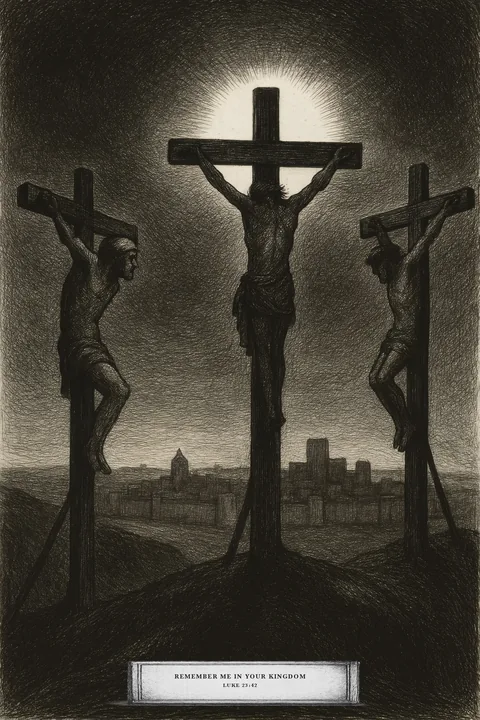
The Path to Salvation
The vast majority of the “church” has been taught that keeping his commandments is a “works-based salvation” and that the Old Testament and its laws are no longer relevant. We are not saved by our works, but we can be condemned by willful, unrepentant breaking of his commands and denying their truth.
Do not think that I (Jesus) came to destroy the Law or the Prophets. I did not come to destroy but to fulfill (to cause to abound, to bring to realization, to establish, to bring to fullness). For assuredly, I say to you, until heaven and earth pass away, not one jot (punctuation) or one tittle will pass from the law till all is fulfilled. Whoever therefore breaks one of the least of these commandments, and teaches men so, shall be called least (or nothing) in the kingdom of heaven; but whoever does and teaches them, he shall be called great in the kingdom of heaven.
Jesus came to explain the law, and everything he taught can be found in the Old Testament. It is the Old Testament that spoke of Jesus through prophecies of the coming Messiah; therefore, the Messiah’s first and second comings are part of his word and his law, which must be fulfilled.
For if we sin willfully after we have received the knowledge of the truth, there no longer remains a sacrifice for sins, but a certain fearful expectation of judgment, and fiery indignation which will devour the adversaries.
What is sin? How do we know it?
What shall we say then? Is the law sin? Certainly not! On the contrary, I would not have known sin except through the law. For I would not have known covetousness unless the law had said, “You shall not covet.”
Whoever commits sin also commits lawlessness, and sin is lawlessness.
NKJV
What is “the truth” of which we have received knowledge? We must be careful not to rely solely on dictionary definitions of words which often change over time. The Bible is symbolic and defines its own terms so that the meaning can survive translation errors and language evolution, and be carried through many different languages. We must let the Bible define its own terms; this is the key to understanding the Bible.
Thy righteousness is an everlasting righteousness, and thy law is the truth.
Righteousness is a way of referring to the keeping of the law, and the Psalms have just declared it to be everlasting, never-ending, and the truth. With this definition, Hebrews 10:26 can be understood to say, “If we sin willfully after we have received knowledge of the law (of Moses).”
This is supported by Paul immediately bringing up the law of Moses after talking about willful sinning.
Anyone who has rejected Moses’ law dies without mercy on the testimony of two or three witnesses. Of how much worse punishment, do you suppose, will he be thought worthy who has trampled the Son of the LORD underfoot, counted the blood of the covenant by which he was sanctified a common thing, and insulted the Spirit of grace? For we know Him who said, “Vengeance is Mine, I will repay,” says the LORD. And again, “the LORD will judge His people.” It is a fearful thing to fall into the hands of the living LORD.
Once we have knowledge of the law, we must profess it to be the truth and ask for forgiveness when our flesh continues to break it. If you deny the truth, the law, then you are willfully sinning and denying Jesus as your Lord/Master.
But whosoever shall deny me before men, him will I also deny before my Father which is in heaven.
For whoever is ashamed of Me and My words (which come from his Father via Moses and the Prophets), of him the Son of Man will be ashamed when He comes in His own glory, and in His Father’s, and of the holy angels.
Jesus is “the way, the truth (the law, the word), the life,” and the law is “the truth”; therefore, by denying His law, his words, you are denying Jesus, and He will deny you before his Father, the LORD.
The testimony of Jesus is his advocacy for us as our High Priest.
Seeing then that we have a great high priest, that is passed into the heavens, Jesus the Son of the LORD, let us hold fast our profession. For we have not an high priest which cannot be touched with the feeling of our infirmities; but was in all points tempted (tested) like we are, yet without sin. Let us therefore come boldly unto the throne of grace, that we may obtain mercy, and find grace to help in time of need.
It is the High Priest who makes intercession on behalf of the people and who presents the sacrifice to cover the sins of the people. Jesus presents his own blood to cover our unintentional sins and those sins for which we have repented.
Jesus’s role as our High Priest is defined by the Old Testament law, which clearly identifies willful and defiant disregard of the law as blaspheming the LORD (aka grieving the spirit of grace).
The priest (Jesus) shall make atonement before the LORD for the person who commits an error when he sins unintentionally, making atonement for him so that he may be forgiven. You shall have one law for him who sins unintentionally, whether he is native-born among the Israelites or a stranger who is living among them as a resident alien. But the person who does [anything wrong] willfully and defiantly, whether he is native-born or a stranger, that one is blaspheming the LORD, and that person shall be cut off from among his people [excluding him from the atonement made for them].
Remember therefore from whence thou art fallen, and repent, and do the first works (beginning, old ways); or else I will come unto thee quickly (suddenly), and will remove thy candlestick out of his place, except thou repent.
Works-Based Salvation?
So then, is keeping the law a works-based salvation? No. It is only by the Law that we have a High Priest in Jesus, who intercedes on our behalf and provides his own blood and testimony to forgive our unintentional sins and those acts of lawbreaking from which we have repented (turned). His role as our High Priest is established by the law; by the law, there is no means of salvation except through that High Priest’s intercession and blood.
Does he thank that servant because he did the things that were commanded him? I think not. So likewise you, when you have done all those things which you are commanded, say, ‘We are unprofitable servants. We have done what was our duty to do.’
Jesus makes it very clear that obedience isn’t earning our salvation. We are in debt because of our sins and the wages of sin is death, but the gift of the LORD is eternal life (Romans 6:23).

If we could earn something by obeying, then obeying would have been optional. As servants, we have nothing that our creator didn’t give us in the first place; therefore, we owe him our very life. When we sin, we owe him even more; therefore, the more we sin, the greater our debt grows, and the first rule of getting out of the hole is to stop digging. Stop sinning!
The typical three-step path to salvation is:
-
Admit that you are a sinner (lawbreaker).
-
Believe that Jesus paid for your sin on the cross.
-
Confess that Jesus is Lord (Master) and call on Him for salvation.
You cannot complete the first step without knowing what it means to be a sinner; that is, without knowing the law you broke. You cannot accept the second step without believing the law provides a High Priest, demands a sacrifice, and prophesies of a Messiah, and that Jesus meets the requirements of the law and the Prophets. And you cannot complete the final step without submitting to follow Jesus as your master. And who is Jesus except the word and the law made flesh, who does nothing except what his Father said and what was written in the Old Testament?
I am able to do nothing of Myself. As I hear, I judge; and My judgment is just, because I do not seek My will, but the will of the One (the LORD) having sent Me.
So Jesus replied, "Truly, truly, I tell you, the Son can do nothing by Himself, unless He sees the Father doing it. For whatever the Father does, the Son also does.
For I have come down from heaven, not to do My own will, but to do the will of Him who sent Me.
Jesus is our Judge and High Priest, and everything he says and does is as he heard from the LORD. Jesus himself followed the law, doing only that which the LORD spoke. An in-depth study of everything Jesus did and said will show that everything he taught can be found in the Old Testament.
A disciple is not above his teacher, but everyone who is perfectly trained will be like his teacher.
NKJV
Then said Jesus unto his disciples, If any man will come after me, let him deny himself, and take up his cross, and follow me. For whosoever will save his life shall lose it: and whosoever will lose his life for my sake shall find it.
If you aspire to be a Christian, a “like-Christ,” then your aim is to be like him, to walk as he walked, and to do nothing unless you see the Father, the LORD, doing so or commanding so, as it is written in the Old and New Testaments. If you are living through the tribulation, then Matthew 16:26 is the number one warning to keep in mind.
Go and Sin No More
Sin is the transgression of the law; therefore, when Jesus says, “Go and sin no more,” it can be understood as “Go and keep the law.” Once we have been made well by calling upon Jesus to save us from our breaking of the law, we cannot keep willfully breaking it.
And Jesus said unto her, “Neither do I condemn thee: go, and sin no more.”
Afterward Jesus found him in the temple, and said to him, “See, you have been made well. Sin no more, lest a worse thing come upon you.”
Notice that after being healed, the penalty for sinning—also known as breaking the law—is worse than if we had never been healed or saved in the first place. This lines up exactly with what Paul said.
Of how much worse punishment, do you suppose, will he be thought worthy who has trampled the Son of the LORD underfoot…
The most obvious way to willfully break the law of the LORD is to claim that there is no law, that it has been done away with, and that you do not have to follow it because “Jesus has paid the price for you not following it.”
Whoever commits sin also commits lawlessness, and sin is lawlessness. And you know that He was manifested to take away our sins, and in Him there is no sin. Whoever abides in Him does not sin (willfully). Whoever sins (willfully) has neither seen Him nor known Him.
Many will say to Me on that day, ‘Lord, Lord, did we not prophesy in Your name, and in Your name cast out demons, and in Your name perform many miracles?’ And then I will declare to them, ‘I never knew you; depart from Me, you who practice lawlessness.’
All Have Sinned & Continue to Sin
For I (Paul) do not understand my own actions. For I do not do what I want, but I do the very thing I hate.
ESV
If sinning after coming to Jesus is even worse than never knowing Jesus, then who can be saved? Even Paul, author of most of the New Testament, admits that he continues to do the very thing he hates: sin.
For all have sinned, and come short of the glory of God;
The fundamental truth is that all have sinned and deserve death, and there is nothing in our own power we can do to attain salvation except to pray for His mercy and have faith in His finished work on the cross.
He that follows me shall not walk in darkness, but shall have the light of life.
And ye shall know the truth (the law), and the truth shall make you free… Jesus answered them, Verily, verily, I say unto you, Whosoever commits sin is the servant (slave) of sin. And the servant abides not in the house for ever: but the Son abides ever. If the Son therefore shall make you free, ye shall be free indeed.
While in the flesh, we are at war with sin and lawlessness. This war was described by Paul in Romans 7:
If, then, I do what I do not want to do, I agree with the law that it is good. But now, it is no longer I who do it, but sin that dwells in me.
The first thing to notice is that Paul declared the law good in his mind and spirit. If we do not agree that the law is good, then we are in agreement with the sin that dwells within us. Paul states that this sin-nature, inherited from Adam, has enslaved our flesh. Sin is “personified,” like a demon having influence over our flesh, causing us to act contrary to our mind and will.
For I know that in me (that is, in my flesh) nothing good dwells; for the will (to follow the Law) is present with me, but how to perform what is good (the Law) I do not find. For the good that I will to do, I do not do; but the evil I will (desire) not to do (breaking the law), that I practice. Now if I do what I will not to do, it is no longer I who do it, but sin that dwells in me.
I find, then, a law (authority) that is the evil present with me, the one who wills to do good (the law).
For I delight in the law of the LORD according to the inward man (mind and spirit).
But I see another law (authority) in my members (flesh), warring against the law (authority) of my mind, and bringing me into captivity to the law (authority) of sin which is in my members.
O wretched man that I am! Who will deliver me from this body of death? I thank the LORD—through Jesus Christ our Lord! So then, with the mind I myself serve the law of the LORD, but with the flesh the law of sin.
NKJV
How, then, shall we be saved? This chapter went into great depth to highlight that salvation depends upon confessing that the law (of the LORD via Moses and the Prophets) is good. We must be willing to obey the law in our mind and spirit even if the flesh continues to enslave us to sin against our will.
That if you confess with your mouth, “Jesus is Lord,” and believe in your heart that the LORD raised Him from the dead, you will be saved.
This simple verse means confessing that Jesus is Lord. Jesus does nothing that the LORD didn’t tell him (as documented in the Old Testament). He came to fulfill and establish the law of the LORD documented by Moses and the Prophets. Confessing Jesus to be Lord means he is your master and that your desire and will is to do nothing Jesus hasn’t commanded you. And if Jesus only commands what the LORD commands, then we should desire to do all that the LORD commands.
If that is the desire of your mind and heart, then you will do your best to keep the law of the LORD, even if you occasionally sin. It means that when you become aware of your sin, breaking the law, you immediately repent and stop sinning. If you deny the law with your mouth, you have denied Jesus as Lord and he will deny you.
For by grace you have been saved through faith. And this is not your own doing; it is the gift of the LORD, not a result of works, so that no one may boast. For we are his workmanship, created in Christ Jesus for good works, which the LORD prepared beforehand, that we should walk in them.
Our salvation is not a result of works, which means no one can boast that they are saved because of their works. I certainly wouldn’t want my salvation to depend upon my works because, like Paul, I do what I hate and not what I teach. We are saved because we make Jesus our Lord and follow the Law of his Father to the best of our ability and with the help of his Holy Spirit.
Can one have salvation without repentance? What is repentance except the turning from sin to obedience? Obedience is the logical outcome of confessing him to be your Lord. Is preaching obedience a works-based salvation or is attempted obedience the evidence of faith? Why try to obey unless you have faith that Jesus’s blood will cover your failures? Did Jesus’s death on the cross free us from any obligation to attempt obedience?
So the law is holy, and the commandment is holy and righteous and good.
“Not everyone who says to me, ‘Lord, Lord,’ will enter the kingdom of heaven, but only the one who does the will of my Father who is in heaven.
What is doing the Father’s will except being obedient to the least of his commands? Is perfect obedience possible? Not in the flesh. Is perfect obedience required for salvation? No. But a mind and heart of obedience is.
Many say, “Lord, Lord,” confessing with their mouths, but their actions show rebellion against seeking to understand and follow His commands. They say in their hearts, “There are no laws or commands because I am forgiven of all sin.” This is like a reckless driver claiming there are no rules of the road because someone has paid his tickets. When you say, “Lord, Lord,” you are saying, “Master, Master,” and how can someone be your “master” unless you attempt to obey their commands?