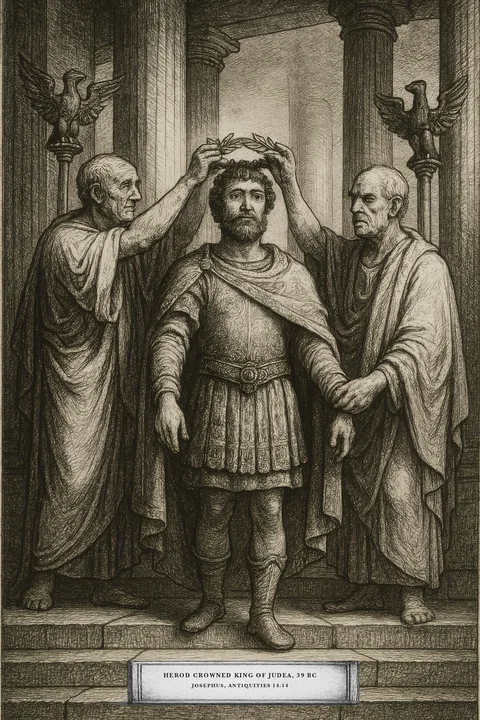
Herod's Appointment & Battle of Actium
Josephus stamps Herod’s appointment with a Roman date: the 184th Olympiad, in the consulship of Calvinus and Pollio — the year we call 40 BC. The received chronology reads that stamp as the date of the Senate’s decree, counts Herod’s reign from it, and arrives at the familiar 4 BC death. But Josephus did not record a decree with a date; he recorded a journey — flight, storm, shipwreck, a winter’s shipbuilding — and set his time-stamp at the end of the whole account. This chapter walks that journey at the pace Josephus describes, asks what his consular reference actually dates, and then puts both readings to an independent test: the one event in Herod’s reign whose date no one disputes, the Battle of Actium.
The Journey to Rome
The story begins with the Parthian invasion of Judea, which escalated around Shavuot and drove Herod from Jerusalem. On the full-moon reckoning this book has proven, Shavuot fell that year about the first of July, 40 BC — weeks later than the traditional count would place it — and the lateness matters: every week the crisis began later was a week taken off the sailing season that remained. He moved his family to the fortress of Masada, crossed Idumea, and sought help in Arabia, where King Malchus refused him; only then did he turn toward Egypt, reaching Alexandria after four to six weeks of overland flight through hostile country. Cleopatra tried to keep him for a campaign of her own; he declined and put to sea late in the season.
[Herod] sailed away in a storm, which fell upon him as he sailed, with great danger; and he was sorely shaken with the tempest, and was thereby in distress… So he set sail from thence to Pamphylia: and falling into a violent storm, he had much ado to escape to Rhodes; with the loss of the ship’s burden.
Antiquities 14.14.3
The sea nearly ended the story. Herod reached Rhodes with his cargo gone and his ship unfit for the crossing to Italy — and Rhodes itself was in no state to help quickly.
And as he found that city very much damaged in the war against Cassius, though he were in necessity himself, he neglected not to do it a kindness: but did what he could to recover it to its former state. He also built there a three-decked ship; and set sail thence, with his friends, for Italy: and came to the port of Brundusium.
Antiquities 14.14.3
A three-decked ship is not an afternoon’s repair. In a city still rebuilding from Cassius' war, sourcing timber, hiring shipwrights, and fitting out a vessel of that class is a work of months — and those months land exactly where the ancient sailing calendar closes. From roughly November to March the Mediterranean was mare clausum, the closed sea; voyages ceased until spring. Scripture itself keeps this almanac, and keeps it by the feast calendar — Luke dates the turn of the season on Paul’s own shipwreck voyage not by a Roman month but by the Day of Atonement:
Now when much time was spent, and when sailing was now dangerous, because the fast was now already past, Paul admonished them…
Once the Fast has passed, sailing is “now dangerous” — and the captain who pressed on anyway wrecked the ship. Herod’s autumn at Rhodes sat on the wrong side of that same marker. Set the whole journey against the calendar and watch the season run out:
| Leg of the journey | Time it demands | The calendar meanwhile |
|---|---|---|
Parthian invasion; night flight from Jerusalem |
— |
Shavuot — about July 1, 40 BC, on the full-moon reckoning |
To Masada and through Idumea, the family secured in the fortress |
about a week, through country under Parthian arms |
early-to-mid July |
To Petra, where Malchus refuses aid |
one to two weeks, with the failed negotiation |
late July |
Petra to Rhinocolura, Pelusium, and Alexandria along the desert coast |
two to three weeks |
mid-August |
Cleopatra’s detention; he sails late in the season |
days to weeks |
late August – early September |
The storm; the cargo lost; refuge made at Rhodes |
— |
September |
Building the three-decked ship in a war-ruined port |
three months and more |
October into December — and the Fast passes near the end of October: sailing “now dangerous” (Acts 27:9) |
Mare clausum — the sea closes |
November through March |
winter at Rhodes |
The sea opens; Rhodes to Brundusium, the Appian Way to Rome |
three to four weeks |
late Adar — toward the end of March, 39 BC |
Seven days in Italy; the Senate’s decree |
one week |
Nisan — April, 39 BC |
Count the rows and the conclusion writes itself: a flight that began at a late Shavuot consumed the summer; the storm and the shipbuilding consumed the autumn; and before the new vessel stood ready, the Fast had passed and the sea had shut. It did not open again until late Adar — and only then, with the first sailing of spring, could Herod cross to Brundusium and take the road to Rome.
Grant the impossible, and the traditional date still fails. Suppose Herod defied the Fast’s warning and the closed sea and sailed with the November gales: the crossing and the Appian Way would set him in Rome in the middle of December — a city given over to Saturnalia, its courts and curia at rest — with the consulship of Calvinus and Pollio itself expiring at the new year. He would still have had to find and win both of his patrons — Antony and Octavian, men who had spent that autumn at Brundisium on the brink of war with each other, their reconciliation only weeks old — and then have a senate convoked and a decree carried, all inside a festival fortnight before the consular year ran out. Josephus' “seven days” in Italy would have to be the seven days of Saturnalia. Even recklessness cannot buy the traditional date; the decree belongs to the sailing season of the new year, exactly where the narrative leaves it.
When the sea opened, the rest moved quickly.
And when he was come to Rome, all his friends met him… So a senate was convocated: and Messala first, and then Atratinus introduced Herod into it… This seemed good to all the senators: and so they made a decree accordingly.
Antiquities 14.14.4
Antony and Octavian, needing a reliable hand against Parthia, carried the matter through the Senate at once — Herod had his kingship within seven days of landing in Italy. The delays all belong to the road and the sea, not to Rome; on this evidence the decree falls in the spring of 39 BC.
What the Consular Year Dates
Only after telling the whole story does Josephus reach for his date:
And thus did this man receive the Kingdom; having obtained it on the hundred eighty fourth olympiad; when Caius Domitius Calvinus was consul the second time; and Caius Asinius Pollio [the first time.]
Antiquities 14.14.5
Notice what the sentence dates. It does not say the Senate decreed in that year; it says Herod obtained the kingdom — and the obtaining, as Josephus has just spent a chapter showing, ran from the Parthian invasion through the flight, the storm, the winter at Rhodes, and the voyage to Rome. Josephus habitually sets a consular or Olympiad marker at the head of a sequence — the year a war began, a campaign opened, a crisis broke — and lets the sequence run past it. The consulship of Calvinus and Pollio dates the year the crisis began and the obtaining started: 40 BC, the invasion and the flight. Reading it as the decree’s own date requires everything the narrative denies — a swift road, a harmless storm, a refit measured in days, and a winter crossing no ancient captain would make. The traditional 40 BC appointment is not evidence; it is an assumption of haste laid over a story whose every detail testifies to delay.
With the appointment in the spring of 39 BC, Herod’s first regnal year begins, on Josephus' spring-to-spring reckoning, in the spring of 38 BC — the starting point this book’s chronology runs on.
The Battle of Actium
The reconstruction can now be tested, because Josephus ties one year of Herod’s reign to the best-dated event in the ancient world.
Now at this time it was that the fight happened at Actium, between Octavius Caesar and Antony, in the seventh year of the reign of Herod…
Antiquities 15.5.2
The occasion for the note is a catastrophe at home: that spring an earthquake shattered Judea, killing ten thousand by the count in Antiquities (thirty thousand in War), destroying houses and cattle — Herod’s army survived only because it was encamped in open fields, and the Arabs, believing Judea broken, murdered the Jewish ambassadors sent to them. The battle itself is fixed: September 2, 31 BC, Octavian’s fleet against Antony’s — one of the most precisely dated events of antiquity, and one that owes nothing to Herodian chronology. It depends on no eclipse, no death date, no son’s reign. Whatever count Josephus was keeping, this verse lets us check it — and the language he uses is the unqualified “reign,” which, as Herod: Regal vs De Facto established, is his regal count from the appointment, not the de facto count from the capture of Jerusalem.
Run the count from each candidate starting year and watch where September of 31 BC lands:
| Reckoning of the seventh year | Its span | Actium — September 2, 31 BC |
|---|---|---|
Regal from spring 38 BC (this book) |
Spring 32 – spring 31 BC |
About five months past the seventh year’s edge |
Regal from 40 BC (the consensus) |
Spring 34 – spring 33 BC |
Three years late — the battle falls in the tenth year |
De facto from the consensus’s 37 BC capture |
Spring 30 – spring 29 BC |
A year early — the seventh year has not yet begun |
Neither reading is perfect, but they do not miss by the same amount. On this book’s count the battle falls about five months past the boundary of the seventh year — the kind of gap a spring-to-spring reckoning produces at a year’s edge, or that rounded language absorbs. On the consensus count the battle misses the seventh year by three full years, an error no rounding explains. The consensus has one escape: abandon the regal reading and count de facto years from the 37 BC capture with inclusive accession-year counting, which does put a seventh year at 31 BC. But that escape costs three deviations at once — treating Josephus' unqualified “reign” as de facto against his own established pattern, switching count systems mid-argument, and adopting an inclusive accession convention Josephus does not use for the earlier kings. Three deviations against one small boundary approximation: the test is not close. If Josephus was rounding, he was rounding from this book’s timeline.
The verse also closes the ring of the larger reconstruction. A regal count starting in the spring of 38 BC puts Actium at the edge of the seventh year; the capture of Jerusalem “twenty-seven years to the day” after Pompey fixes 36 BC; thirty-four de facto years from 36 BC lands Herod’s death in 1 BC. One starting point, three independent statements of Josephus, no contradictions.
After the Battle
Actium ended Antony, and Herod — Antony’s man — moved fast. Josephus records that he sailed to meet Octavian at Rhodes, laid his crown at the victor’s feet, and was confirmed in his kingdom despite his history: the meeting falls in 30 BC, Herod’s eighth or ninth regal year on this book’s count, exactly where the narrative expects it. The earthquake, the battle, and the pivot to Octavian are one sequence, and they run on the same clock as everything else in his reign — the clock that started when a fugitive who had wintered at Rhodes finally stood before the Senate in the spring of 39 BC.