Introduction
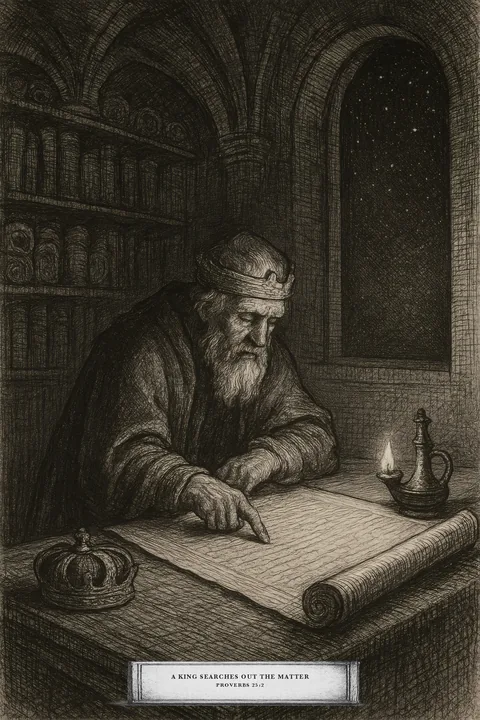
It is the honor of kings to search out a matter (Proverbs 25:2), and there is no greater mystery than seeking to know Him by honoring his appointed times and Sabbaths. Most assume the calendar and Sabbath day is a settled matter, but few have actually tested this assumption against history, physics, and the rest of scripture; instead, history is mercilessly twisted to fit preconceived conclusions — traditions inherited from our fathers, in which there is no profit (Jeremiah 16:19).
This book is written to those who value truth over tradition and are willing to test everything (1 Thessalonians 5:21) so that they may show themselves approved, workmen who need not be ashamed (2 Timothy 2:15). The biggest hurdle to discovering the truth is our own unavoidable cognitive biases that blind us to truths that are obvious in hindsight. We get anchored to the first thing we hear, to the things that are most familiar, and the ones that are most socially acceptable. For teachers and pastors, even considering a teaching that would instantly cause you to lose your following, your congregation, or your job is enough for your subconscious to go into overdrive to defend what you already believe over an inconvenient truth.
The one who states his case first seems right, until the other comes and examines him.
ESV
God is truth, and he seeks those who will humble themselves, because the fear of the Lord is instruction in wisdom, and humility comes before honor (Proverbs 15:33). We must first humble ourselves before our eyes can see, and our ears can hear new wisdom. The ideas presented in this book are the result of years of study in which every effort was made to seek the truth over what is comfortable, familiar, and widely accepted, and while I believe the conclusions are conclusive enough to justify writing this book, they are not guaranteed to be infallible.
Then I saw all the work of God, that man cannot find out the work that is done under the sun. Even though a man should seek laboriously, he will not find it out; and though the wise man claims to know, he cannot find it out.
Though it may seem impossible to know anything with certainty, we are still expected to seek truth and obey our understanding with all of our heart, mind, body, and soul.
The heart of the prudent getteth knowledge; and the ear of the wise seeketh knowledge.
What knowledge could be of greater value than to learn God’s appointed times, the days He has set aside to meet with mankind, and the shadows pointing us to the substance of Jesus? Without this knowledge, we are lost, walking in darkness, and stumbling without the light of His truth. And while we may have good intentions in keeping the Sabbath and feasts on popular days, our good intentions done in ignorance still constitute unintentional sins.
The times of ignorance therefore God overlooked; but now he commandeth men that they should all everywhere repent.
ASV
Many are tempted to remain ignorant, to avoid knowledge, and to trust in God’s mercy on the ignorant; however, willful ignorance leads to destruction.
My people are destroyed for lack of knowledge; because you have rejected knowledge, I reject you from being a priest to me. And since you have forgotten the law of your God, I also will forget your children.
Sin always has consequences, even if we are ultimately forgiven; therefore, we should seek the Truth in all things and, once discovered, obey the Truth because Jesus is the Truth. Let us not make a habit of practicing lawlessness and always remember this warning from Jesus:
Many will say to Me on that day, 'Lord, Lord, did we not prophesy in Your name, and in Your name cast out demons, and in Your name perform many miracles?' "And then I will declare to them, 'I never knew you; depart from me, you who practice lawlessness.'
We are not saved by our obedience to his law, but our effort at obeying is the evidence of a renewed heart. Obedience can never repay the debt we owe; however, continued disobedience will continue to defile, and willful, unrepentant disobedience is tantamount to the rejection of Jesus and the Spirit of Grace. It is only by the blood of Jesus and his mercy that we are forgiven and the debt of our sins is paid.
The Name of Our Lord
God, the creator of the universe, has a name: in the Hebrew texts it is written with four letters, YHWH. Most English Bibles render that name as “the LORD” and render His Son’s Hebrew name as “Jesus”. God and Lord are titles like President, Master, or King and do not identify any specific “god” — the name does.
It shall come about in that day," says the LORD, "That you will call Me Ishi (my husband) and will no longer call Me Baali (my Lord), For I will remove the names of the Baals (lords/false gods) from her mouth, So that they will no longer be mentioned or remembered by their names.
There is great debate about how to pronounce the name — Yahuah, Yehovah, Yahweh — and He will reveal the truth to us in His time. Since nothing in this book turns on the pronunciation, this edition keeps the familiar English conventions: “the LORD” for the name of the creator of Heaven and Earth, the God of Abraham, Isaac, and Jacob, and “Jesus” for His Son — so that nothing stands between the reader and the evidence. The Name, it turns out, is more than a pronunciation — Scripture joins it to the ark of the covenant, using the two interchangeably. An entire chapter of MEAT The Bible’s Symbolic Language is dedicated to revealing the deeper meaning behind taking the Name in vain. For the purposes of this second edition, it is enough to know that mispronouncing — or misspelling — His Name is not what the text means.
Quotes
Throughout this book, I quote scripture, but occasionally I annotate that scripture to provide context or alternative understandings of the underlying word in Hebrew or Greek. My clarifications are placed in “(…)” and insertions of context are “[…]”. Where possible I use KJV, NKJV, ESV, and AMP versions of the Bible in that order based upon my understanding of which version is most accurate to the underlying Hebrew and Greek and which reads the best without distorting the meaning of the text.
I view all translations as evidence of the underlying Hebrew and Greek and not proof. Each translator brings their own perspective when resolving ambiguous cases and only those with the greatest context can truly resolve all ambiguity in an accurate way. When in doubt, look up the verses for yourself.
Structure
This book is divided into parts. The first parts establish the case for the biblical calendar by answering when the day, the month, and the year start, and how to observe them — the proactive case. Then comes a deep dive into the Sabbath, testing the scriptures that give us enough information to fix the day of the month, the day of the week, and the year against each proposed calendar. Saturday fails most of these tests.
The ultimate test is the year of the cross — a debate that has grown larger than the evidence warrants for one reason: the untested assumption that Saturday must be the Sabbath. When every primary source is allowed to speak plainly, they point to one practically unanimous conclusion: Jesus died and rose again in 32 AD. Proving it requires examining every primary source ever presented without the bias of needing to force a particular year for the cross — and that opens a deep investigation into the reign of Herod the Great, exposing the contortions and special pleadings required to prop up the traditional narrative. The final part turns from the evidence to what it demands: salvation and obedience.
This means the book can be read in layers, according to how much evidence you require. If you accept the conclusion on Herod the Great’s reign, the part that investigates it — exposing the holes in the official arguments — is optional.
This book’s length stems largely from the need to refute an abundance of misconceptions, rationalizations, and the like.
How easy it is to make people believe a lie, and how hard it is to undo that work again!
Autobiography of Mark Twain
O LORD, my strength and my stronghold, my refuge in the day of trouble, to you shall the nations come from the ends of the earth and say: "Our fathers have inherited nothing but lies, worthless things in which there is no profit."