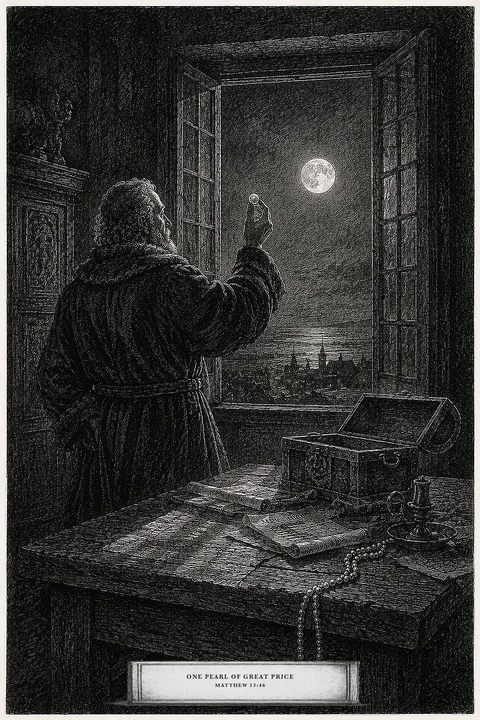
Again, the kingdom of heaven is like unto a merchant man, seeking goodly pearls: who, when he had found one pearl of great price, went and sold all that he had, and bought it.
— Matthew 13:45-46
The Pearls of Wisdom
Jesus gives the pearl parable in one sentence:
Again, the kingdom of heaven is like unto a merchant man, seeking goodly pearls: who, when he had found one pearl of great price, went and sold all that he had, and bought it.
The little parable turns on 2 questions: Who is the merchant, and what did he purchase?
The parable immediately before it tells of a man who sells all to buy a field for the treasure hidden within it (Matthew 13:44). The Coin chapter has already followed those symbols: the field is the world, and the treasure within it is God’s people — His peculiar treasure, refined as silver and gold (Matthew 13:38; Exodus 19:5; Job 23:10; Zechariah 13:9). Within the same sequence, Jesus has identified the man sowing in that field as the Son of man (Matthew 13:37). The next sentence repeats the purchase in a new form: a merchant finds one pearl, sells all, and buys it. The buyer has not changed. Proverbs 31 will bind both purchases into one woman’s portrait: she is priced above pearls, is likened to the merchant’s ships, calls her merchandise good, and buys the field. The field and the pearl are not separate clues; Solomon gathers both parables around the same woman.
The Merchant is the Son, and the pearl is the bride He came to purchase.
The Bride in the Sky
Jesus begins by naming the realm: “The kingdom of heaven is like” — literally, the kingdom of the heavens. Genesis names the firmament Heaven and places the sun, moon, and stars within it (Genesis 1:8, 14-18). Before the merchant takes a step, the parable has already lifted our eyes to the sky.
The Sun, Moon, and Stars chapter established the relationships pictured there. The sun represents the Father and the husband. The moon is the faithful witness: the Son reflecting His Father, and the bride reflecting her Bridegroom. The moon represents the submissive side of a covenant relationship — the Son under His Father, and the bride under her husband (1 Corinthians 11:3; Ephesians 5:22-24). It does not produce an independent light; it receives the light of its head and faithfully makes that light visible.
The parable asks us to find one complete pearl in that heavenly arrangement. The full moon already answers in 2 ways: it has the visible shape of one complete pearl, and the moon represents the bride in the covenant relationship. The next step is to follow the words of both purchases through Scripture: field, treasure, buy, merchant, found, one, good, pearl, great price, and heaven.
Following the Words
Pearl and great price lead directly to Proverbs. First, Wisdom is priced above pearls:
KJV — “pearls” restored
Proverbs 8:11 and Job 28:18 repeat the comparison. Then the woman of valour — the bride — is priced above the same pearls:
The find-verb of Proverbs 3:13 returns in 2 revealing statements: “whoso findeth me” (Proverbs 8:35, Wisdom speaking) and “whoso findeth a wife” (Proverbs 18:22). Wisdom and the bride occupy the same place in Solomon’s search, and both lead back to the merchant’s defining action: “when he had found one pearl of great price” (Matthew 13:46).
Merchant and good converge there too. Wisdom’s “merchandise” is good (Proverbs 3:14). The bride “tasteth that her merchandise is good” (Proverbs 31:18). The kingdom’s merchant seeks “goodly pearls” (Matthew 13:45). Wisdom, bride, pearl — the good merchandise is one continuous trail.
That leaves one. If the trail is sound, Scripture should not merely compare a woman to a pearl; it should gather the picture into one complete bride.
These searches lead to 2 poems in Proverbs. The first prices Wisdom above pearls; the second prices the bride above pearls and places the merchant and good merchandise inside her portrait. We will read each poem whole before examining its lines. Bold type marks the words under examination. Where a line uses a less familiar rendering, its note preserves the familiar wording and the reason for the change without interrupting the picture. Then Scripture can answer whether the woman they describe is the one pearl in the heavens.
Proverbs 3: Wisdom’s Poem
Blessed is the man that findeth wisdom, and the man that draweth out understanding. For the gain of her going-round is better than the going-round of silver, and her yield than fine gold. She is more bright than pearls: and all thy delights are not to be compared unto her. Length and appropriateness of days is in her right hand; and in her left hand riches and shining. Her ways are ways of splendour, and all her paths are wholeness. She is a tree of life to them that lay hold upon her: and blessed is every one that holdeth her fast. The LORD by wisdom hath founded the earth; by understanding hath he established the heavens. By his knowledge the depths were broken open, and the skies drop down the dew.
Proverbs 3, Line by Line
Blessed is the man that findeth wisdom, and the man that draweth out understanding.[2]
The poem begins with the merchant’s action: he finds. Understanding is not purchased from outside; it is drawn from the Word like treasure brought out of a field. The same search will end with the wife: “whoso findeth a wife findeth a good thing” (Proverbs 18:22).
For the gain of her going-round is better than the going-round of silver, and her yield than fine gold.[3]
Merchandise is what that traveling trader gains; the MEAT rendering keeps the root’s motion audible. Yield is what a field, a tree, or a life produces. The line joins the merchant’s circuit to Wisdom’s yield. Its opening phrase, “her merchandise is good,” returns in the bride’s portrait, where she tastes that her merchandise is good (Proverbs 31:18). The pearl parable has entered Solomon’s vocabulary before a pearl is named.
The verse prices Wisdom against a second treasure: her yield is better than fine gold — charuts, gold as mined. What gold contributes to the poem is not its price but its property, and Scripture develops that property from text to text. Job moves from “bright light” in a cleansed sky to zahav, the ordinary gold-word (Job 37:21-22).[4] The Song portrays the Bridegroom’s head as fine gold and His hands as gold rings, then sets bright ivory beside sapphire (Song of Solomon 5:11, 14). Solomon covered the sanctuary in gold and set ten golden lamps before the most holy place (1 Kings 6:20-22; 7:49), and the holy city John saw is “pure gold, like unto clear glass” under the light of God’s glory (Revelation 21:18, 23). Gold does not yet define Wisdom’s yield; it gives the poem a visible property to carry forward: luster — received light made visible. The next line calls Wisdom bright; the line after it gives her shining.
She is more bright than pearls: and all thy delights are not to be compared unto her.[5]
The poem therefore prices Wisdom above pearls in the moon’s own vocabulary: precious, and heard again, bright.
Length and appropriateness of days is in her right hand; and in her left hand riches and shining.[6]
The line therefore holds both the count of days and their fitness — time measured and time appointed. Glory or honour is displayed here as radiance.
The hands also carry direction. Strong’s gives the right hand as the south and the left as the dark or northern side. The complete witness holds the days in her bright hand and their shining even in her dark one.
Her ways are ways of splendour, and all her paths are wholeness.[7]
A full witness walks a complete path. The poem is beginning to describe not merely a jewel but a light completing its appointed course.
She is a tree of life to them that lay hold upon her: and blessed is every one that holdeth her fast.[8]
It is the action the bride’s palms will perform when they hold the circuit. It is also the verb of Moses' hands held steady — emunah, faithfulness — until the going down of the sun (Exodus 17:12). The Tree of Life also keeps the moon’s measure: it bears 12 fruits and yields its fruit “every month” (Revelation 22:2). Wisdom is held as the faithful witness holds its course.
The LORD by wisdom hath founded the earth; by understanding hath he established the heavens.
KJV
The poem now tells us where its picture belongs. The Hebrew verb translated established, konen (H3559), is echoed when David looks upon “the moon and the stars, which thou hast ordained” (Psalm 8:3). The Wisdom priced above pearls is the Wisdom that built the sky: “when he prepared the heavens, I was there” (Proverbs 8:27).
The depths recall the fountains of the flood (Genesis 7:11), while the fine sky is where the faithful witness is established (Psalm 89:37). The poem ends with the heavens opened above and the measured waters below. Moses joins the same deep and dew to “the precious fruits brought forth by the sun” and “the precious things put forth by the moon” (Deuteronomy 33:13-14). Its Wisdom belongs to the ordered creation whose lights govern days, months, and appointed times.
Eight Verses, One Complete Picture
The count is striking: 8 verses, with the lunar thread unbroken in every one. Verse 13 gives the merchant’s finding of the heavenly pearl; verse 14, the going-round and gold’s luster; verse 15, the bright pearl; verse 16, measured days, appointed time, direction, and shining; verse 17, the complete path; verse 18, the Tree of Life yielding every month and held fast; verse 19, the moon established in the heavens; and verse 20, the deep and dew joined to what the moon puts forth. No verse drops the thread. The poem has not merely compared Wisdom with a pearl; it has drawn one complete pearl across the whole sky.
But wait, there’s more.
Proverbs 31: The Bride’s Portrait
A woman of valour who can find? for her price is far above pearls. The heart of her husband doth safely trust in her, and gain shall never diminish. She doeth him good and not evil all the days of her life. She seeketh wool, and flax, and worketh willingly with her palms. She is like the ships of the one who travels round; she bringeth her bread from afar. She riseth also while it is yet night, and giveth meat to her household, and the appointed portion to her maidens. She considereth a field, and buyeth it: with the fruit of her palms she planteth a vineyard. She girdeth her loins with strength, and strengtheneth her arms. She tasteth that it is good, her merchandise: her lamp goeth not out in the night. She layeth her hands to the spindle, and her palms hold fast the circuit. She spreadeth out her palm to the poor; yea, she reacheth forth her hands to the needy. She is not afraid of the whiteness for her household: for all her lineage wraps in years. She maketh herself coverings; her clothing is white linen and royal maroon. Her husband is known in the gates, when he sitteth among the elders of the land. She maketh fine linen, and selleth it; and delivereth girdles unto the merchant. Strength and splendour are her clothing; and she laugheth at the last day. She openeth her mouth with wisdom; and in her tongue is the law of kindness. She keepeth the watch over the walkings of her household, and eateth not the bread of idleness. Her sons arise, and call her blessed; her husband also, and he maketh her shine. Many daughters have done valiantly, but thou hast gone up above them all. Charm is a lie, and beauty a vapour: a woman that feareth the LORD, she it is that shall shine. Give her of the fruit of her hands; and let her own works make her shine in the gates.
Proverbs 31, Line by Line
A woman of valour who can find? for her price is far above pearls.
The first poem opened with a man who finds Wisdom; this one opens by asking who can find the woman. The Hebrew noun chayil names strength or valour. The same pearls that priced Wisdom now price the woman. The thing the Merchant seeks has now been given a woman’s form.
The heart of her husband doth safely trust in her, and gain shall never diminish.[10]
The faithful wife does not diminish her husband’s gain; she sustains and reflects it. In the heavenly portrait, her husband is the sun, and his gain is the light seen upon her. Her whole visible face receives and faithfully returns his light. The line points specifically to the full moon, not a waxing or waning one.
She doeth him good and not evil all the days of her life.
KJV
This is submission expressed as covenant faithfulness, not passivity. Her life is ordered toward the good of her husband. The moon likewise serves the office appointed by its head through every one of its days.
She seeketh wool, and flax, and worketh willingly with her palms.[11]
The Hebrew noun is kaph, the palm, rather than the more general word for hand; Strong’s traces it to kaphaph, “to curve,” and uses the same noun for the hollow of a hand and the bowl of a dish. The palm is the open, curved face of the hand — a vessel made to receive, hold, and cover. Job places light in that same vessel: “By two palms He hath covered the light” (Job 36:32, YLT). Flax is the stalk-fiber that is spun and woven into linen. The poem begins with wool and flax as raw material; by verse 22 she is clothed in white linen, and by verse 24 she makes fine linen. The bride is already preparing the garments by which her deeds will be made visible.
The merchant-word returns. Her bread is the Word: “man doth not live by bread only, but by every word that proceedeth out of the mouth of the LORD” (Deuteronomy 8:3). That Word is “a lamp unto my feet, and a light unto my path” (Psalm 119:105). Psalm 19 gives speech to the heavens, sends their words to the end of the world, and then shows the sun running his circuit (Psalm 19:1-6). The earthly woman brings bread home by merchant ship; in the heavenly hearing, the bride brings her Husband’s Word from above and bears it through the night as light while she travels her appointed course.
She riseth also while it is yet night, and giveth meat to her household, and the appointed portion to her maidens.[13]
The light has now entered the night. Of all the lights, the full moon rises as darkness falls and remains through the night.
The meat-word itself, teref, is unchanged; Psalm 111:5 joins that same meat to remembrance of the covenant. The bride distributes the calendar’s own food at the appointed time.
Jesus names that exact office:
KJV
Jesus calls the servant both faithful and wise. Proverbs has attached Wisdom to the woman, while Psalm 89 attaches the title Faithful Witness to the moon. The woman performs the deed of that faithful and wise servant: under her lord, she gives the household meat at the appointed time. Her food and her light are both received; she gives neither her own word nor her own calendar, but faithfully delivers what her head appointed.
She considereth a field, and buyeth it: with the fruit of her palms she planteth a vineyard.
KJV — “palms” restored
The field is the world, and the vineyard is the house of Israel (Matthew 13:38; Isaiah 5:7). The moon’s meaning follows the covenant relationship: bride → Messiah → Father. Under Messiah, the moon represents the bride receiving her Bridegroom’s light; under the Father, it represents Messiah receiving and bearing His Father’s light. The woman remains the bride in Proverbs' plain portrait, but the lunar figure can carry both relationships. As the bride, she is the pearl Messiah purchased; in the moon’s other relational role, the field-buyer is Messiah, purchasing the field for the treasure hidden within it (Matthew 13:44). The parable of the gold hidden in the field has returned through the moon’s other office, and the vineyard planted within that field identifies the treasure as Israel. Proverbs 31 now holds both adjacent parables: verse 10 supplies the pearl and its price; verses 14 and 18 supply the merchant and good merchandise; verse 16 supplies the field and its purchase. Solomon has bound the pearl and the field into one portrait.
She girdeth her loins with strength, and strengtheneth her arms.
KJV
Daniel sees the same pattern in a body filled with light:
Then I lifted up mine eyes, and looked, and behold a certain man clothed in linen, whose loins were girded with fine gold of Uphaz: His body also was like the beryl, and his face as the appearance of lightning, and his eyes as lamps of fire, and his arms and his feet like in colour to polished brass, and the voice of his words like the voice of a multitude.
KJV
The portraits align line by line. Her flax becomes white linen; Daniel’s man is clothed in linen. She girds her loins with strength; his loins are girded with fine gold. She strengthens her arms; his arms shine like polished brass. In the next line her lamp does not go out in the night; his face flashes like lightning and his eyes are lamps of fire. Later she opens her mouth with wisdom; the voice of his words sounds like a multitude.
The figure then touches Daniel and strengthens him: “Be strong, yea, be strong … thou hast strengthened me” (Daniel 10:18-19). He does not merely display strength; he gives it. The woman likewise strengthens what she plants, and her lamp bears light into the night. The sequence reveals the moon’s Messiah-role in the woman’s portrait: what comes from the Head is faithfully carried and given onward.
The same “it is good” was spoken over the light (Genesis 1:4), and the same merchandise was introduced in Proverbs 3:14. Now its lamp burns in the night. Wisdom, bride, merchant, good, and light have arrived in one sentence.
She layeth her hands to the spindle, and her palms hold fast the circuit.[15]
The word also comes from roundness and can carry the sense of a circuit; the MEAT line gives that second hearing while preserving the spinning image. The housewife holds the spinning tool; the heavenly bride holds the round. The palm supplies the open, curved face; the circuit supplies the circle. Together they form the full moon’s open face, receiving light and holding its appointed course. The verb hold fast, tamak, is the one Wisdom used in Proverbs 3:18. The two poems touch palm to circuit and hold it in place.
The open face now turns outward and gives what it received. The same curved palm introduced in verse 13 now opens toward the poor — in Scripture’s sense of the word: the bowed and empty-handed before God, not merely those short of money. That is the King’s signature: “He shall deliver the needy when he crieth; the poor also” (Psalm 72:12). The same psalm sets this mercy “with the sun and before the face of the moon” through all generations (Psalm 72:5).
She is not afraid of the whiteness for her household: for all her lineage wraps in years.
The familiar pointed reading — “not afraid of the snow… clothed with scarlet” — already contributes to the lunar portrait: snow is white and scarlet is red, the 2 colors of the ordinary full moon and the blood moon. It also prepares the white linen and royal maroon of the next verse. But that is one reading; the unpointed letters carry additional hearings. The word for house, bayit, can also name a lineage, and the verb rendered wraps, labash, properly means to wrap around and, by implication, to clothe. The consonants under “scarlet” can be heard as shanim, years, or shnayim, double.[16] The years wrap around her household: successive months circle through generations, gathering them into the completed count the lights were made to measure.
She maketh herself coverings; her clothing is white linen and royal maroon.[17]
The first term names bleached linen; the second, the costly murex-dyed cloth of royalty and the sanctuary. This is semantic drift hiding a meaning that the symbolic language recovers. Read alone, purple suggests the modern violet or lilac range; read beside the preceding snow and scarlet, the surrounding witnesses confirm the white-and-red pair. White linen and royal maroon preserve that same pair in the bride’s clothing. The full moon’s ordinary face is white; under eclipse the same complete face becomes blood-dark and royal maroon. The 2 colors belong to one garment and one witness.
Her husband is known in the gates, when he sitteth among the elders of the land.
KJV
The husband is the sun of this portrait, and Psalm 19 gives the sun the form of a bridegroom running his appointed course:
Which is as a bridegroom coming out of his chamber, and rejoiceth as a strong man to run a race. His going forth is from the end of the heaven, and his circuit unto the ends of it.
KJV
He is known in the gates of that circuit and seated among the elders of the heavenly host. The wife is not an independent light; her position and glory identify the head whose light she bears.
She maketh fine linen, and selleth it; and delivereth girdles unto the merchant.
KJV
The Merchant who sought the pearl now appears inside her portrait and receives the work of her hands. Her 2 wares — fine linen and girdles — match the clothing of the luminous man already seen in Daniel: he is “clothed in linen” and his loins are “girded with fine gold” (Daniel 10:5). The Son of man likewise appears “girt about the paps with a golden girdle” (Revelation 1:13), while Revelation calls the bride’s fine linen “the righteous acts of the saints” (Revelation 19:8, NKJV). The bride does not purchase the Merchant; her faithful deeds bear His likeness and return to the One who purchased her.
Strength and splendour are her clothing; and she laugheth at the last day.[18]
The word behind splendour, kavod, can display honour as radiance. Scripture defines the last day as the day of resurrection: “I will raise him up at the last day” (John 6:39-40, 44, 54), and Martha confesses that her brother “shall rise again in the resurrection at the last day” (John 11:24). It is also the day of judgment, when the Word judges the one who rejected it (John 12:48). Beneath the laugh-verb, the same consonants can be heard as shachaq, the sky where the moon is established as a faithful witness (Psalm 89:37). The rest of the portrait now follows in order: her sons arise, her Husband makes her shine, and she has gone up above all the daughters (Proverbs 31:28-29). The full-moon bride does not merely rejoice at an indefinite future; she laughs at the day of resurrection. The Return on the Full Moon chapter follows that day through the Prophets and Revelation — and shows why it is her phase.
She openeth her mouth with wisdom; and in her tongue is the law of kindness.
KJV
The bride speaks with the Wisdom of the first poem. Her nightly testimony is the speech of Psalm 19: the heavens declare, and their line goes through all the earth. What she declares is law, delivered kindly by a faithful witness rather than imposed by an independent ruler.
She keepeth the watch over the walkings of her household, and eateth not the bread of idleness.[19]
She watches the ordered walkings of her house, as Job sees “the moon walking in brightness” (Job 31:26). The witness keeps watch because the household’s course marks time.
Her sons arise, and call her blessed; her husband also, and he maketh her shine.[20]
The senses meet here: the husband praises her by making her shine. This is the sun-moon relationship stated without naming either light — her brightness comes from her husband, and the household sees it.
Many daughters have done valiantly, but thou hast gone up above them all.[21]
She rises above the daughters as the full witness rises above the lesser lights. The next biblical portrait will call her the one woman above the daughters and identify her openly with the moon.
Charm is a lie, and beauty a vapour: a woman that feareth the LORD, she it is that shall shine.[22]
Surface beauty passes. The light that remains is the fear of the LORD worked into faithful obedience. Again halal joins praise and shining. The bride shines because she reflects the judgment and character of her Head.
Give her of the fruit of her hands; and let her own works make her shine in the gates.[23]
The portrait ends with fruit, deeds, light, and gates. Revelation clothes the bride in the righteous deeds of the saints and makes each gate of her city one pearl (Revelation 19:8; 21:21). Her works do not buy her husband; they make visible the light of the Husband who bought her.
Through all 22 lines the poem never uses the word moon. It paints a woman who rises in the dark, shines through the night with light her husband gives her, distributes appointed portions, holds the circuit, walks in brightness, and shines in the gates. Then the Song of Songs supplies the withheld name:
My dove, my undefiled is but one; she is the only one of her mother, she is the choice one of her that bare her. The daughters saw her, and blessed her; yea, the queens and the concubines, and they praised her. Who is she that looketh forth as the morning, fair as the moon, clear as the sun, and terrible as an army with banners?
The poem paints the portrait; the Song signs it. The one woman above the daughters is the moon toward the sun — the bride under her husband, bearing his light.
The Sapphire Form
Scripture places sapphire inside the same wisdom-and-pearl chain. Job names “the precious onyx, or the sapphire”; two verses later, the same price-list declares, “the price of wisdom is above pearls” (Job 28:16, 18). Lamentations returns to the pearl and adds its colors:
KJV — “pearls” restored
The passage follows the same Nazarites through a terrible reversal. They had been pure as snow, white as milk, ruddy beside pearls, and polished like sapphire. Under the famine their appearance became black, their skin withered against their bones, and the people who once knew them no longer recognized them in the streets. The white, ruddy, pearl, and sapphire comparison describes their former splendour; the blackness measures how completely that splendour was lost under judgment. The reversal also gives the preceding chapter’s counterfeit a human face: “darkness for light, and light for darkness” (Isaiah 5:20). The people once distinguished by purity and brightness are made to wear the opposite.
Scripture defines sapphire’s office elsewhere. Moses first places it beneath God’s feet:
Ezekiel then sees the same stone above the firmament:
And above the firmament that was over their heads was the likeness of a throne, as the appearance of a sapphire stone: and upon the likeness of the throne was the likeness as the appearance of a man above upon it.
KJV
Ezekiel 10:1 repeats the same sapphire likeness above the cherubim. The unpointed word is כסא. Point it as kisse and the sapphire has the likeness of a throne; hear the same consonants as keseh, the word Proverbs 7:20 uses for the full moon, and the sapphire in the firmament has the likeness of the full moon. Both hearings stand in the letters, and Psalm 89 makes the pairing explicit by setting the throne as the sun and establishing it as the moon. Scripture has given the lunar throne a mineral likeness: sapphire is the full moon in its enthroned form.
Scripture itself unfolds this brightness. The Hebrew word behind it grows from clean and appears only 4 times: twice for the days of “purifying” (Leviticus 12:4, 6), once for this bright sapphire pavement — and once more as glory in the psalm of the throne:
Thou hast made his glory to cease, and cast his throne down to the ground.
KJV
Purifying, brightness, glory — one word spans them all, and it names a shining that is worn. The king’s glory can be made to cease because a reflector’s light was never its own.
Job hangs the mirror in the same sky.
Hast thou with him spread out the sky, which is strong, and as a molten looking glass?
And now men see not the bright light which is in the clouds: but the wind passeth, and cleanseth them.
KJV
The mirror is the very heaven where the psalm’s faithful witness stands (Psalm 89:37). Three verses after naming it, Job shows what happens when the wind passes over it. The sky is a cast mirror; to cleanse it is to clear it until the light comes through; and the pavement under the God of Israel is “the body of heaven” in exactly that brightness — a pure surface returning light. John keeps the geometry in the throne room: “before the throne” stands “a sea of glass” — before in the sense of in the face of (Revelation 4:6). What faces a light returns it, and the Sea & Waters study in Part Six will meet that mirror-sea and the temple’s copy of it.
The law’s mirror and the sky’s mirror are one surface. James sets the hearer before “a mirror” that shows a man “his natural face,” and names the glass: “the perfect law of liberty” (James 1:23-25) — the Word shows a man himself. Paul turns the same glass toward its Owner: “we all, with open face beholding as in a glass the glory of the Lord, are changed into the same image from glory to glory” (2 Corinthians 3:18). One mirror — the Word — gives back both faces, and the looking transforms the one into the other. The moon is that mirror hung in the sky: the faithful witness bearing light not his own, as “the Word was made flesh, and dwelt among us, and we beheld his glory” (John 1:14).
Marriage completes the portrait. The Song places sapphire within the husband-and-wife figure: the Beloved is white and ruddy, bright ivory overlaid with sapphires; the one woman is “fair as the moon, clear as the sun” (Song of Solomon 5:10, 14; 6:9-10). Isaiah calls the woman’s Maker her Husband, then promises, “I will lay thy foundations with sapphires” (Isaiah 54:5, 11). Revelation calls the holy city “the bride, the Lamb’s wife,” sets sapphire as its second foundation, and makes every gate one pearl (Revelation 21:9, 19, 21).
The pearl names the full moon by visible form — one, white, round, complete. Sapphire names the same witness by throne and marriage office. Revelation seals the union in one Bride-city: sapphire in the foundations, one pearl at every gate.
The One Pearl of the Night Sky
Notice the pearl’s properties as Scripture handles the figure. It is one: the merchant found “one pearl of great price” and stopped collecting, for the kingdom is not a collection but one bride, bought whole. It is round and complete: the roundness sits inside Strong’s definition itself. It is white — a bearer of soft, borrowed light out of darkness — and it is born of the waters. Then Revelation prices the city’s entrances in it:
And the twelve gates were twelve pearls; every several gate was of one pearl…
The Greek doubles the point — each one of the gates, of one pearl — and the Hebrew Revelation doubles it the same way: every single gate, of one pearl. Not gates studded with pearls: each gate is one pearl — one, complete, whole. So the pearl, wherever Scripture uses it, is the one complete thing of great price — and it is a gate. Now ask the merchant’s question: has the King hung such a thing anywhere in plain sight — one, round, white, complete, and standing at a door?
Look up. Of all the moon’s phases and all the lights of heaven, exactly one is white, round, and complete: the night sky owns precisely one pearl. And Scripture had already assigned that light its office: the moon appointed for the moedim, the appointed times, from the fourth day (Psalm 104:19; Genesis 1:14).
The pairing was set at the pattern’s founding: Joseph’s dream read the moon as the mother (Genesis 37:9-10), and the sun comes out of his chamber “as a bridegroom” (Psalm 19:5) — a bridegroom’s answering light is his bride, the counterpart that the Sun, Moon, and Stars chapter already seated facing him, moon toward her Bridegroom as the Son is moon toward His Father.
The Letters Confirm It
If the pearl has led truly, the letters should be waiting at the same spot — and they are. Scripture keeps a “fulness” overhead. The Hebrew is keseh — Strong’s: “fulness or the full moon” — and Psalm 81 places it on the feast day:[26]
Blow the trumpet at the time of the New Moon, at the full moon, on our solemn feast day.
NKJV
Of the moon’s phases exactly one is full and conspicuous, while the dark conjunction is the one day the sky shows no sign at all. The Hebrew places the new-moon trumpet, the full moon, and the festival sacrifice on one day: the full moon is the head of the month and feast-day of Numbers 10:10 and 28:11.
Solomon uses the same word for the day the traveling husband returns: “he will come home at the full moon” (Proverbs 7:20) — keseh again — and there it is spelled כסא, letter for letter the spelling of kisse’, “throne.” The last chapter stood on that identity from the enemy’s side; here is the LORD’s side of it. Both words grow from one root, kasah, to cover, to fill — the throne is the covered seat, the full moon the filled light — and Job holds the two senses up in a single verse: “He holdeth back the face of his throne, and spreadeth his cloud upon it” (Job 26:9), the veiled face of His full moon.
If it is asked which way the covering runs — whether the throne-word is covered in darkness or covered in light — Scripture describes the throne itself. Daniel saw the throne-room itself, and every detail belongs to this chapter:
I watched till thrones were put in place, and the Ancient of Days was seated; His garment was white as snow, and the hair of His head like pure wool. His throne was a fiery flame, its wheels a burning fire.
NKJV
The thrones are put in place like lights in their stations. And the title under “Ancient of days” is built on a root of moving onward, going before — read once, He is the Ancient of Days; read again, He is the Foremost of Days: the One at the head of the days, seated where the days begin. His garment white as snow, His hair like the pure wool, His throne flame, His wheels burning fire — and the plural on “wheels” is the ending this book met on Daniel’s sevens: an intensive, not a count — the wheel complete, the perfect circle of fire.
Whiteness enthroned on light; brightness round about it, “as the appearance of the bow that is in the cloud in the day of rain” (Ezekiel 1:26-28); and its Occupant “coverest thyself with light as with a garment” (Psalm 104:2). If the throne is the keseh, Daniel’s vision draws what the letters spell: the full moons set in their stations, and the Head of Days taking His seat — white, complete, covered in light — where the month begins.
The psalm that gave this book the faithful witness already sets the throne as the sun and as the moon — Psalm 89:36-37 — plain simile, not wordplay, and the throne is a throne of light.[27] Where darkness stands near it, it stands outside, as a veil: “clouds and darkness are round about him” (Psalm 97:2) — round about, not within — the cloud of Job 26:9 spread upon the face, holding the light back. The keseh is covered in light; only the counterfeit is covered in dark.
The Gate That Opens
The sky is built like a sanctuary — the tabernacle Psalm 19 pitched for the sun — and its front, like the tabernacle’s, faces the sunrise, the east. Now hear Ezekiel on the gates of the house:
Three kinds of days — working days, sabbaths, new-moon days (Amos knew the third kind too: “When will the new moon be gone, that we may sell corn?” Amos 8:5) — and on the day that begins the month, the east gate stands open. A gate is opened because something is meant to come through it. Exactly one phase enters by the east gate at the fall of night: the full moon enters in the east at the hour already fixed by the portrait — through the front door of the sky’s tabernacle, the faithful witness at maximum.
The sliver, by contrast, is hunted low in the west, at sunset, beside the sun — and the sheepfold has a rule about entrances:
The prince of Ezekiel’s house comes and goes “by the way of the gate that looketh toward the east” (Ezekiel 46:12). The true light enters at the front gate; the counterfeit climbs in from the dark side — which is precisely the address his heart chose in the last chapter.
One Pearl, One Gate
Now set the pieces together. The pearl is the full moon; the city’s pearl-gates are His appointed times — for the moedim are, as the last chapter read the word, meetings: the fixed days on which the King receives. Twelve gates; twelve months of full moons; the stars of God gathered into the twelve constellations, the “Mazzaroth” brought forth “in his season” (Job 38:32), through which the full moon makes its yearly round. And there Solomon’s woman collects what her portrait promised — praised in the gates her fulness passes through, her husband at home among the elders.
The Merchant who sold all He had was not buying His own entrance into the kingdom. He was purchasing the Bride-city whose people are His treasure and whose gates are pearls — the bride gathered to meet her King at His appointed times. Isaiah had already welded the paired parables into one sentence: “wisdom and knowledge shall be the stability of thy times… the fear of the LORD is his treasure” (Isaiah 33:6). The treasure and the bride; the pearl and the gate; the King and the appointed meeting.
“It is the glory of God to conceal a thing: but the honour of kings is to search out a matter” (Proverbs 25:2) — He hid the bride’s portrait where the Merchant who would give everything for her was already looking.
Pearls Before Swine
Jesus uses the word pearl only once more, and there it carries a warning:
Give not that which is holy unto the dogs, neither cast ye your pearls before swine, lest they trample them under their feet, and turn again and rend you.
The dogs and the swine are one family — unclean beasts, the nations outside the covenant table. And what swine do to pearls is exactly what Scripture says the nations do to holy things: they tread them underfoot — “it is given unto the Gentiles: and the holy city shall they tread under foot” (Revelation 11:2); the sanctuary and the host “trodden under foot” (Daniel 8:13); “Jerusalem shall be trodden down of the Gentiles, until the times of the Gentiles be fulfilled” (Luke 21:24).
The sentence ends on times: even the trampling has an appointed limit. If the pearl is the appointed time of meeting, the warning reads whole: hand the holy times to the nations, and they will not keep them — they will trample them, and turn and rend the hand that gave them. Daniel named the plan — to change the times and the laws; this verse is the Lord’s advance notice of how the theft would look on the ground — the pearl underfoot.
The Two Moons
Read this chapter and the last as the pair they are. The enemy raises the moon covered in darkness; the LORD’s sign is the same seat covered in light — the Father’s whole face borne through the dark. One moon reflects everything; the other reflects nothing, for its source produces only dark. One enters by the door; the other climbs up some other way.
The sky itself stages the ambition, for the two moons stand in two different places: the full moon, standing always opposite, can never come between; only the moon covered in darkness can stand over the sun — slide before his face and put out the day at noon — and blot the stars from the same sky. That is the plan of the last chapter drawn in one picture — “Woe unto them… that put darkness for light, and light for darkness” (Isaiah 5:20).
The stars — the righteous, who keep time — follow one moon or the other. That is why the parable’s Merchant sells all: the pearl is not an ornament a sinner purchases from the kingdom; it is the bride the Son redeems, pictured at the gate where she meets her King. Only the Son could pay that price, and Scripture says He paid it gladly.
Grade this chapter the way the Parables of the Kingdom chapter graded everything, for the method matters more than any single finding. Every link stands in the text: wisdom and the bride priced above peninim; the city’s gates each of one pearl; the moon set over the moedim from the fourth day; keseh, the full moon, sharing the letters of “throne”; the east gate opened on the new-moon day; and the two poems painting the same light from beginning to end. The chain that joins the links is a reading — this book’s reading, offered to be tested, not swallowed.
The reckoning that follows from it — where the month truly begins, how the sabbaths fall, what history did to the calendar and what the sky and the records of the nations still testify — is a book of its own.[28] This chapter needs only the symbol. The kingdom has a gate; the gate is one complete pearl; and the Bridegroom gave all to purchase the bride who meets Him there.
The appointed times the pearl governs are counted in sevens — and the word Scripture counts them with is the next chapter.