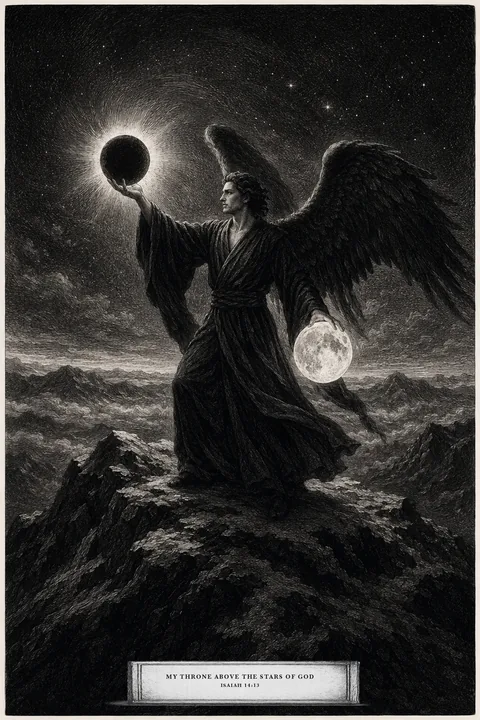
For thou hast said in thine heart, I will ascend into heaven, I will exalt my throne above the stars of God.
— Isaiah 14:13
Lucifer's Declared Plan
The plan was never announced. It was “said in thine heart,” where no creature could hear it; but the LORD is He who “declareth unto man what is his thought” (Amos 4:13). God read the counsel where it was conceived and commanded His people to take it up as a proverb against the king of Babylon (Isaiah 14:4). The conspirator kept his counsel; the Judge published it.
How art thou fallen from heaven, O Lucifer, son of the morning! how art thou cut down to the ground, which didst weaken the nations! For thou hast said in thine heart, I will ascend into heaven, I will exalt my throne above the stars of God: I will sit also upon the mount of the congregation, in the sides of the north: I will ascend above the heights of the clouds; I will be like the most High. Yet thou shalt be brought down to hell, to the sides of the pit.
The received reading is true: the rebel intends to make himself like the Most High. Nothing that follows asks that reading to yield its place. The question is whether it says all that the words say. It tells us his ambition, but leaves the strange precision of the boast unresolved. Why a mountain of assembly? Why the recesses of the north? Why do stars, high places, and a dark cloud carry an ambition usually reduced to an abstract wish to be God?
The consonants answer in stages: first their permitted senses, then the second reading beneath “throne,” then the double reading at the summit. Only after the words stand do the symbols enter.
First Hearing: The Darkness in the Words
The name opens with a contradiction. Helel is the shining one, yet the consonants under shachar serve both the noun dawn and the verb be black — the verb Job uses when “my skin is black upon me” (Job 30:30). Ben, son, names more than physical descent: the sons of Belial are characterized by worthlessness, and the children of light are characterized by light. The phrase is therefore heard twice: son of dawn and son — the product and bearer — of blackness.[1] He appears bright but produces darkness.
The same darkness gathers around his destination. The King James’ “mount of the congregation” is har moed. Moed does mean an assembly, but its full lexical field is appointed time, appointed place, and appointed meeting. The Torah refuses to separate those senses: “the appointed times (moedim) of the LORD” are the days Israel must “proclaim to be holy convocations” (Leviticus 23:2). Har moed is the mountain — the high place — of the appointed assembly.
The “sides of the north” are yarkete tsaphon. Yarkete means the farthest or innermost recesses: the hold of Jonah’s ship, the recess of David’s cave, and, in the sentence answering this boast, the recesses of the pit (Jonah 1:5; 1 Samuel 24:3; Isaiah 14:15). The points read the final word tsaphon, north; the same consonants read tsafun, hidden, concealed, treasured. Scripture uses that second form for Jerusalem, God’s treasured place, and for His saints, “thy hidden ones” (Ezekiel 7:22; Psalm 83:3). The phrase can therefore be heard as the innermost recesses of the hidden place.
The north reading remains true and supplies another witness. Psalm 48 uses Isaiah’s exact phrase for Zion: “mount Zion, in the recesses of the north, the city of the great King” (Psalm 48:2). The north is not an idle compass direction; it is the royal mountain of God’s presence. He seeks the hidden seat of the King and the appointed assembly gathered there. Hiddenness also keeps the darkness already present in the name: Job says “all darkness shall be hidden in his secret places,” using this same root (Job 20:26).
The next word makes the darkness visible. The “cloud” is av, a dark cloud or cloud-mass, and what he ascends upon is its bamah — its height or high place. The immediate vocabulary has now supplied a shining one who bears blackness, a mountain of appointed meeting, an innermost hidden place, and the high place of a dark cloud. No symbol has created that pattern; the words have.
How art thou fallen from heaven, shining one, son and bearer of blackness! For thou hast said in thine heart: I will ascend the heavens; I will raise my seat above the stars of God; I will sit in the high place of the appointed assembly, in the innermost recesses of the hidden place; I will ascend upon the high places of the dark cloud; I will make myself like the Highest.
The seat supplies the next hearing without yet importing a sun, calendar, or eclipse.
Second Hearing: The Full Moon and the Covered Seat
“I will exalt my throne.” The pointed word is kisse' — a throne, a royal seat, the place from which its owner rules. Strong’s traces it to covering: a covered or canopied seat. Strip the possessive ending from “my throne,” and the letters are כסא — the same letters that spell keseh, the full moon.
This is not a spelling assembled for Isaiah. Proverbs writes the full-moon word exactly that way, כסא: “he will come home at the full moon” (Proverbs 7:20, ASV). Psalm 81 uses its other biblical spelling, כסה, in the command to sound the trumpet “at the full moon, on our solemn feast day” (Psalm 81:3, NKJV). The throne has the same two spellings, כסא and כסה. Point the letters one way and the seat is a throne; point them another and the seat is the moon at fulness.
Job writes the throne with the second spelling and then covers its face:
He incloseth the face of his throne, and spreadeth his cloud upon it.
ASV
Read kisseh, and a throne is veiled by cloud. Read keseh, and the full moon’s face is veiled by cloud. The sentence survives either hearing, and the psalm of David removes any doubt that throne and luminary belong together:
His seed shall endure for ever, and his throne as the sun before me. It shall be established for ever as the moon, and as a faithful witness in heaven.
The throne is set as the sun and established as the moon before any wordplay is asked to carry the identification. The consonants then bind the throne specifically to lunar fulness. Isaiah’s “my throne” can therefore be heard as my covered seat and as my full-moon seat — a claimed place among the lights.
The surrounding words decide how his version is covered. The LORD “coverest thyself with light as with a garment” (Psalm 104:2); the faithful witness bears the whole face of the sun through the night. Lucifer is the son of blackness, operating from the hidden place beneath a dark cloud. He claims the throne of fulness and covers it in the opposite substance. His is not the faithful full moon shining from the Father’s light; it is the lunar seat covered in darkness.
I will raise my covered lunar seat above the stars of God; I will sit in the high place of the appointed assembly, in the innermost recesses of the hidden place.
Third Hearing: The Highest Light Silenced
Elyon is both an adjective and a title. As an adjective it means high, upper, uppermost; as a title it names God, the Most High. Isaiah has filled the sentence with the heavens, stars, a lunar seat, height, and cloud. Inside that field, the unnamed uppermost light is the sun — “the greater light to rule the day” (Genesis 1:16) — and the title and the symbol meet in one verse: “the LORD God is a sun” (Psalm 84:11). The Most High and the Highest Light are not rival referents. One is the Person; the other is His sign.
The verb before elyon is likewise heard twice. The consonants of edameh belong to two verbs kept side by side in the lexicon. The first means be like, resemble: “I will make myself like the Most High.” The second means cease, cause to cease, cut off, destroy — the verb Isaiah uses when Moab is “brought to silence” and Hosea when a mother is destroyed (Isaiah 15:1; Hosea 4:5).
The form is Hithpael, whose self-reference need not make the subject the thing silenced. The stem can describe an action done for oneself, in one’s own interest, while taking an external object; Biblical Hebrew can also mark an affected object with le, the letter lamed attached here to elyon.[2] The alternate hearing is therefore not I will silence myself but I will bring the Highest to silence for myself.
I will ascend upon the high places of the dark cloud; I will make myself like the Highest — I will bring the Highest to silence for myself.
heard twice
The readings are not rivals. The received reading states his ambition: make himself like the Most High. The second hearing adds the act by which he pursues it: bring the Highest Light to silence by taking its place. Together they disclose the whole: I will make myself like the Most High by taking His place, and I will bring the Highest Light to silence for myself by covering it.
The Symbols Take Their Places
The words have earned their readings; Scripture now supplies the identities.
The stars are the righteous: “they that turn many to righteousness” shine “as the stars for ever and ever” (Daniel 12:3). A mountain is a kingdom: Daniel’s stone becomes a great mountain filling the earth, and Daniel interprets it as the kingdom God establishes over every other kingdom (Daniel 2:35, 44). The mountain of the appointed assembly is therefore the kingdom of God’s covenant people gathered at His appointed times.
The moon governs when that assembly meets. The lights were given “for signs, and for seasons” — moedim — from the fourth day, and “he appointed the moon for seasons” (Genesis 1:14; Psalm 104:19). Leviticus joins the time to the people: the moedim are appointed days proclaimed as holy convocations. To seize the lunar throne is to seize the signal by which the stars of God assemble.
The hidden recess now joins both people and place. Psalm 48 locates the city of the great King in the yarkete tsaphon; Psalm 83 calls God’s people His tsafunim, His hidden ones. The rebel seeks the hidden royal seat of the appointed assembly, and he operates its lunar sign from the phase hidden from sight. The legitimate throne is the full moon, standing opposite the sun and carrying its whole face through the night. The counterfeit takes that office to the opposite station: the moon covered in darkness, beside the sun, reflecting nothing toward the earth. Isaiah pronounces woe upon precisely that exchange: “that put darkness for light, and light for darkness” (Isaiah 5:20).
One Place, Two Readings
Every verb in the boast moves through space: ascend; raise above; sit; enter the recesses; ascend upon the high places; reach the Highest. His throne is his seat — his claimed place of rule. To “make myself like the Highest” inside this spatial sequence is not merely to imitate God’s character; it is to put his seat where the sign of the Highest appears.
The sky performs the sentence exactly. A full moon stands opposite the sun and can never cover it. A moon covered in darkness stands on the sun’s side of the earth; when the three bodies align, its black disk enters the sun’s apparent position and covers the greater light. It does not become the sun, generate the sun’s light, or acquire the sun’s authority. It becomes like the sun by taking the sun’s visible place.
Taking that place produces the second reading. The heavens “declare the glory of God,” and day pours forth speech from the tabernacle and circuit of the sun (Psalm 19:1-6). Cover the sun and its visible testimony ceases; the counterfeit has brought the Highest Light to silence for itself. Its likeness is substitution, and its substitution is suppression.
This is how Satan can appear as “an angel of light” while producing darkness (2 Corinthians 11:14). He does not create a greater light. He raises a dark form into the light’s position and depends upon the light he covers for every appearance of greatness. The received reading names the usurpation; the second reading names the silencing by which it is attempted.
How art thou fallen from heaven, shining one, son of darkness! For thou hast said in thine heart: I will ascend the heavens; I will raise my covered lunar throne above the righteous of God; I will sit in the kingdom of the appointed assembly, in the innermost hidden place; I will ascend beneath the dark covering; I will make myself like the Highest by taking His place, and bring the Highest Light to silence for myself.
The Appointed Times Corrupted
The eclipse explains why the plan passes through har moed: the moon marks the appointed meetings, and the stars are the people who keep them. Raise the wrong moon above the stars and the people still count and assemble — but at the counterfeit’s signal, a light that reflects nothing.
Daniel names the same agenda without the celestial figure. The enemy “shall wear out the saints of the most High, and think to change times and laws” (Daniel 7:25). The saints and the times are attacked in one sentence because the times govern the saints’ assembly. Isaiah gives the plan; Daniel gives its historical work: change the signal, change the assembly, and weaken the nations without requiring them to know whose calendar they follow.
The phase matters. Begin the month with the full moon and the month’s middle approaches the hidden conjunction; begin it with the hidden conjunction and the month’s middle approaches the full moon. The two reckonings invert the lights. Only the covered conjunction can stand in the sun’s apparent place and produce the sign Isaiah describes. The counterfeit claims the full-moon throne while moving its rule to the phase that can cover the sun.
God answers the ambition in the rebel’s own word. He sought the yarkete of the hidden royal place; the judgment brings him down to the yarkete of the pit (Isaiah 14:15). He asked for the highest recess and received the lowest.
The Sun Failed at Noon
The Prophets had already joined the sign to an appointed feast and an only son:
And it shall come to pass in that day, saith the Lord GOD, that I will cause the sun to go down at noon, and I will darken the earth in the clear day: And I will turn your feasts into mourning, and all your songs into lamentation… and I will make it as the mourning of an only son, and the end thereof as a bitter day.
The prophecy binds the pieces before the Gospels arrive: the sun fails at noon, an appointed feast becomes mourning, and the grief is the grief of an only son. At the Passover cross, “from the sixth hour there was darkness over all the land unto the ninth hour” (Matthew 27:45). Luke records the same sign in the vocabulary of cessation:
And it was now about the sixth hour, and a darkness came over the whole land until the ninth hour, the sun’s light failing: and the veil of the temple was rent in the midst.
ASV
The sun failed, and the covering of the sanctuary was torn. The sign lasted far beyond ordinary totality; Scripture does not reduce it to a natural eclipse. It uses the eclipse’s exact act: at the feast of the only Son, the greater light was covered at noon and its speech ceased over the land.
God had read the rebel’s plan first and turned its image into testimony at the cross. The darkness could not hold the Light; what looked like silencing became the heavens' loudest declaration.
The two readings of Isaiah therefore stand together. “I will make myself like the Most High” is the ambition to take His place. “I will bring the Highest to silence for myself” is the means: the covered lunar seat raised into the sun’s position. The stars, the appointed assembly, the hidden recess, the dark cloud, the Highest, and the answering recess of the pit all belong to that one act.
The counterfeit is precise because the original is precious. The moon still marks the LORD’s appointments, the full witness still bears the Father’s light, and the next question is the price of recognizing that witness when it appears as one complete pearl in the night.