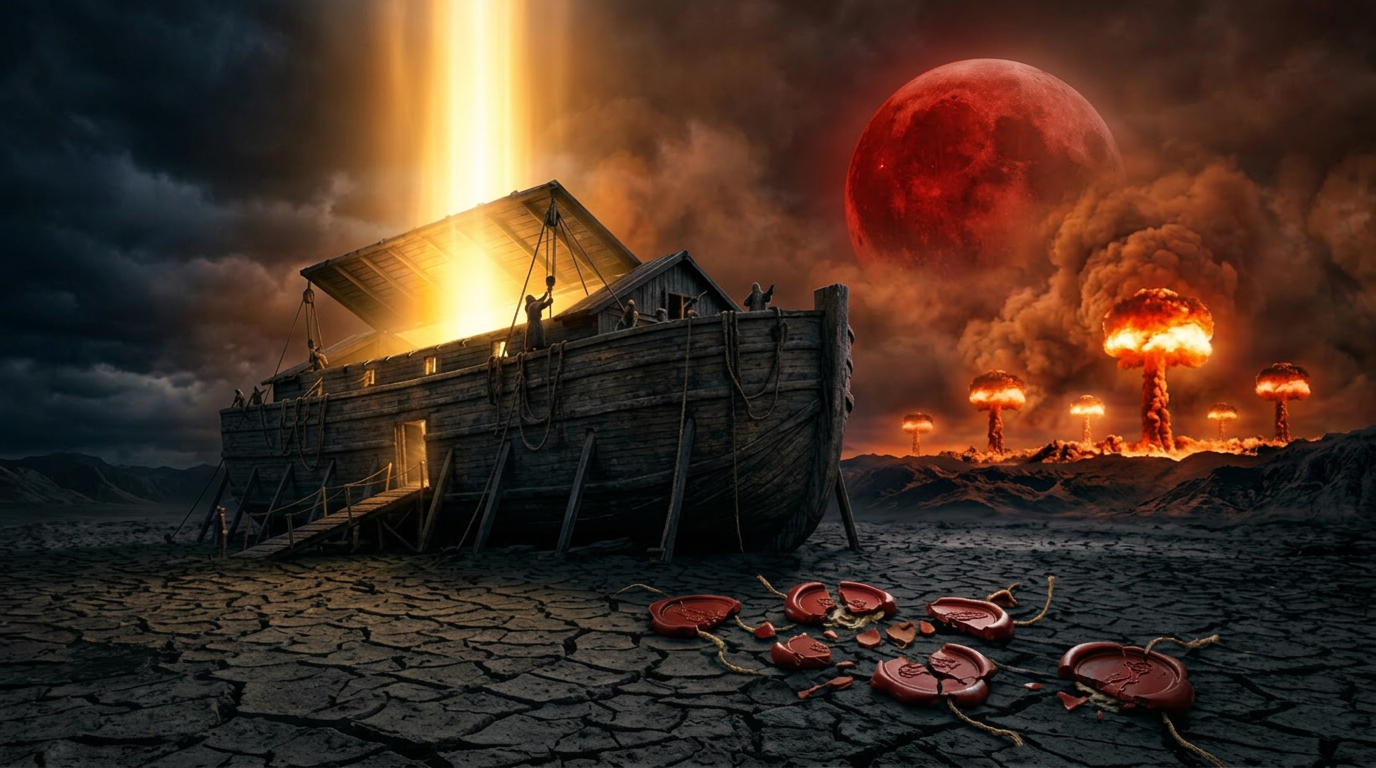
Don't Be a Fool Next Full Moon — This Is No Joke
The cup is almost full. Every timeline ends at the same dawn.
The blood moon fell on Adar 1 — March 3, 2026 — exactly as positioned. The war with Iran started. Fifteen countries were attacked. The convergence of timelines was real. The sign appeared in the sky exactly where it was expected.
Nothing visible happened.
This is the third miss in a row. The 10th month full moon had Hanukkah connections and days-of-Noah parallels. The 11th had Joshua's long day and full-moon geometry. The 12th had an actual blood moon on the exact date of Ezekiel 32's prophecy. Each case looked strong. Each was wrong.
But the underlying framework was never about a single full moon. Seven independent timelines — from different books, different centuries, different methods — converge on this year (Summer Is Near):
Gen 6:3
~1876 BC • Dan 9:24
1406 BC • 70×49+1
598 BC • Dan 12:11
33 AD • 2 Pet 3:8
~1536 AD • Dan 9:25
1948 • bride at 77
The year was identified by convergence. The specific day was identified by process of elimination — four full moons in the winter window, tested one at a time. Three eliminated. One remaining. But the three misses were not wasted — each one exposed a constraint that had been overlooked or misapplied. Two corrections emerged from the process, and both point to the final full moon rather than vaguely past it.
One of the most surprising findings of my recent study is a parallel reading of the Days of Noah that directly connects the coming Fool Moon (pun intended) with the sixth seal at the end of the age. I am going to share the reading up front to give you a hint of where this is going — but first I need to address the corrections on past understandings.
Genesis 8:13 says Noah removed the covering of the ark on the first day of the first month — Nisan 1. That is the standard reading. The same consonantal text could produce the following understanding:
[Brackets] indicate words inserted for readability. Hover or tap any dotted-underlined phrase for its derivation.
Once you see the evidence — every word justified from the Hebrew lexicon and confirmed by other Scripture — it is hard to unsee. Everything is pointing to the coming full moon. So hold tight — this is going to be a big post.
The Over-Constraint — The Blood Moon Was Before, Not On
The word translated "before" is liphnei (H6440) — literally "to the face of." It carries two valid readings: temporally prior ("before the day comes") or spatially facing ("in the presence of the day"). If temporal, the blood moon is a precursor sign and the great day follows later. If spatial, the blood moon and the great day are simultaneous — the sign and the event are one moment.
Previous posts had already argued that no literal blood moon eclipse was required — the smoke and fire of Joel 2:30 could produce the blood-red moon atmospherically, without any eclipse at all. What was missed was not the reading of "before" but the date. The full moon of Adar 29 — the last night before Nisan 1 — sits right at the boundary where the Jubilee year ends and the new year begins. It was so close to the edge of the window that I associated it with being outside it. Only after time tested the prior assumptions — three full moons eliminated in a row — was I forced to look closer at the one I had dismissed.
Both readings of "before" are true simultaneously. The verse immediately before Joel 2:31 names what produces the darkened sun and blood moon:
Pillars of smoke. Fire. Blood. These are not eclipse phenomena — they are the effects of destruction. And Ezekiel names the mechanism explicitly:
The sun covered with a cloud. The moon not giving light. Stars darkened. This is not an eclipse — it is atmospheric: the smoke and debris of judgment literally blocking the sky. The same effect that wildfire smoke produces when it turns the moon blood-red and blots out the sun. The "pillars of smoke" of Joel 2:30 are the cause; the darkened sun and blood moon of Joel 2:31 are the effect.
This means Joel does not require choosing between the temporal and spatial readings. Both are true at once. The astronomical blood moon on Adar 1 was the sign sequentially before the great day — the eclipse fulfillment. And on the day itself, the pillars of smoke from destruction literally darken the sun and turn the moon to blood — the cloud fulfillment. The eclipse was the announcement. The smoke is the arrival.
Total lunar eclipses are not rare — they occur roughly every 18 months on average. The next one falls on December 31, 2028. What makes the March 3 blood moon significant is not the eclipse itself but two factors: its convergence with Adar 1 of the 70th Jubilee year — the date Ezekiel 32 names for the sun and moon going dark, Moses' death, and the start of the plagues — and the sequence that preceded it.
Joel 2:31 names an order: the sun turned to darkness, then the moon to blood. On February 17, 2026, an annular solar eclipse darkened the sun. Fourteen days later, on March 3, the total lunar eclipse turned the full moon to blood. Sun dark, then moon blood — Joel's sequence, in order, two weeks apart.
This pairing — a significant (annular or total) solar eclipse followed by a total lunar eclipse within the same eclipse season — is not common. Searching NASA eclipse data back through the 21st century, only four such pairings occur between 2001 and 2033:
| Year | Solar Eclipse | Lunar Eclipse | Gap |
|---|---|---|---|
| 2008 | Feb 7 (Annular) | Feb 21 (Total) | 14 days |
| 2015 | Mar 20 (Total) | Apr 4 (Total) | 15 days |
| 2026 | Feb 17 (Annular) | Mar 3 (Total) | 14 days |
| 2033 | Mar 30 (Total) | Apr 14 (Total) | 15 days |
The previous Joel-order pair was in 2015 — eleven years earlier. The next one after 2026 falls in 2033 — seven years later. Both the 2026 and 2033 pairs fall in March, seven years and one lunar month apart:
- February/March 2026 — Annular solar, then total lunar. The sign before the great day.
- March/April 2033 — Total solar, then total lunar. Passover 33 AD + 2,000 years.
- Between them — zero Joel-order matches with significant solar eclipses. The sign goes silent for exactly the duration of the tribulation, then reappears at the end.
If "before" is temporal, then the 2026 pair is the opening sign and the 2033 pair marks the arrival. If the tribulation is seven years, the sky itself brackets it: Joel's sign at the beginning, Joel's sign at the end, silence in between.
The Missed Constraint — The Jubilee Harvest Ban
No reaping during the Jubilee year. The $[harvest] ban is on the act of cutting the grain — the sickle cannot touch the standing crop.
The firstfruits wave sheaf — which previous posts established as the type for the rapture (Peace and Safety, Last Call before the Fall) — is a harvest act. It requires reaping. And the Jubilee forbids reaping.
If the Jubilee year runs spring to spring — years being counted from Nisan (Exodus 12:2) — then the harvest ban runs through the end of Adar. The sickle could not touch the grain on Adar 1. The firstfruits could not be harvested while the Jubilee was still in effect.
The date was missed. In honesty, I was aware of the Jubilee harvest ban before Adar 1 — and ignored it. The convergence on the blood moon felt strong enough to override it. That is cognitive bias: letting the weight of accumulated connections overrule a clear textual constraint. The constraint was there. I chose not to let it disqualify the date I wanted.
Note the distinction: the Jubilee bans reaping (Lev 25:11). The firstfruits law bans consumption until the wave sheaf is offered (Lev 23:14). Two constraints, two release points. The Jubilee ban lifts first — at the turn of the year. Then the firstfruits can be cut, offered, and consumed.
Why Not Later? — The Cup Must Be Full
If the harvest ban prevented reaping during the Jubilee, what prevents the date from sliding past Nisan 1? Why not next month, next year? The answer is in the Hebrew word behind "accomplished" in Jeremiah 25:12 — and in the grid that locks the Jubilee to a single year.
The word translated "accomplished" is male' (H4390) — "to fill." Not approximately. Not "in the general timeframe." Filled — as in a cup filled to the brim. Every time Scripture uses this word with a time period, the action triggers at the exact moment the period is complete:
Jacob demands his wife the day his seven years of labor are complete. Not early, not late. The days are filled.
The same pattern holds everywhere the word appears with a time period: Rebecca delivers the day her pregnancy is filled (Gen 25:24). The plague ends the day the seven days are filled (Ex 7:25). The Nazarite comes to the tabernacle the day his separation is filled (Num 6:13). The priestly consecration ends and ministry begins the day the seven days are filled (Lev 8:33). David's life ends and his seed is raised up when his days are filled (2 Sam 7:12). It is a precision word. The cup is full. The action fires.
And the Chronicler uses this same word for Jeremiah's seventy years explicitly:
Same word. Same construction. The seventy must be filled — not overflowed, not half-full. And the sequence in Jeremiah 25 is precise: verse 11 says the nations serve Babylon for seventy; verse 12 says when the seventy are filled, then Babylon is punished; verse 13 says then everything written in this book is brought upon the land. The fall of Babylon and all that follows — including every prophecy Jeremiah spoke — are triggered at the completion, not before it and not after it.
This means we are not yet there. The 70th Jubilee is still running. The cup is not yet full. But the cup has a fixed size — and the Jubilee grid prevents it from being any larger.
The Grid Cannot Slide
The Jubilee count begins when Israel enters the land — the only place Scripture commands it (Lev 25:2). From the Jordan crossing in 1406 BC: 70 × 49 + 1 (the Jubilee year itself) = 3,431 years, landing at 2025/2026. This is not a window — it is a grid point. The next Jubilee is not 2027. It is 2075 — a full 49-year jump. And 2075 breaks every independent convergence: the two days from the cross (32 AD + 2,000 − 7 = Nisan 1, 2026), the 490 years from Suleiman's decree (~1536 + 490 = ~2026), and every other timeline that converges on this year.
Even if all anchor dates were wrong and the entire chronology needed to slide, the Sabbatical cycle — historically attested and fixed at seven-year intervals — forces any shift to be a multiple of seven. And within the 49-year Jubilee grid, only a full 49-year jump lands on another Jubilee. The date cannot slide by a month or a year. It is locked.
The Cup Was Not Yet Full
This is the honest explanation for the three prior misses. The framework was not wrong. The cup was not yet full. The 10th month, the 11th month, the 12th month — each full moon was a moment when the longing for His return overwhelmed the precision of the word. The harvest ban was saying not yet in agricultural language. The word "filled" was saying not yet in cup language. The constraints were always there. The longing overrode them.
Adar 29 is not the next guess. It is the first date where the cup is full — where the Jubilee ends, the 70 reach the brim, the harvest ban lifts, and the sickle is permitted. The prior misses each exposed a constraint that was being violated: the harvest ban, the temporal reading of "before," the Nisan 1 pattern. Those constraints did not weaken the case. They refined it — pointing past the filling to the moment the cup is complete.
The Days of Noah — Genesis 8:13
Jesus told us explicitly what to watch for:
The previous case for Adar 1 lacked a strong connection to the Noah timeline. At best, it fell seven days after the dove was sent and did not return — a loose fit. Nisan 1 has a direct, explicitly dated connection — and the Hebrew consonantal text of that verse, read with different vowel assumptions than the Masoretes chose, says far more than the English translation reveals.
Noah removes the covering from the ark on the first day of the first month — Nisan 1. The night before Nisan 1 is the night of Adar 29 — the last full moon. That is the standard reading. The same consonantal text could produce the following understanding:
That reading is arrived at through three steps, each justified word-by-word in the sections that follow:
- Step 1 — Parallel vowels or senses. Hebrew consonants often support multiple words depending on the assumed vowels. Where the same consonants map to more than one attested root in the lexicon, both readings are simultaneously legitimate.
- Step 2 — Scriptural typology. Some words function as types elsewhere in Scripture — Noah is defined as "righteous in all his generations" (Gen 6:9); waters represent "peoples, multitudes, nations" (Rev 17:15). These identifications come from Scripture itself, not from the reader.
- Step 3 — Translation. Hebrew-to-English is rarely word-for-word. The result is expressed as a coherent English sentence, with each word's derivation shown below.
The test for validity: every word in the prophetic reading must be a real Hebrew root (an attested Strong's number), the grammar must hold, and — most importantly — the resulting reading must not contradict other Scripture. If it contradicts Scripture or produces nonsense, it fails. If it produces themes independently attested across multiple books, the pattern is in the text.
באחת ושש מאות שנה — The Date Itself
The date phrase reads באחת ושש מאות שנה — "in the one and six hundreds year." The word order is unusual: אחת (echad — one, unity, first) is fronted before "six hundreds." In Hebrew, fronting a word signals emphasis. Compare Genesis 7:6, which says Noah was "six hundred years old" with the standard order: שש מאות שנה. Genesis 8:13 breaks the pattern by placing the one first.
The emphasis is the signal. Read the remaining words with parallel vowel assumptions:
| Word | Narrative Reading | Prophetic Reading |
|---|---|---|
| באחת | "in the one" (first) (H259) | "in the unity" — echad, the Shema word (Deut 6:4). Unity implies wholeness — nothing missing, nothing divided. Rendered as "completeness" because what is fully unified is complete. |
| ושש | "and six" (H8337) | "and six" — unchanged in both readings. The prefix ו means "and." The English "of six" rearranges the word order; the "of" comes from the מ prefix on the next word. |
| מאות | "hundreds" (H3967) | מ + אות = "of signs" (H226 ot — sign, token, covenant mark) |
| שנה | "year" (H8141) | H8138 shanah — root meaning "to change, turn, repeat." A year is "a revolution of time" — a turning, an era. Since שנה follows מאות without a conjunction, the construct chain reads naturally: "signs of the age." The disciples asked the same question: "What shall be the sign of thy coming, and of the completion of the age?" (Matthew 24:3). Also rendered "signs of the times" (Matthew 16:3) or "the year of my redeemed is come" (Isaiah 63:4). |
Narrative: "In the 601st year." Prophetic: "At the completeness of six signs (seals) of the age." Compare: "Can ye not discern the signs of the times?" (Matthew 16:3).
And in Scripture, a sign (H226) IS a seal. Paul states it directly:
The sign IS the seal. Every sign in Torah functions as a protective seal: the blood on the doorposts was a sign that sealed the household from the destroyer (Exodus 12:13). Circumcision was a sign of the covenant that Paul calls a seal (Romans 4:11). The Sabbath is a sign between God and His people (Exodus 31:13). God set a sign on Cain to seal him from being killed (Genesis 4:15). The words are functionally interchangeable by apostolic authority. Six signs = six seals.
The sixth seal of Revelation contains every element of this verse:
| Sixth Seal (Rev 6:12-17) | Genesis 8:13 Prophetic Reading |
|---|---|
| Sun black, moon blood | Feb 17 solar eclipse + March 3 blood moon |
| "Hide us from the face of him on the throne 🌕" | The face of the earth laid bare; the covering (full moon) removed |
| The peoples cry out in terror | The peoples (waters) desolated and laid waste from above the earth |
| "Who shall be able to stand?" | The righteous appeared — they stood |
Now the word-by-word derivation, following the order of the verse:
חרבו — Dried Up AND Sword
The word for "dried up" is חרבו (charevu, H2717). The consonantal root חרב carries a second meaning: חרב (cherev, H2719) = sword. The waters were desolated — laid waste by the sword — from the earth. And what are waters? "The waters which thou sawest... are peoples, and multitudes, and nations, and tongues" (Revelation 17:15). The peoples were desolated and laid waste from upon the earth. This word appears twice in the verse.
נח — The Righteous of All Generations
Noah's name (H5146) means rest, from H5117 nuach. Scripture defines him as "a just man and perfect in his generations" (Genesis 6:9). Three details matter here:
First, the word translated "generations" (H1755 dor) does not primarily mean "a group of people born at the same time." Its root (H1752 dur) means "to move in a circle, to remain." Strong's defines dor as "properly, a revolution of time, i.e. an age or generation." It is a cycle word — an age, an era, a turning. And the lexicon documents a third sense: a class of people defined by moral quality — "the righteous dor" or "the wicked dor" — a moral type that transcends any single time period.
Second, the prefix ב carries a range: in/among/throughout/for — not just "in."
Third, the word is plural: דרתיו ("his dorot"), not the singular דורו ("his dor"). If Moses meant "righteous in his single era," the singular would be natural. In Hebrew, plurals don't simply mean "two or more" — they can indicate fullness, extent, or totality (as in שמים "heavens," חיים "life," פנים "face" — all grammatically plural for concepts that are singular but complete in scope).
And the word translated "perfect" — tamim (H8549) — means complete, whole, entire. Its root (H8552) means "to complete, come to the full, make an end." The lexicon documents a specific sense: "complete in time — full, unbroken periods of time; complete days, years, or sabbatical cycles" (e.g., Lev 25:30, a "full year" in the Jubilee context). It is also the word for an unblemished sacrifice — the Passover lamb must be tamim (Ex 12:5).
So the phrase is: righteous and complete (tamim) throughout (ב) his ages/cycles (dorot, plural). The word "all" is no longer inserted — it is attested by tamim, which means the full, unbroken, entire extent. Put it together in stages:
- Stage 1 — Standard: "Noah was a just man and perfect in his generations" — a righteous man in his era.
- Stage 2 — Roots + plural: "Righteous and complete throughout his ages/cycles" — tamim (complete, whole, full in time) + plural dorot (revolutions of time) + the full range of ב. The completeness of tamim applied to the plural of a cycle-word = the full, unbroken extent of every age.
- Stage 3 — Name substitution: Noah = nuach (H5117) = rest. The same root used for the Sabbath: "that thy manservant may rest (nuach)" (Deut 5:14). So "his ages" = Rest's ages — the cycles that belong to the Sabbath rest. "There remaineth therefore a rest to the people of God" (Hebrews 4:9).
Each stage is justified: the preposition and plural are in the text; tamim means complete/whole/full-in-time per the lexicon; the root of dor means revolution/cycle; the name meaning is in Genesis 5:29.
Now notice what connects: the date phrase says "completeness and six of signs of time/age/cycle" — six ages completing. And the subject is "the righteous complete throughout Rest's ages." The six and the rest are in the same verse. Six ages of labor, then the Sabbath — "one day is as a thousand years" (2 Peter 3:8), six thousand years of striving, then the seventh millennium of rest. The righteous who are complete throughout all six ages take up the covering at the moment the sixth age ends and the rest begins. When the verse says "Noah took up the covering," the type says: the righteous of the Sabbath's ages — the faithful across all six turnings — took up the covering at the turn of the seventh.
ויסר — Removed OR Took Up
The verb ויסר (vayyasar, Hiphil of H5493 sur) means "to remove, take away, carry off." In the literal reading, Noah takes the covering off the ark. But "took" carries a second direction: Noah took up the covering — received it, bore it. Same subject, same verb, same object. Two directions of "took."
מכסה — The Covering IS the Keseh
The word for "covering" is מכסה (mikhseh, H4372). Its root is כסה (kasah, H3680) — "to cover, to fill up." This is the same root that produces כסא (keseh, H3677 = full moon) and כסא (kissé, H3678 = throne). With different vowels, the same consonants מכסה read either as "covering" or as מ (from) + כסה (the keseh). The covering of the ark, the full moon, and the throne all flow from one root. Noah removed the keseh. And "removed the full moon" encodes the timing: the full moon of Adar 29 has passed, the covering is gone, and Nisan 1 — the first day after the full moon — has begun. The verb tells you when it happens.
התבה — The Vessel AND The Covenant
The word התבה (hattevah, H8392) is used only for Noah's ark and Moses' basket — both vessels that preserve life through judgment and water. In English, "ark" is the same word used for the Ark of the Covenant (H727 aron). Both are covered vessels that carry the covenant through destruction. Both are sealed with atonement (כפר). The ark of the covenant held the tablets, the manna, and Aaron's rod — the terms and provisions of the covenant. The "covering of the ark" is the "covering of the covenant."
וירא — He Revered
The consonants וירא carry three valid readings depending on the assumed vowels: "and he saw" (Qal of ראה, H7200), "and he revered" (from ירא, H3372), or "and he appeared" (Niphal of ראה). Every encounter between the righteous and divine glory in Scripture produces the same reaction — not terror, but overwhelming awe: Isaiah fell undone (Isaiah 6:5), Ezekiel fell on his face (Ezekiel 1:28), John fell at His feet as dead (Revelation 1:17). The righteous revere. The wicked cry "hide us from the face" (Revelation 6:16). Same face (פני). Opposite reactions.
פני האדמה — The Face of the Earth
The "face of the ground" is פני האדמה (penei ha'adamah). The word פני (penei) means "face," "presence," and "surface." The word אדמה (H127) means not just "ground" but the inhabited, cultivated earth — from the same root as אדם (adam, H120) — mankind. The connection to humanity is built into the word itself. "The face of the earth was desolated" carries the full weight without substitution.
The connection between face and $[nakedness] runs through the same chapter. One chapter after Noah removes the covering, his $[nakedness] is exposed — and his sons cover it (כסו, from the same root כסה) while turning their faces backward (Genesis 9:23). When the covering is removed, what was hidden is laid bare. The righteous keep their garments. The wicked are exposed:
The Sixth Seal and the Last Trump
Then what follows the sixth seal? Revelation 7 — the 144,000 sealed, the great multitude appears in white robes (שש = white linen). And the seventh seal: silence in heaven (Revelation 8:1).
"At the last (G2078 eschatos) trump (G4536 salpinx)" (1 Corinthians 15:52). The word Jubilee (יובל, yobel, H3104) literally means ram's horn — the Jubilee is named after the trumpet. Paul's Greek word for "trumpet" is generic, so the Jubilee connection requires an inference. But the Greek word does not only mean "last in a sequence." It means extremity, uttermost end, boundary — as in "the uttermost part (ἔσχατος) of the earth" (Acts 1:8). If "trumpet" = the Jubilee (since the Jubilee IS a trumpet), then "at the last of the trumpet" = at the extremity of the Jubilee — the uttermost end of the Jubilee year. Adar 29 is the last day of the year, the last day of the Jubilee, the last day of the month, the last day of the week (Sabbath), and the last full moon before Nisan 1. Every sense of "last" converges on a single day. And Jesus used this same word four times for the resurrection:
Four times. Same word. "I will raise him up at the last day." And Martha — in the Lazarus narrative itself — confirms the understanding: "I know that he shall rise again in the resurrection at the last day" (John 11:24). The last day. The last trump. The extremity of the Jubilee. The resurrection at the last.
The Sinai prototype confirms the pattern. At the mountain, the specific word used for the trumpet is yobel — not shofar — and the command is: "when the yobel soundeth long, they shall come up to the mount" (Exodus 19:13). The verb translated "soundeth long" is משך (mashak, H4900) — "to draw out, prolong, extend, reach full extent." When the yobel mashak — when the Jubilee reaches its full extent — they shall come up.
The same word also means "to draw [a person]" — to pull toward: "I drew (mashak) them with cords of a man, with bands of love" (Hosea 11:4). Now read John 6:44 — the same verse that promises resurrection at the last day:
The Father draws him. Then raises him at the last day. Both concepts in one verse. And in Exodus 19:13, the same two concepts in one verse: when the Jubilee is drawn out to its end, they shall come up.
The same consonants carry both readings. The Masoretic vowel points — added roughly 600-900 AD — select one reading, but the original consonantal text supports both equally. This is the same principle established for the throne/full moon word: with different vowels, the same consonants read as either throne or full moon. Here, the same verse describes both the literal opening of the ark and the completion of the sixth seal of the change of the age — the righteous taken up with the covenant-covering and appearing in glory, the peoples desolated and laid waste from above, the face of the earth desolated. On the first of the new year. At the last trump of the last Jubilee.
The Ark as Temple — The Covering's Purpose
The word for "pitch" is כפר (kaphar, H3722) — "to cover, to atone." The noun form כפר (kopher, H3724) means "covering, ransom price." And the covering on the ark of the covenant inside the temple? כפרת (kapporeth, H3727) — the mercy seat. Same root. The ark is literally atoned inside and out. It is the mercy seat writ large — an atonement-vessel.
The covering protected the animals inside — representatives of every kind, every nation — during the judgment. The waters (peoples) raged outside. The covering held. When the covering was removed, the ones inside were exposed — no longer hidden, no longer sealed away. The nations preserved through judgment were revealed to the renewed world. And those outside? They cry for the opposite:
Hide us from the face of him who sits on the throne 🌕 — the same consonants read as both throne and full moon. The righteous were hidden under the covering and are revealed with Him. The unrighteous beg to be hidden from Him and cannot be.
Hidden now. Covered. When He appears — covering removed — they appear with Him.
The covering over all nations removed. Death swallowed. Faces revealed. Same pattern as Genesis 8:13 — covering removed, waters gone, the face of the earth desolated.
Nisan 1 — The Date Everything Begins
If the full moon on the night of Adar 29 is the last keseh, then Nisan 1 is the morning after — the first day of the new year. Every explicitly dated Nisan 1 event in Scripture carries the same theme:
| Event | Theme | Source |
|---|---|---|
| Noah removes covering from ark | Temple/ark unveiled, new world revealed | Genesis 8:13 |
| Tabernacle erected | God's dwelling established among His people | Exodus 40:2, 17 |
| Priests consecrated — 7 days | Royal priesthood set apart, ministry begins on the 8th day | Lev 8:33-35, Lev 9:1 |
| Yeshua likely baptized | Anointed, then sent into the wilderness 40 days before temptation on Iyyar 10 | Matt 3:16, Matt 4:1-2 |
| Foreign wives divorced | Separation from Babylon complete | Ezra 10:17 |
| Hezekiah cleanses temple | Defiled temple restored | 2 Chronicles 29:17 |
| Ezekiel's temple cleansed | Eschatological temple purified | Ezekiel 45:18 |
| Ezra departs Babylon | 5-month journey to restore Jerusalem | Ezra 7:9 |
| Moses' mourning turned to joy | 30 days of Adar mourning end, new era begins | Deut 34:8, Josh 1:1 |
Every Nisan 1 event is the same act in different clothing: the temple established, revealed, or cleansed; separation from the foreign system completed; or mourning turned to joy.
Ezra's 5-month journey from Babylon to Jerusalem — Nisan 1 to Ab 1 (Ezra 7:9) — parallels the five months of Revelation 9:5, 10. Same duration. One is the departure from Babylon to restore Jerusalem. The other is the period of judgment.
The Lazarus Window
Yeshua raised Lazarus from the dead in John 11. The text contains two temporal markers that constrain the date.
Marker 1 — "Are There Not Twelve Hours in the Day?"
At the spring equinox (~March 20), day and night are exactly equal — twelve hours each. Earlier in winter, when Yeshua was beyond Jordan after Hanukkah (John 10:22), daylight in Israel is roughly ten hours. By late Adar it is twelve. Yeshua names the number as a fact of the present moment — an equinox-season timestamp embedded in the dialogue.
Marker 2 — "Six Days before the Passover"
Six days before Passover (Nisan 14), counting inclusively: Nisan 14, 13, 12, 11, 10, 9. Yeshua returns to Bethany on Nisan 9.
The Minimum Timeline
Between the raising of Lazarus (John 11:44) and the return to Bethany (John 12:1), the text records: news reaching the Pharisees (John 11:45-46), the Sanhedrin meeting (John 11:47-53), Yeshua withdrawing to Ephraim (John 11:54), and "continuing" there with His disciples (John 11:54 — the Greek implies a stay, not a stopover). The raising falls in a window between the equinox and the first week of Nisan.
Adar 29 sits inside that window. The text does not pin the date with precision — but it is consistent with it. The chronology opens the door. The convergences walk through it.
Three Calendars, One Day
April 1, 2026 falls on three calendars simultaneously:
| Calendar | Date | Meaning |
|---|---|---|
| Biblical (full-moon) | Adar 29 | Last full moon. Last Sabbath. Last day of Jubilee. |
| Rabbinic (calculated) | Nisan 14 — Passover | The feast turned to mourning. |
| Secular | April Fools Day | The day named for mockery. |
One leading theory for the origin of April Fools Day: when France adopted the Gregorian calendar in 1582, New Year's Day moved from late March to January 1. Those who continued celebrating the old new year around April 1 were mocked as "April fools." The day is literally about who kept the old calendar versus who adopted the new one.
All Constraints Converge
With the over-constraint removed, the missed constraint accounted for, the days of Noah anchored to Nisan 1, and every line of evidence presented — every remaining timeline points to the same date: Adar 29 — the last day of the twelfth month. April 1, 2026.
- Last full moon. The blood moon on March 3 (Adar 1) + 29.5 days = April 1. The last full moon of the twelfth month. The last full moon of the 70th Jubilee.
- "Summer is near" expires. Adar is the last month. Nisan 1 begins the new year — the harvest season. Adar 29 is the final day the fig tree parable holds: "know that summer is near" (Matthew 24:32). After Nisan 1: "The $[harvest] is past, the summer is ended, and we are not saved" (Jeremiah 8:20).
- Jubilee ban lifts. The harvest becomes legal at the turn of the year. The firstfruits can be reaped.
- 490 years exhausted. Suleiman's decree to rebuild Jerusalem (~1536 AD) + 490 years = Spring 2026. No extension possible.
- Two days from the cross. The cross was 32 AD. The first full year of absence begins Nisan 1, 33 AD. Two thousand years later = Nisan 1, 2033. Minus 7 years = Nisan 1, 2026. Hard stop.
- Joel's sign bracketing the tribulation. The 2026 and 2033 Joel-order eclipse pairs bookend seven years — the sign appears, goes silent, and reappears at the end.
- Full moon return. Thirty-one verses require or imply a full moon for His return (Blood Moon over the Moon City).
- Days of Noah. Noah removed the covering from the ark on the first day of the first month — Nisan 1. The night of Adar 29 is the last full moon before that morning.
- Nisan 1 pattern. Every Nisan 1 event in Scripture is a temple established, a separation completed, or mourning turned to joy.
- Three calendars. Biblical: last Sabbath, last full moon. Rabbinic: Passover — feast turned to mourning. Secular: April Fools — the day named for mockery.
- Sabbath. Adar 29 = the 4th Sabbath of the month. Healing on the Sabbath. Raising the dead on the day of rest.
The Precision — Dawn of the Last Day
The full moon over Jerusalem on the night of April 1-2, 2026 peaks at 5:12 AM Israel time. Here is what surrounds that moment, computed from Swiss Ephemeris astronomical data for Jerusalem's coordinates (view on the calendar):
| Event | Time (Jerusalem) | Sun Altitude |
|---|---|---|
| End of total darkness (astronomical twilight) | 5:04 AM | -18° |
| Full moon peak | 5:12 AM | -15° |
| Nautical twilight (horizon visible) | 5:33 AM | -12° |
| Civil twilight | 6:02 AM | -6° |
| Sunrise | 6:26 AM | 0° |
The full moon peaks 8 minutes after total darkness ends and 21 minutes before the horizon becomes visible — squarely in the transition from night to day. The covering reaches its absolute fullness during the dawn, as the old age gives way to the new.
But here is what makes this extraordinary. The full moon peak is a global event — it happens at the same UTC instant everywhere on Earth. What shifts with location is the local time of dawn. Each degree of longitude moves dawn by 4 minutes. So the question becomes: where on Earth does the full moon peak at the exact moment darkness ends?
The answer: ~2 degrees west of Jerusalem — roughly the longitude of Gaza and Beersheba. The western boundary of the promised land. At that longitude, the full moon reaches peak fullness at the precise instant astronomical twilight begins — the covering is full at the exact moment the first light of the new day appears. Move east to the Jordan Valley and the full moon peaks deeper into twilight. Move west to Egypt and it peaks in full darkness. The exact alignment — full moon peak at the boundary between night and day — falls within the borders of the land of Israel.
The full moon can peak at any of the 1,440 minutes in a day. The chance of it falling during the ~30-minute dawn transition over the promised land is roughly 1 in 48. And this is not any random full moon. It is the last full moon of the 70th Jubilee, in the year where seven independent timelines converge, over the land where the covenant was made. The convergence operates at four levels: the year (seven timelines), the day (Jubilee grid + harvest ban), the hour (midnight to dawn — the thief-in-the-night window), and the location (the exact alignment falls within the promised land).
This is what "accomplished" means in the Hebrew. Not approximately. Not in the general timeframe. Filled — and the action fires at the dawn of the new day, over the land of the covenant.
This alignment also independently confirms the conclusion reached in my book Time Tested — that the biblical day begins at dawn, not at sunset or midnight. The full moon peak falls at the dawn boundary only if the day starts at first light. If the day started at sunset, the full moon would peak 10 hours into the day — nowhere near a boundary. The astronomy arrives at the same answer as the scriptural evidence. (Read Chapter 6: When Does the Day Start?)
The full case for dawn-beginning days, new-moon months, and the chronology behind these timelines — with chapter-by-chapter scriptural evidence.
The Priestly Cycle Resets
One more detail. The 24 priestly divisions (1 Chronicles 24:7-18) rotate through temple service on a continuous cycle. But the cycle resets at Nisan 1 only in specific years — because every year with a 13th month shifts the rotation by four divisions. The result: the priestly cycle starts over with the first division in the first week of Nisan only about 2 years out of every 15. This year is one of them. The rotation returns to its beginning at the same moment the Jubilee ends, the year turns, and the full moon peaks.
The Honest Reckoning
This post began with a miss. Adar 1 was wrong. But correcting the two errors that produced the miss did not weaken the case — it exposed a layer beneath the original that is harder to dismiss.
The blood moon was always "before" the day, not the day itself — and the Joel-order eclipse pairing (sun dark, then moon blood) occurs only twice in twelve years: 2026 and 2033, seven years apart, with silence between. The Jubilee harvest ban — a constraint the original analysis ignored — explains why the firstfruits could not be reaped during Adar: the sickle was not permitted until the Jubilee year ended.
Genesis 8:13, read with parallel vowel assumptions, encodes the sixth seal of Revelation in its date, the rapture in its verb, the covenant in its ark, the full moon in its covering, the resurrection in its "appeared," and the judgment in its sword — with "the last day" and "the last trump" both resolving to the extremity of the Jubilee through the same Greek word. The Jubilee trumpet "drawn out" at Sinai mirrors the Father who "draws" His own and raises them at the last day — both concepts in one verse, in both Testaments.
Every timeline is exhausted. The 490 years from Suleiman's decree reach Spring 2026 and stop. The two days from the cross reach Passover 2026 and stop. The 70th Jubilee from the Jordan crossing closes at the end of this month. There is no next window to push to.
The date they converge on is the last day of the year, the last day of the month, the last day of the week, the last day of the Jubilee, and the last full moon before Nisan 1 — within the last minute of the last hour, at the resolution of the moon itself. The day the Rabbinic calendar calls Passover, and the day the world calls April Fools.
Note who "your" refers to in "I will turn your feasts into mourning" (Amos 8:10). This is not addressed to pagans. It is addressed to the people who claim to follow the covenant but are keeping the wrong calendar — those who call April 1 "Passover" when the biblical calendar calls it the last day of Adar. Their feast is turned to mourning because they are celebrating on the wrong day. The same pattern as "when they shall say, Peace and safety; then sudden destruction cometh" (1 Thessalonians 5:3) — the "they" are not outsiders but insiders who believe they are safe (Peace and Safety).