Last Call before the Fall
The Objective Math of "Few There Be That Find It"
I have spent much of the past several days doing extensive research, and produced a number of large studies at this site. I could produce those studies as videos, but the hour is late and you can read them here at TimeTested.Bible. Instead, I want to take the time to focus on what matters most: that as many people as possible wake up before it is too late.
The Problem with Subjective Interpretation
One of the things I make every effort to do is look for objective tests to resolve subjective interpretations of Scripture. It is simply far too dangerous to rely upon our own sensibilities about how to interpret ambiguous texts.
We are told plainly what will happen when He comes:
We all have rationalizations for why "we" are not included in those who are told to "depart from me." Most Christians will say this verse condemns those who rely upon their works — such as keeping Torah — to get into heaven, and because they firmly believe the law has been done away with, they cannot possibly be relying upon their wonderful works. Others interpret this to say that many Christians preach using His name and even see miracles done, but they have denied His law and willfully break His commandments.
Since people have gone around in circles on which "perspective" is right, it is pointless to argue over the meaning directly. Instead, we must look for ways to objectively consider whether the "majority" or the "minority" is right.
We are constantly told that "many are called" and "few are chosen," that only a "remnant" remains, that the way is wide that leads to destruction and narrow that leads to life. The issue is whether we are talking 2/3 vs 1/3, or 99 to 1, or 1,000 to 1.
The most comforting interpretation is that up to 1/3 of humanity — almost 2 billion people who believe Yeshua died for their sins — will be saved, while the 5 billion who deny Him are on the broad road that leads to destruction.
This interpretation feels safe. But it is merely an assumption that is not backed by data. We want hard facts to determine the ratio — and Scripture gives us a number of examples.
The Answer
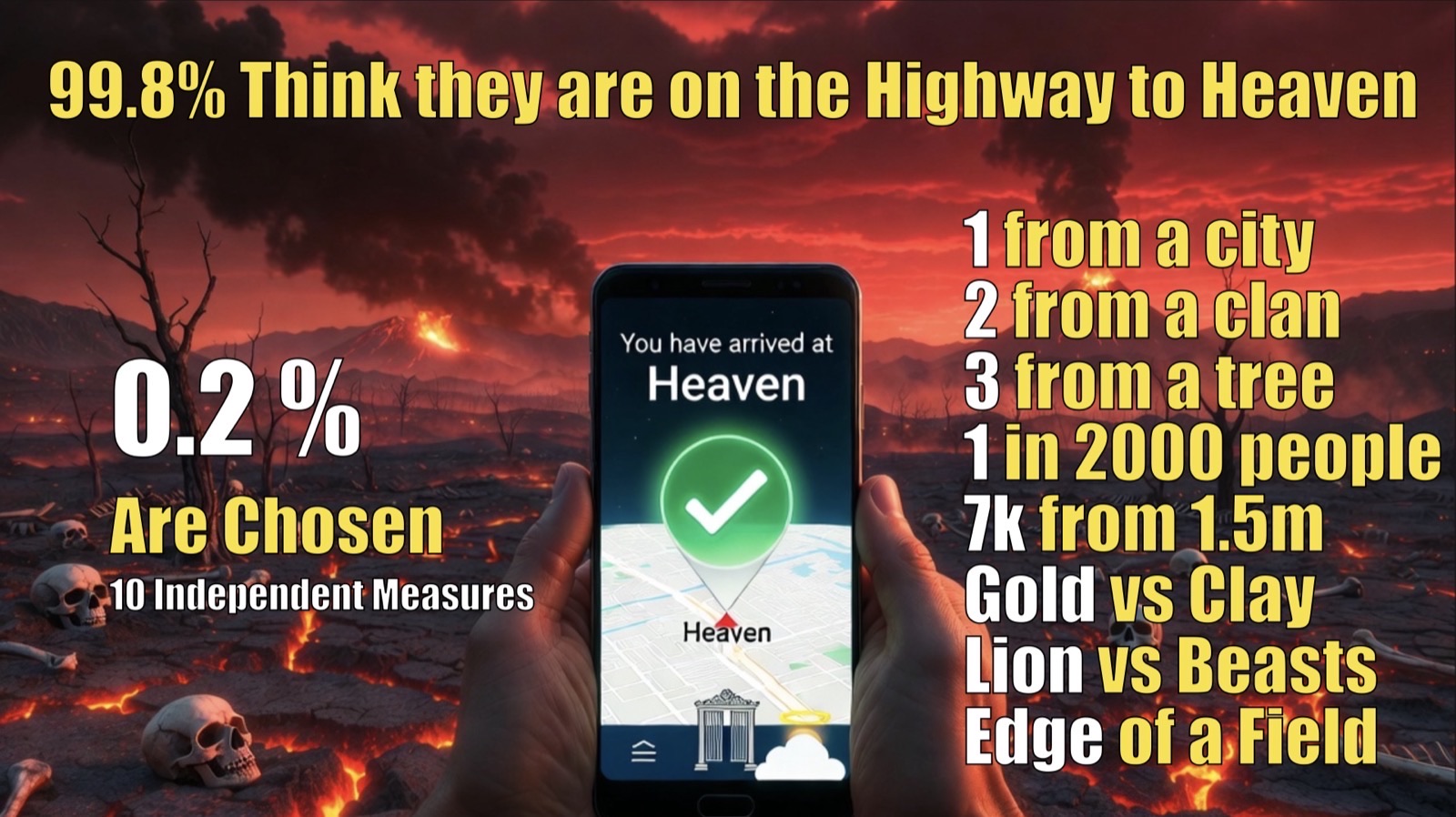
I have compiled every line of evidence in Scripture that speaks to this ratio — demographic, prophetic, prophetic leadership, agricultural, metallurgical, wisdom, ecological, typological, archaeological, spatial, geometric, extrabiblical, narrative, historical, and gospel. Fifteen independent methods. Different authors, different centuries, different domains of knowledge. They all land in the same narrow band:

When combined statistically, these fifteen lines produce a combined median of 0.21% — with a 95% confidence interval of 0.19–0.25%.
Applied to the current world: 0.21% of 8.2 billion = approximately 17 million people. Those 17 million come from within the ~2.65 billion who identify as Christian — less than 1 in 150 professing believers. There are an estimated 5 million congregations worldwide. If the remnant were spread evenly, that would be fewer than 4 per congregation. But they are not spread evenly — the vast majority of churches will have zero.
If that number disturbs you, good. It should. What follows is the evidence that produced it.
The Anchor Data Point — Elijah's 7,000
Of all the evidence in Scripture, one passage stands above the rest — because it gives us an actual census number from God Himself, and an apostolic declaration that the same ratio applies today.
Elijah had just defeated the prophets of Baal on Mount Carmel. Yet he fled in despair, believing he was the last faithful man alive:
God's answer was a number:
Seven thousand. Out of what?
We can estimate the northern kingdom's population during Ahab's reign from a source that does not depend on the eleph/clan question at all. Menahem exacted 1,000 talents of silver at 50 shekels per wealthy man (2 Ki 15:19–20). One talent = 3,000 shekels. 1,000 talents = 3,000,000 shekels ÷ 50 = 60,000 wealthy men in the northern kingdom. If the wealthy represent 5–10% of adult males, total population was roughly 1–2 million — consistent with the archaeological settlement surveys for the 9th century BC (800,000–1.2 million).
Using the lowest population estimate — the one most generous to the remnant — gives 7,000 faithful out of ~1,000,000 total = approximately 0.7%. Using the higher population estimates pushes the ratio down to ~0.35%.
But here is the critical point. This is not just a historical footnote. Paul quotes this exact passage and makes it prescriptive:
"Even so then at this present time also." Paul does not say the Elijah situation was unique. He says the ratio is the current pattern. The same percentage of faithfulness that existed then exists now. A remnant according to the election of grace — not a majority, not a third, not even a tenth. A remnant.
He continues:
Two groups: the election (small, obtained the promise) and the rest (blinded). This is not ambiguous. The ratio is the same as Elijah's day.
Confirming the Ratio — Every Line of Evidence Agrees
If Elijah and Paul stood alone, one might argue it was a unique period of apostasy. But the same ratio appears independently across numerous additional lines of evidence — prophetic, agricultural, metallurgical, ecological, spatial, archaeological, and extrabiblical, plus the ratio among prophets themselves. Each uses a different method. They all land in the same narrow band.
1. Jeremiah's Stated Ratio — "One of a City"
Ancient Israelite cities ranged from 500 to 5,000 people. One person per city = 0.02–0.2%. Two per clan (mishpachah) is similar — a clan might have 500–2,000 members. This lands squarely in the Elijah range.
2. The Gleaning — Two or Three Berries
Isaiah 17 opens with the burden of Damascus — judgment falling on both Syria and the northern kingdom. Verse 4 says "the glory of Jacob shall be made thin, and the fatness of his flesh shall wax lean." Then comes the harvest image: a harvestman reaping ears of grain (v.5), stripping the field clean. That is the judgment. What follows is the remnant:
This is not a metaphor. It is an agricultural fact. After an olive tree is beaten for harvest, a few berries cling to the highest, most inaccessible branches — 2–3 at the very top, 4–5 on the outermost limbs. A productive olive tree bears 15,000–30,000 individual olives. The gleanings are a handful: ~0.03–0.13%.
But the next verse tells you who the gleanings are:
The gleanings are the ones who look to their Maker and stop looking at the work of their hands. Everyone else trusted in what they built — their altars, their groves, their images, the works of their own fingers. The 2–3 berries at the top are those who abandoned self-made religion and turned their eyes back to the Holy One. The entire nation was harvested. These few remained.
Isaiah 24:13 repeats the same gleaning image — but this time the scope is global. And the context is devastating:
Three causes: transgressed the laws, changed the ordinance, broken the everlasting covenant. This is not pagan idolatry — pagans never had the covenant to break. This is God's own people changing His instructions, breaking His covenant, and transgressing His Torah. And the result is global: "the inhabitants of the earth are burned, and few men left."
Then comes the gleaning:
The "few men left" of verse 6 ARE the gleanings of verse 13 — the same handful of olives clinging to the topmost branch. And the cause of the judgment that reduced the world to gleanings? Lawlessness. Breaking the covenant. Changing the ordinances.
Now read Matthew 7:23 again: "Depart from me, ye that work iniquity." The Greek is anomia — literally, lawlessness. Without-Torah. The very thing Isaiah 24:5 identifies as the cause of the global harvest that leaves only gleanings.
The Edge of the Field — A Ratio Built into the Geometry
There is a structural detail in the gleaning law that encodes the ratio into the land itself. Leviticus 19:9 says: "Thou shalt not wholly reap the corners (H6285 pe'ah) of thy field." Leave the edge. Don't harvest the perimeter.
This is a geometry problem. If you leave one row of grain standing at the perimeter of a field, the ratio of edge to total area is fixed by mathematics. Wheat and barley — the staple crops, the bread of the land, the primary calorie source — are planted in dense rows approximately 7 inches apart:
| Field Size | Rows per Side | Perimeter Rows | Edge as % of Total |
|---|---|---|---|
| 1 acre | 353 | 1,408 | 1.13% |
| 5 acres | 790 | 3,156 | 0.51% |
| 10 acres | 1,117 | 4,464 | 0.36% |
| 20 acres | 1,580 | 6,316 | 0.25% |
| 100 acres | 3,534 | 14,132 | 0.11% |
For a typical ancient Israelite family plot (5–20 acres), the perimeter is 0.25–0.51% of the total field. For a larger estate, it drops below 0.2%.
The edge of the field is inherently a small fraction of the whole — and that fraction shrinks as the field grows. The pe'ah is not a fixed percentage imposed by tradition. It is a geometric reality: the boundary of any area is always a tiny fraction of its interior. The larger the field — the larger the population — the smaller the edge becomes relative to the whole.
The $[harvest] feeds the nation. The pe'ah feeds the remnant. And the geometry of the grain field itself — the bread of the land — produces the same ratio as every other line of evidence: ~0.25–0.51% for the typical family plot. The Elijah ratio, written into the shape of the earth.
The Wing of the Garment
The connection goes deeper. The gleanings are found at the pe'ah — the edge, the corner, the border.
Now compare: Numbers 15:38 commands Israel to make fringes (tzitzit) on the borders (H3671 kanaph) of their garments — a reminder of all the commandments. The word kanaph means $[wings], edge, corner, border. The pe'ah of the field and the kanaph of the garment are parallel concepts — the outer edge, the place where the boundary meets the world.
Ruth found her redemption at the kanaph. She said to Boaz: "Spread therefore thy skirt (kanaph — $[wings]) over thine handmaid; for thou art a near kinsman" (Ruth 3:9). Earlier, Boaz had told her: "The 𐤉𐤄𐤅𐤄 recompense thy work... under whose $[wings] (kanaph) thou art come to trust" (Ruth 2:12). The gleaner from the pe'ah of the field takes shelter under the kanaph of the redeemer — the same word, the same edge.
Malachi 4:2: "The Sun of righteousness arise with healing in his $[wings] (kanaph)." And when the woman with the issue of $[blood] reached out in desperation, she "touched the border (kraspedon — fringe, tassel) of his garment: and immediately her issue of $[blood] stanched" (Lk 8:44). The kraspedon is the Greek equivalent of the tzitzit — the fringes hanging from the kanaph. She touched the commandment-reminder at the edge of His garment and was healed. Healing in His $[wings].
The remnant is found at the edge. Not in the center of the $[harvest] — that was reaped. Not in the main body — that was gathered in. At the pe'ah, the corner, the border, the fringe. The gleanings cling to the outermost branches (Isa 17:6). The faithful cling to the kanaph — the $[wings] of the Redeemer. The small, knotted tzitzit hanging from the edge of the garment are a visible reminder of all the commandments (Num 15:39) — and they are where the healing is found. (See the full $wings study for the complete thread.)
Who Are the Gleanings For?
The gleaning law itself tells us something deeper. Torah specifies exactly who receives the gleanings left on the tree:
Leviticus 19:10 adds the poor to the list. Four categories. And every one of them has a symbolic identity in Scripture that maps precisely onto the remnant:
The Poor. "Blessed are the poor in spirit: for theirs is the kingdom of heaven" (Mat 5:3). "Hath not God chosen the poor of this world rich in faith, and heirs of the kingdom?" (Jas 2:5). Isaiah 66:2: "To this man will I look, even to him that is poor and of a contrite spirit, and trembleth at my word." The poor are those who own nothing of their own and trust nothing they have built — the opposite of those in Isaiah 17:8 who look to "the altars, the work of his hands." The kingdom belongs to the poor.
The Stranger. "These all died in faith... and confessed that they were strangers and pilgrims on the earth" (Heb 11:13). "I beseech you as strangers and pilgrims, abstain from fleshly lusts" (1 Pet 2:11). "I am a stranger in the earth: hide not thy commandments from me" (Ps 119:19). Abraham called himself "a stranger and a sojourner" (Gen 23:4). The faithful are defined as strangers — people who know this world is not their home. And here is the demographic fact: a sojourner is by definition a tiny minority in any population. You cannot sojourn where you are the majority. The word itself encodes the ratio. If the remnant are "strangers and pilgrims on the earth," they are inherently few among many — exactly the 0.2–0.7% range.
The Fatherless. "A father of the fatherless... is God in his holy habitation" (Ps 68:5). And in John 14:18, when Jesus tells the disciples He is leaving, He says: "I will not leave you comfortless." The Greek word is orphanos — literally, "I will not leave you as orphans." The disciples become fatherless during the absence of the Messiah. Lamentations 5:3 says it plainly about Israel in exile: "We are orphans and fatherless, our mothers are as widows." The fatherless are those whose covering has been removed — who depend entirely on God as their Father.
The Widow. "Thy Maker is thine husband; the LORD of hosts is his name" (Isa 54:5). But before that reunion: "thou shalt not remember the reproach of thy widowhood any more" (Isa 54:4). Israel without God is a widow — "how is she become as a widow!" (Lam 1:1). The widow is one whose husband is absent, who waits faithfully for his return. The prototype: Anna, who "was a widow of about fourscore and four years, which departed not from the temple, but served God with fastings and prayers night and day" (Lk 2:37). And Babylon defines herself as the opposite: "I sit a queen, and am no widow, and shall see no sorrow" (Rev 18:7). The worldly system specifically rejects the widow identity — claims she has not lost her husband, claims she is not desolate.
The gleaning law says the remnant belongs to: those who own nothing (poor), those who are not at home in this world (strangers), those whose covering has been removed (fatherless), and those who wait for an absent husband (widows). These are not just social categories. They are the identity of the remnant — the congregation waiting for the Bridegroom's return.
Ruth — The Gleaning Enacted
There is one person in Scripture who is all four categories simultaneously, and who literally gleans from the field: Ruth.
- Poor — destitute, arriving in Bethlehem with nothing. Naomi says: "I went out full, and the LORD hath brought me home again empty" (Ruth 1:21).
- Stranger — a Moabitess, a foreigner. "Why have I found grace in thine eyes, that thou shouldest take knowledge of me, seeing I am a stranger?" (Ruth 2:10).
- Widow — her husband Mahlon is dead (Ruth 1:5).
- Fatherless — she has left her father and her homeland. "Thou hast left thy father and thy mother, and the land of thy nativity, and art come unto a people which thou knewest not heretofore" (Ruth 2:11).
And what does Ruth glean? She gleans in the field of Boaz — the kinsman-redeemer (goel), the one who will restore her inheritance, marry her, and raise up seed. The gleaner finds the Redeemer in the field. She goes from gleaning to bride. And she enters the lineage of the Messiah (Mat 1:5).
Ruth is the enacted parable of the remnant: a poor, widowed, fatherless stranger who gleans from the field of the covenant and is redeemed by the goel. The gleaning law doesn't just tell you how many survive the $[harvest]. It tells you who they are.
3. Rarer Than Gold
This is explicitly about rarity. The context is the Day of the LORD (v.9) and the judgment of $babylon (v.1). After judgment, a righteous man will be rarer than $[gold].
How rare is gold? In the earth's crust: ~4 parts per billion. In a rich gold mine: ~5–10 grams per ton of rock, or about 0.0005–0.001%. The "golden wedge of Ophir" — refined, pure gold — is rarer still.
Ezekiel goes further. God calls the entire house of Israel "dross":
Dross is the waste slag left after smelting. In ancient metallurgy, the yield of pure silver from raw ore was typically 1–5%. God is saying the nation is the slag — the waste product — and the pure metal to be extracted is a small fraction of the total mass.
The Parable of the Gold in the Field
Most readers know Matthew 13:44 as "the kingdom of heaven is like unto treasure hid in a field." But the Hebrew Matthew (Shem Tov) reads differently: the kingdom is like $[gold] hidden in a field. Not a buried chest — ore in the ground. $[gold] dispersed through dirt, indistinguishable from common earth until someone digs and refines it.
This changes the parable. The man finds the $[gold], and "for joy thereof goeth and selleth all that he hath, and buyeth that field." He doesn't buy just the $[gold] — he buys the whole field to get what's hidden within it. The field is the world (Jesus defines this symbol two parables earlier in Mat 13:38). The buyer is the one who pays the price — "ye are bought with a price" (1 Cor 6:20), "thou wast slain, and hast redeemed us" (Rev 5:9). And Israel is explicitly God's treasure — His segullah: "ye shall be a segullah unto me above all people" (Ex 19:5). The $[gold] hidden in the field is the remnant hidden within humanity.
The extraction economics are the point. You do not buy a field for the dirt. You buy it for what is hidden in it. In gold mining, even a "bonanza-grade" deposit — the kind worth selling everything for — contains only 0.002% $[gold] by weight. The remnant at 0.2% is 100 times more concentrated than bonanza-grade ore, and a miner who recognized that deposit would sell everything he owned to acquire it.
| Ore Grade | Gold per Ton | Percentage |
|---|---|---|
| Low-grade | <1 g/t | <0.0001% |
| Medium-grade | 1–5 g/t | 0.0001–0.0005% |
| High-grade | 5–20 g/t | 0.0005–0.002% |
| Bonanza-grade (extremely lucrative) | >20 g/t | >0.002% |
| The remnant | ~2,000 g/t | 0.2% |
The Hebrew text makes the metallurgical connection explicit: this is not a chest someone buried and forgot. This is $[gold] laced through the earth itself — rare, valuable, invisible to the untrained eye, requiring purchase of the whole field and $[fire] to extract. "Buy of me $[gold] tried in the $[fire]" (Rev 3:18). "The trial of your $[faith], being much more precious than of $[gold] that perisheth, though it be tried with $[fire]" (1 Pet 1:7). The remnant are the $[gold] that survives the refining — hidden in the field of humanity, indistinguishable from dirt until the Refiner digs.
The Gold and the Clay — 2 Esdras
2 Esdras (4 Ezra) — in the 1611 KJV Apocrypha, the Latin Vulgate, and the Ethiopian Bible — uses the same gold-vs-clay image with the actual earth science behind it:
The earth produces 32 billion metric tons of pottery-grade $[clay] — the "mould whereof earthen vessels are made." It contains approximately 400 million metric tons of $[gold] scattered through the crust. But all the $[gold] ever mined in human history — every ring, every bar, every coin from every civilization — totals only 250,000–300,000 tons. A microscopic 0.00006% of the $[gold] that exists. And the ratio of extractable $[gold] to usable pottery $[clay] is roughly 1 : 492,000.
The Potter has abundant $[clay] (Isa 64:8, Rom 9:21). The $[gold] is sovereignly selected, extracted, and refined from that abundance.
4. A Lion among Beasts
Two images for the same remnant: dew (scattered, tiny, life-giving) and a $[lion] (powerful, ruling, but vastly outnumbered). How rare are $[lion]s among large mammals in the ecosystems God designed?
| Ecosystem | Lions | Other Large Mammals | Lions as % |
|---|---|---|---|
| Serengeti (Tanzania) | ~3,000–4,000 | >2,000,000 | ~0.14–0.2% |
| Kruger National Park (South Africa) | ~1,600–2,000 | ~170,000–220,000 | ~0.9% |
Lions constitute approximately 0.14–1% of the large mammal population. Apex predators — dominant in authority, few in number. The creation itself testifies to the ratio God declares.
5. Solomon's Census — One in a Thousand
The wisest man who ever lived conducted his own search — "counting one by one, to find out the account" (v.27). He had more exposure to humanity than almost anyone: 700 wives, 300 concubines, kings visiting from every nation, the wealthiest court on earth. His verdict: 1 righteous man in 1,000. And among women: zero. Combined: 1 in 2,000 = 0.05%.
Solomon is not making a statement about gender. He is making a statement about rarity — and he searched exhaustively. His ratio (0.05%) sits squarely between Jeremiah's "one of a city" (0.1–0.2%) and the olive gleaning ratio (0.03–0.13%). The wisest observer of human nature in Scripture arrived at the same band as every other line of evidence.
6. Israel among the Nations
God told Israel from the beginning what their ratio would be:
Today, the State of $[israel] is 1 nation out of 193 recognized by the United Nations — 0.52% of all countries. Its population of ~9.5 million out of ~8.2 billion people on earth is 0.12% of the global population. One nation among the nations. The fewest of all people, exactly as declared — at exactly the percentage every other line of evidence produces.
6. The Land Itself
Revelation 14:4 identifies a specific group: "These were redeemed from among men, being the firstfruits unto God and to the Lamb." These are the 144 eleph of Revelation 7:4–8. The Hebrew word eleph means both "thousand" and "clan" — and the verse itself pairs it with mishpechot (families/clans), the parallel confirming the meaning: 12 tribes × 12 clans = 144 clans, a complete covenant structure. John hears the number — 144 clans, structured, countable. Then he looks and sees "a great multitude, which no man could number, of all nations, and kindreds, and people, and tongues" (Rev 7:9). Same group, two views: the structured view (complete clans from every tribe) and the demographic view (an uncountable multitude drawn from every nation across all generations). A small percentage of a vast number is still genuinely uncountable. The ratio is few. The total is vast. Both are true. (See The Tree That Wakes First for the full 144-clans study.)
If these firstfruits inherit a physical land with defined borders (Gen 15:18, Ezek 47–48), and the prophetic vision is "every man under his vine and under his fig tree" (Mic 4:4), then they must fit on that land at that density.
| Scenario | Firstfruits | Land | Density | Match? |
|---|---|---|---|---|
| 0.2% of ~43B post-Christ births | ~86 million | Greater Israel (900K sq mi) | 6.7 acres/person | Spacious homesteads |
| 0.2% of current 8B generation | ~16 million | Greater Israel (900K sq mi) | 36 acres/person | Large farms |
| 1% of ~43B post-Christ births | ~430 million | Greater Israel (900K sq mi) | 1.3 acres/person | Exceeds Solomon capacity |
| "All Christians saved" (~2B) | ~2 billion | Greater Israel (900K sq mi) | ~1,250 sq ft/person | A large bedroom |
At 0.2%, the firstfruits fill Greater Israel at the exact density that produced Solomon's golden age — the era Scripture describes as "every man under his vine and under his fig tree" (1 Ki 4:25). At 1%, they already exceed it. At 2 billion (all professing Christians), each person gets a bedroom. The land was sized for the remnant. The remnant was sized for the land. (See The Population of the Renewed Earth for the full study.) Daniel's throne scene confirms the same number from a completely different angle: the "thousand of thousands" (elef alphin) and "myriad of myriads" (ribo ribvan) of Daniel 7:10 use the same "clan" word (elef) from the tribal census — making "thousand of thousands" the 144-clan structure and "myriad of myriads" its total headcount, landing on the same ~100–200 million range. (See the Daniel 7:10 verse study.)
7. 2 Esdras — Wave vs Drop, Grape from the Cluster
2 Esdras also stacks several non-metallurgical analogies that independently confirm the ratio:
One grape from a cluster of 100–300 = 0.33–1%. A wave vs a drop. The ten-thousandth part of men (7:68). Every analogy pulls in the same direction. And the grape didn't preserve itself — "with great labour have I made it perfect." The Vinedresser selected, kept, and perfected it.
8. The Pharisee Census — An Upper Bound from Josephus
Josephus provides the only ancient headcount ever given for any Jewish sect:
Six thousand adult males. Set during Herod's reign (~7 BC) — at the time of Yeshua's birth. The total Jewish population in the land was roughly 500,000–1,000,000. The Pharisees — the most visibly religious group in Judaism, the ones who tithed mint and cumin, wore the broadest phylacteries, and fasted twice a week — numbered 0.6–1.2% of the population.
But the Pharisees were not genuine Torah keepers. They had replaced Torah with traditions of men — exactly as Yeshua charged: "Full well ye reject the commandment of God, that ye may keep your own tradition" (Mk 7:9). "Teaching for doctrines the commandments of men" (Mk 7:7). They made "the word of God of none effect through your tradition" (Mk 7:13). The Pharisees are the pattern for mainstream Christianity today — outwardly religious, doctrinally elaborate, and systematically replacing the actual commands with human traditions.
This makes the Josephus number an upper bound, not an estimate of the remnant. Even the most outwardly devout group — the ones who at least appeared to take Torah seriously — were only 0.6–1.2% of the population. And Yeshua said the remnant must exceed even that:
The Greek is perisseuō — to overflow, abound, be in excess. And the Hebrew remnant word yether means exactly this: to exceed, to overflow, to excel. The remnant IS the exceeding portion — those whose righteousness overflows beyond the traditions of men and into actual obedience to the commands of God. The Pharisees at 0.6–1.2% are the ceiling. The remnant must exceed them. The ratio tightens from above.
9. The Bread of Life — The Ratio in Real Time
Another witness to the stable remnant ratio appears in John 6 during Yeshua's earthly ministry. After feeding exactly five thousand men (besides women and children, bringing the total crowd to an estimated 15,000–25,000), He delivered the $[bread]-of-Life teaching the very next day in the Capernaum synagogue. The feeding itself is the giving of the word — "man shall not live by $[bread] alone, but by every word that proceedeth out of the mouth of God" (Mat 4:4). The multitude received the word gladly. But when He declared the full covenant terms — unless they eat His flesh and drink His $[blood] they have no life in them — the response was immediate:
What drove them away was not merely a difficult idea. "Eat my flesh and drink my $[blood]" is covenant language — the terms of the $[renewed-covenant] meal enacted at the Last Supper, the Passover of the Lamb. The crowd was willing to follow a miracle-worker who fed them bread. They were not willing to enter the covenant. They rejected the terms — and He warned them plainly: "Except ye eat the flesh of the Son of man, and drink his $[blood], ye have no $[the-life] in you" (Jn 6:53). In Scripture, $[the-life] is itself covenant-existence — (see the full Life study) — so "no life in you" means outside the covenant entirely. And they walked away — just as Isaiah 24:5 describes the cause of global judgment: "broken the everlasting covenant."
Out of the thousands who had witnessed the miracle and the hundreds who had become committed followers, the vast majority abandoned Him when the covenant was placed before them. In the end, only the Twelve remained as the faithful core. When Yeshua turned to them and asked, "Will ye also go away?" (v. 67), the pattern is visible in real time: the main $[harvest] walks away, leaving only a tiny gleaning.
12 out of 5,000 men = 0.24%. Including women and children: 12 out of 15,000–25,000 = 0.05–0.08%. This single event — from massive crowd to faithful handful in twenty-four hours — lands squarely in the same band that runs from Noah through Elijah to the end of the age. And even among the Twelve, one was a $[deceive]r (Jn 6:70–71) — reducing the faithful to 11.
The same pattern repeats in the feeding of the 4,000 (Mat 15:32–39). Yeshua feeds 4,000 men besides women and children — an estimated 12,000–20,000 total. After they have eaten and are satisfied, He "sent away the multitude" (apolyō — the strong word of dismissal) and immediately "took ship with his disciples." The large crowd is blessed and then departed. The tiny gleaning stays with the Redeemer and crosses over in the vessel of safety — the boat functioning as an ark, echoing Noah's family preserved through the $[water] while the world is left behind. Many are called and fed. Few are chosen to stay and cross over with the King.
The Convergence — All Lines Together
Here is every line of evidence in one table:
| Method | Source | Implied Ratio |
|---|---|---|
| Demographic | Elijah's 7,000 / Israel's population — confirmed by Paul | 0.35–0.7% |
| Prophetic | Jeremiah 3:14 — "one of a city, two of a family" | ~0.1–0.2% |
| Agricultural | Isaiah 17:6 / 24:13 — olive gleanings | ~0.03–0.5% |
| Metallurgical | Isa 13:12, Ezek 22:18, 2 Esd 8:2, Mat 13:44 (Heb) | <1% |
| Wisdom (observation) | Ecclesiastes 7:28 — Solomon: 1 man in 1,000; 0 women = 1 in 2,000 | ~0.05% |
| Ecological | Micah 5:8 — lion among beasts | 0.14–1% |
| Typological | State of Israel: 1/193 nations; 0.12% of world — Deut 7:7 | 0.12–0.52% |
| Spatial | Greater Israel at vine-and-fig-tree density | ~0.2% |
| Extrabiblical | 2 Esdras: 5 analogies combined | 0.09–0.21% |
| Geometric | Pe'ah field edge: perimeter row on 5–20 acre plot | 0.25–0.51% |
| Narrative | Job 1 — 5 survivors from a household of 400–800+ | 0.6–1.25% |
| Historical | Josephus: 6,000 Pharisees / Jewish population (upper bound) | ≤0.6–1.2% |
| Prophetic leadership | 1 Ki 22:6 — Micaiah vs 400 false prophets; 1 Ki 18:22 — Elijah vs 850 | 0.12–0.25% |
| Archaeological | Rahab's house in Jericho's wall — one household in a walled city | ~0.4–1.5% |
| Gospel | John 6 — 12 remain from 5,000+ after hard teaching | ~0.24% |
| Definitional | Gleaning recipients: stranger = inherently few | by definition, few |
Every analogy God uses to describe the remnant — gleanings after harvest, $[gold] extracted from ore, $[lion]s among prey, dew across grass, strangers in a foreign land, a stump after burning, one house in a fallen wall, one true prophet among 400 false — is drawn from the physical world He designed. And in every case, the real-world ratio falls in the same band. The creation testifies to the same proportion the text declares.
What the Creed Cannot Do
Virtually 100% of professing Christians — Catholic, Protestant, Orthodox, roughly 2.4 billion people — affirm the Apostles' Creed or something equivalent:
Every line is belief. Not one line is action. And the remnant is ~17 million out of the 2.4 billion who affirm it. Therefore the creed, while not necessarily wrong, is clearly not enough. Whatever distinguishes the 0.21% must be something the 99.79% are NOT doing.
The creed is entirely "I believe." Not one "I do." When Yeshua addresses the seven churches in Revelation, He opens every single letter the same way: "I know thy works" (Rev 2:2, Rev 2:9, Rev 2:13, Rev 2:19, Rev 3:1, Rev 3:8, Rev 3:15). Seven churches. Seven times. Not once does He say "I know thy beliefs" or "I know thy theology." Works. Every time. And the dividing line He draws is not belief — it is obedience: "Not every one that saith unto me, Lord, Lord, shall enter into the kingdom of heaven; but he that doeth the will of my Father" (Mat 7:21). And we already saw the cause of the global judgment that reduces the earth to gleanings (Isa 24:5): transgressed the laws, changed the ordinance, broken the everlasting covenant. Three charges. The creed addresses none of them. Revelation 14:12 defines the saints as those who "keep the commandments of God, and the $[faith] of Jesus" — both halves, not one or the other.
Consider what mainstream Christianity has changed:
- The Sabbath — God's appointed day of rest, established at creation (Gen 2:2–3), commanded at Sinai (Exod 20:8–11), never altered in Scripture. Mainstream Christianity not only moved it — some to Saturday (Saturn's day), others to Sunday — but explicitly teaches that violating it is not a sin. And because they no longer call it sin, they cannot confess it — and "if we say that we have no sin, we $[deceive] ourselves, and the $[truth] is not in us" (1 Jn 1:8). Unconfessed sin remains. Meanwhile, those who profess the Sabbath and yet profane it in subtle and overt ways — but confess their failure and desire to keep it — find that the Sabbath does exactly what God said it would: "It is a sign between me and you throughout your generations; that ye may know that I am the LORD that doth sanctify you" (Exod 31:13). The sign is not perfection. The sign is the ongoing desire to keep it, the confession when you fail, and His work of sanctification through the process. The biblical Sabbath is counted from the $[new-moon], not from a continuous weekly cycle. (See When Is the Sabbath? for the full evidence.) "Changed the ordinance."
- The appointed times — The feasts of Leviticus 23 are called "the feasts of the LORD" — not the feasts of Israel. They were replaced with Christmas, Easter, and other observances with no scriptural basis. "Changed the ordinance."
- The dietary laws — Leviticus 11 was never repealed. The common reading of Acts 10 (Peter's vision) is about people, not food — Peter himself says so: "God hath shewed me that I should not call any man common or unclean" (Acts 10:28). And Isa 66:15–17 places this squarely in the end-time judgment: "The LORD will come with $[fire]… they that sanctify themselves, and purify themselves in the gardens behind one $[tree] in the midst, eating swine's flesh, and the abomination, and the mouse, shall be consumed together, saith the LORD." The Hebrew for "gardens" (H1593 gannah) means an enclosed orchard — a grove of $[tree]s. $tree|Trees in Scripture are $[nation]s. God's people were dispersed among the $[nation]s, and many attempt to sanctify and purify themselves — but if they follow the $[nation]s and eat what the $[nation]s eat, they will be consumed with the $[nation]s. This is not ancient history. It is a prophecy of the coming judgment. (See the full Isa 66:17 verse study for the detailed Hebrew analysis.) "Transgressed the laws."
- The $[name] — "Thou shalt not take the $[name] of the LORD thy God in vain" (Exod 20:7). The Hebrew for "in vain" is H7723 shav — to make nothing, to empty. This is not about pronunciation or titles. In Scripture, the $[name] IS the covenant — His character, His promises, His terms, His identity. To "call on the $[name]" (Joel 2:32) is to invoke the everlasting covenant itself. When mainstream Christianity declares the law done away with, the Sabbath optional, and the feasts irrelevant — they have emptied the $[name] of its content. They are calling upon a god, a lord, a christ — but not upon His $[renewed-covenant]. The $[name] has been taken in vain: made nothing. "Broken the everlasting covenant."
- The destination — The creed actually says "the resurrection of the body" — which is correct. But the churches teaching the creed functionally teach the opposite: that the righteous go to heaven at death, bypassing the resurrection entirely. Scripture says the meek inherit the earth (Mat 5:5), the dead are in the graves until they hear His voice (Jn 5:28–29), and the city comes down to earth (Rev 21:2). The creed affirms the resurrection; the tradition denies it in practice.
Each of these changes is accepted by over 90% of Christianity. And the remnant is 0.21%.
Many sincere believers will say: "I have personally trusted Jesus as my Savior, I talk with Him daily, and I am learning to obey Him because I love Him." That is good — and it is not enough. The issue is not sincerity. The issue is what they believe obedience means. They say they want to obey Him, but they have been taught that the very commands He gave — His Sabbath, His dietary laws, His appointed times, His covenant $[name] — are obsolete. They "reject the commandment of God, that ye may keep your own tradition" (Mk 7:9). No one knows everything perfectly. But there is a difference between imperfect obedience to the right commands and sincere obedience to the wrong ones. "My people are destroyed for lack of $[knowledge]: because thou hast rejected $[knowledge], I will also reject thee… seeing thou hast forgotten the law of thy God, I will also forget thy children" (Hos 4:6). In Hebrew, $[knowledge] (H1847 da'ath) is not information — it is discernment between good and evil, first introduced as the fruit of a $[tree] in the garden (Gen 2:9). It begins with the fear of God (Prov 1:7), and Hosea equates it directly with Torah: rejected $[knowledge] = forgotten the law. They perish not because they lacked access to truth, but because they rejected the standard that defines good from evil.
The creed tells you who to believe in. The commandments tell you what to do. The remnant does both.
Where Are the 17 Million?
If the remnant is defined by acknowledging and attempting to keep His commands — the Sabbath as a sign (Exod 31:13), the dietary laws, the appointed times — how many people on earth do this, even imperfectly?
The critical distinction is not between perfect obedience and imperfect obedience. No one keeps the commands perfectly. The distinction is between those who acknowledge the commands and stumble in keeping them, and those who deny the commands exist at all. The one confesses and is sanctified (1 Jn 1:9). The other cannot confess what they do not call sin (1 Jn 1:8).
| Group | Acknowledges the commands | Keeps a Sabbath | Eats clean | Worldwide | % of 8.2B |
|---|---|---|---|---|---|
| Mainstream Christianity | Explicitly denies | No | No | ~2+ billion | ~25% |
| Sunday sabbatarians | Partially (wrong day, but honor the principle) | Sunday | Varies | ~100–200M | ~1.5–2.5% |
| Seventh-day Adventists | Yes | Saturday | Many | ~23.7 million | 0.29% |
| Messianic + Hebrew Roots | Yes | Yes | Yes | ~600K | 0.008% |
The Seventh-day Adventists, at 23.7 million, are strikingly close to the 0.21% convergence number. They acknowledge the Sabbath, eat clean, and do not make the law void — though they still reject many commands such as the feasts, the tzitzit, and other "ceremonial" distinctions. Sunday sabbatarians at least honor the principle of a weekly rest. Both groups get significant details wrong, but they do not wholesale deny the law. They confess, they strive, and the sign does its work of sanctification (Exod 31:13).
Meanwhile, the Messianic and Hebrew Roots communities — the groups explicitly pursuing Torah obedience — total only about 600,000 worldwide. But these movements have their own issues: most keep the wrong Sabbath day (by our estimation), some add to the word, and some fall into the same pride and legalism they accuse the churches of. No movement has a monopoly on faithfulness.
The point is not that any single group IS the remnant. The point is the heart posture: do you acknowledge His commands as binding, attempt to keep them, and confess when you fail? Or do you declare them abolished and call obedience a heresy? The first is imperfect obedience on the right road. The second is confident disobedience called freedom. Isaiah 66:2 tells you whom God looks to: "him that is poor and of a contrite spirit, and trembleth at my word."
The model predicts ~17 million. The visible communities that acknowledge the commands — from SDAs to Messianics to Sunday sabbatarians who at least honor the principle — number in the tens of millions. But many of the remnant are uncounted: individuals and families scattered among the nations who have come to His commands through personal study and the quiet leading of the Spirit, who belong to no movement, fill out no surveys, and appear in no membership rolls. They are the berries at the top of the uppermost bough. Jeremiah 3:14 says "one from a city" — scattered individuals, not organized congregations.
The Only Safe Response
When someone asked Jesus directly — "Lord, are there few that be saved?" — He did not say "Don't worry about it." He said:
The Greek is agonizomai — agonize, struggle, fight. The same word used for competing in the arena. Even seeking is not enough. Many will seek and fail. You must strive.
What does striving look like? Scripture gives us the markers of those who were NOT told to depart:
- They keep His commandments (1 Jn 2:3–4, Rev 14:12) — not merely confess them.
- They overcome (Rev 2–3) — every promise in the seven letters is given "to him that overcometh."
- They are not $[deceive]d (Mat 24:24) — the $[elect] cannot be permanently $[deceive]d. That is the $[mark] of election.
- They refuse the beast (Rev 20:4) — they would rather die than comply.
The ratio should not produce despair. It should produce urgency. If the gate is as narrow as every line of evidence suggests, then the comfortable assumption that you are already through it is the most dangerous assumption you can make.
Paul — who declared the remnant pattern in Romans 11 — used another analogy three verses earlier in that same chapter of 1 Corinthians:
This is not an abstract illustration. Paul is writing to Corinth — and the Isthmian Games were held every two years right on their doorstep, on the isthmus near the city. The Corinthians watched these races. They knew exactly what Paul meant. The main sprint race (the stadion, ~180–190 meters) — the most prestigious event and almost certainly the one Paul had in mind — typically had 12 to 20 runners competing in the final heat, with 50 or more entering in qualifying rounds. One receives the prize.
One out of 50+ entrants = ~2%. One out of 12–20 finalists = 5–8%. And Paul says "so run, that ye may obtain" — not "so believe, that ye may obtain." It is a race. It requires exertion. And most runners lose.
Then, three verses later, the same Paul says this about himself:
The man who declared the remnant pattern — who preached the gospel across the Roman world — feared being disqualified from the very race he was running. If Paul did not consider himself safe, neither should you. Neither should I.
What "Remnant" Actually Means in Hebrew
English readers hear "remnant" and think leftovers — scraps, dregs, the unwanted tail end. The Hebrew says the opposite. Four words are translated "remnant" in the Old Testament, and each reveals a different facet of what God is preserving:
שְׁאֵרִית (she'erith) — The Living Flesh
The most common word for "remnant" (H7611), from the root שָׁאַר (sha'ar, H7604), which means "to swell up, i.e. be (causatively, make) redundant." The root meaning is not "what's left behind" — it is what is full, what swells with life.
The sibling noun from the same root is שְׁאֵר (she'er, H7607) — "flesh (as swelling out), as living or for food; figuratively, kindred by blood." Same root, same letters. The remnant (she'erith) shares its root with flesh and blood kinsman. The remnant is the living body of the covenant family — the flesh and blood that remains alive when everything else has been cut away.
יֶתֶר (yether) — The Excellence
H3499, from the root יָתַר (yathar, H3498) — "to jut over or exceed; by implication, to excel; to remain or be left; causatively, to leave, cause to abound, preserve."
The noun yether itself means "an overhanging, i.e. an excess, superiority, remainder; also a small rope (as hanging free)." The feminine form (H3502) means "excellence, i.e. wealth." The name Jethro comes from this same root — "his excellence."
The Hebrew does not say the remnant is what nobody wanted. It says the remnant is the excellence, the superiority, the surplus value — the part that overflows. And the secondary meaning — "a small rope hanging free" — is a lifeline, a cord dangling from something larger. This connects directly to the $[gold]-in-the-field imagery: the remnant is the treasure hidden in the dirt.
שָׂרִיד (sarid) — The One Who Slips Through
H8300, from the root שָׂרַד (sarad, H8277) — "to puncture, i.e. (figuratively through the idea of slipping out) to escape or survive." The related words from the same root are a carpenter's scribing-awl (H8279 — a tool for pricking measurements) and stitching (H8278 — as pierced with a needle).
The remnant-survivor is the one who slips through the puncture point — through the tiny opening. The related words are about needles and piercing. Now hear Yeshua: "It is easier for a camel to go through the eye of a needle, than for a rich man to enter into the kingdom of God" (Mat 19:24). The Hebrew word for the surviving remnant literally comes from "to puncture" — to pass through the impossibly small opening. The remnant are those who fit through the needle's eye.
פְּלֵיטָה (peletah) — The Escaped Portion
H6413, from the root פָּלַט (palat, H6403) — "to slip out, i.e. escape; causatively, to deliver." The related noun פָּלִיט (palit, H6412) means "a refugee."
The remnant here are refugees — those who slipped free from what holds everyone else. And a refugee is by definition few among many — a stranger in a foreign land, exactly the identity of the gleaning recipients (Lev 19:10, Deut 24:20).
Four Words, One Portrait
Hebrew does not describe the remnant as leftovers. It describes them as the living flesh of the covenant (she'erith), the excellence and wealth hidden within the whole (yether), those who slip through the needle's eye (sarid), and the refugees who escape what holds everyone else (peletah). The swelling life. The overflowing surplus. The gold in the field. The berries at the top of the tree. The small rope hanging free.
Job — The Ratio Before Moses
The remnant pattern appears even in what may be the oldest book in Scripture. In Job 1, four disasters strike in rapid succession — Sabeans, $[fire] from heaven, Chaldeans, a great wind — and each messenger delivers the same report:
Four times. Four disasters. Four lone survivors. The Hebrew is נִמְלַטְתִּי (nimlateti) — from מָלַט (malat, H4422), "to slip away, escape" — the same semantic family as peletah, the refugee-remnant.
Compare the language to Elijah: "I, even I only, am left" (1 Ki 19:10). Same claim. Same perception of sole survival. And just as Elijah was not truly alone — God had reserved 7,000 — the Job messengers are not truly alone either. There are four of them. Each thinks he is the only one, but God preserved one from each group.
Now count the survivors against the household. Job was "the greatest of all the men of the east" (Job 1:3) — 7,000 sheep, 3,000 camels, 500 yoke of oxen, 500 donkeys, and "a very great household." Using ancient Near Eastern staffing ratios (from biblical parallels like Nabal's operation in 1 Samuel 25, Ugaritic texts, and modern Bedouin analogs):
| Asset | Workforce | Survivors |
|---|---|---|
| 7,000 sheep | 35–70 shepherds | 1 |
| 3,000 camels | 30–60 handlers | 1 |
| 500 yoke of oxen | 150–300 laborers | 1 |
| 500 donkeys | 15–30 handlers | 1 |
| House feast | 10 children + 20–60 servants | 1 |
Total household: roughly 250–520 (workforce only), or 400–800+ including servant families. Five survivors — the four messengers plus Job himself, the one who endured the total devastation and remained faithful. Job's wife survived physically but failed spiritually: "Curse God, and die" (Job 2:9) — a Lot's wife parallel, escaping the destruction but looking back.
5 out of 400–800 = 0.6–1.25%. Right in the Elijah band. And this is pre-Mosaic, pre-Sinai, possibly the oldest narrative in Scripture. The ratio is there before the Torah is given — because it is rooted in human nature, not in any particular covenant.
But What About…?
Several parables are routinely cited to argue the remnant is much larger — 25% or even 50%. Each dissolves on inspection:
The Ten Virgins (Mat 25:1–13). Five wise, five foolish — 50%? But all ten are already virgins waiting for the bridegroom. They are not the general population. They are the professing community — those who already separated themselves to wait. The 50/50 split is within the narrow group. If professing believers are ~1% of the world, and half of those have $[oil], you get 0.5%.
The Four Soils (Mat 13:3–23). One in four bears $[fruit] — 25%? But 25% of those who hear the word, not 25% of humanity. Most people never receive the seed at all. And even the good soil has varying yields (30, 60, 100-fold). Three of four soils fail — 75% failure among those who hear is devastating, not comforting.
Sheep and Goats (Mat 25:31–46). People assume 50/50 because of the visual symmetry — right hand and left. But the text never states the ratio. "All $[nation]s" are gathered and sorted. The sheep go to $[the-life], the goats to judgment. No count is given.
Wheat and Tares (Mat 13:24–30). Same — no ratio given. Both grow together, and the whole point of the parable is that you cannot tell them apart until $[harvest]. It says nothing about equal proportions.
"A great multitude, which no man could number" (Rev 7:9). This sounds like a large percentage. But 0.2% of the ~43 billion people born since Christ = approximately 86 million. That is genuinely uncountable — drawn from every $[nation], kindred, people, and tongue across two millennia. The multitude is vast. The percentage is not. Both are true.
Every parable cited to widen the gate, on closer reading, either narrows it further or says nothing about the ratio at all.
Do not assume you are through the gate. Examine yourself (2 Cor 13:5). Strive. Keep His commandments. Watch and pray that you may be counted worthy to escape what is coming (Lk 21:36). The Bridegroom is coming. Make sure you have $[oil].