Isaiah 14:12–15 — Son of Darkness
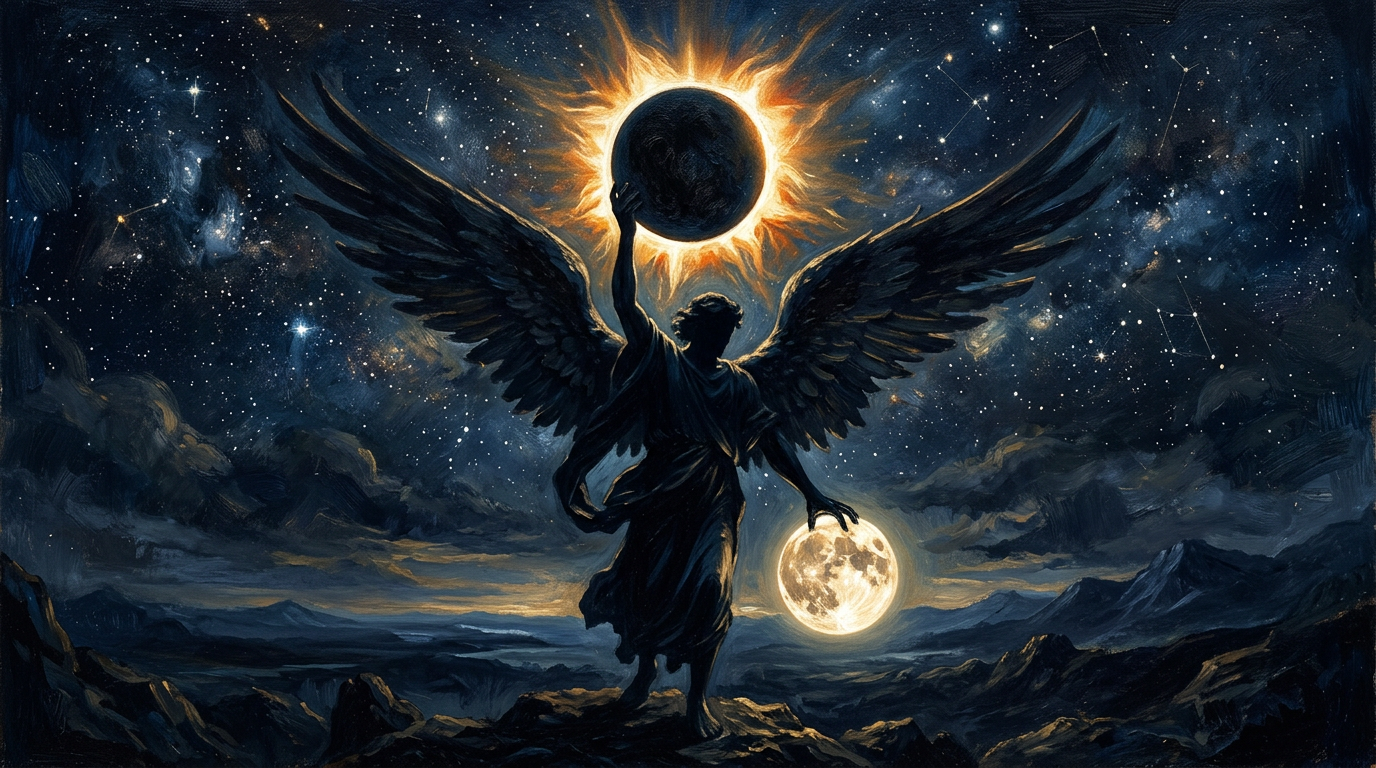
“How art thou fallen from heaven, O Lucifer, son of the morning! how art thou cut down to the ground, which didst weaken the nations! For thou hast said in thine heart, I will ascend into heaven, I will exalt my throne above the stars of God: I will sit also upon the mount of the congregation, in the sides of the north: I will ascend above the heights of the clouds; I will be like the most High. Yet thou shalt be brought down to hell, to the sides of the pit.” — KJV
Everyone knows this passage. The proud rebel who wanted to be God, cast down from heaven for his arrogance. But look up the Hebrew words — every one of them — and something unexpected happens. The passage stops being about generic pride and starts being about something very specific.
When the primary lexical meanings are used instead of the conventional translations, the passage reads:
“How you have fallen from the sky, O shining one, product of darkness! How you are cut down to the ground, you who enfeebled the nations! For you said in your heart: I will rise into the sky. I will raise my covered moon above the stars of God. I will establish the high place of the appointed times from the farthest extent of the darkness [of the moon]. I will rise at the height of the thick covering. I will silence the greatest [light]. Yet you shall be brought down to the grave, to the farthest extent of the pit.”
If this reading is correct, it changes what the passage is about. It is not a story about a spiritual being who wanted a higher rank. It is a blueprint for calendar corruption — raising a counterfeit “covered moon” above God’s stars, seizing authority from the full moon that governs the appointed times, and eclipsing the greatest light. It is the agenda Daniel 7:25 names plainly: “He shall think to change times and laws.” And the consequences are not theoretical — Scripture ties calendar violations directly to exile, national destruction, and the burning of Jerusalem (Lev 26:33–35, Jer 17:24–27, Amos 8:9–10).
The evidence for each word is presented below. Test it yourself — every alternative rendering uses a meaning attested in Strong’s concordance. Nothing is invented.
The Shining One, Product of Darkness
The being called “Lucifer” is H1966 helel — a word that appears nowhere else in Scripture. It comes from H1984 halal, “to shine, to give light.” Helel is the shining one.
He is called ben shachar. H1121 ben comes from H1129 banah — “to build.” In Hebrew idiom, ben doesn’t just mean biological son. It means the product of, the thing characterized by, the thing built from. “Sons of Belial” = people characterized by worthlessness. “Children of light” = people characterized by light.
H7837 shachar means dawn. But the root consonants שׁחר are shared by H7838 shachor — black, dark. In the unpointed consonantal text, ben shachar could be read as the product of dawn or the product of darkness. The Masoretic pointing selects “morning.” But the written root letters hold both — a shining one (helel) that is the product of shachar, a word whose root encompasses both first light and blackness.
He has fallen from H8064 shamayim — a word that means “sky” as readily as it means “heaven.” What follows — stars, a full moon, clouds — confirms the setting is astronomical. We are in the sky.
He “weakened the nations” — H2522 chalash, to prostrate, to enfeeble. Keep this in mind. Whatever this figure does, the result is that nations are weakened. Not individuals. Nations.
Five Declarations in the Sky
The rebel makes five “I will” statements across verses 13–14. In the conventional reading, all five say the same thing: “I want to be above God.” But Hebrew parallelism adds information in each line — it doesn’t repeat. If these are five distinct actions, what are they?
“I will raise my כסא above the stars of God”
Both readings agree on the first declaration — ascending into the sky. The divergence begins here.
The KJV reads “throne” — H3678 kisse (כִּסֵּא), seat of authority. But the consonantal text is just כסא. Those same consonants with different pointing yield H3677 kese (כֶּסֶא) — the full moon, as in Psalm 81:3 and Proverbs 7:20. Both derive from H3680 kasah — to cover, to clothe. The Masoretic pointing (c. 600 AD) selects “throne.” The unpointed text is ambiguous.
God’s כסא is the moon clothed in light — the feast-day moon of Psalm 81:3, fitting the pattern of God clothing His own throughout Scripture (Gen 3:21, Ps 91:4). God is the “Father of lights, with whom is no variableness, neither shadow of turning” (James 1:17) — no phase change, no shadow cast by rotation, constant and full. Lucifer’s כסא is the same word — but he is light that has fallen, a shining one now clothed in darkness, raising his counterfeit from the farthest extent of concealment.
Either reading works as a claim to power. The question is which fits the context. The כסא is raised above “the stars of God.” Genesis 1:16 places the moon and stars together: the lesser light to rule the night with the stars — co-rulers of the night sky. To raise your כסא above the stars is to claim authority over the very arrangement Genesis establishes. Every other contested word in the verse (moed, tsaphon) has a primary meaning connected to the calendar. The כסא raised above the stars is the calendar-marker itself — the full moon — not a generic symbol of authority.
“I will raise my full moon above the stars of God.”
“I will establish the high place of the appointed times from the farthest extent of the darkness [of the moon]”
Two words in this phrase are routinely undertranslated.
H2022 har — translated “mount” in the KJV, but its definitions include “promotion” — elevation, the high position of authority. Not just a geographic feature.
H4150 moed — the KJV says “congregation.” But moed’s primary meaning is appointed time. This is the word throughout Leviticus 23 for God’s feasts: “The feasts (moedim) of the LORD.” Genesis 1:14 says the luminaries are for moedim. And Psalm 104:19 is explicit: “He appointed the moon for seasons (moedim).” The moon governs the appointed times — that’s its stated purpose. The “tent of meeting” (ohel moed) is literally the “tent of the appointed time.” “Congregation” is a derived meaning. The primary meaning is temporal.
H6828 tsaphon — the KJV says “north.” But tsaphon does not mean “the direction opposite south.” Its root H6845 tsaphan means to hide, to conceal, to lurk in secret. Strong’s defines tsaphon as: “properly, HIDDEN, i.e. dark; used only of the north as a quarter (gloomy and unknown).” The $north study traces this in detail. In a passage set in the sky among luminaries, “hidden/dark” is an astronomical concept. “North” is a compass direction that makes no sense for a being already in the heavens.
H3411 yerekah — not merely “sides” but the farthest extent, the uttermost recesses. The innermost part of a ship (Jonah 1:5). The deepest part of a cave (1 Sam 24:3). As far as something goes.
Put them together: “I will establish the high place of the appointed times from the farthest extent of the darkness [of the moon].”
The previous line already told us what the governing authority of the calendar is — the כסא, the full moon. Scripture is explicit about this role. Psalm 104:19: “He appointed the moon for seasons (moedim).” Psalm 81:3: the trumpet sounds at the kese (full moon) on the feast day. Jeremiah 31:35: God gives “the ordinances of the moon and of the stars for a light by night.” The moon governs the appointed times — the har moed is the elevated position from which they are reckoned.
This figure is establishing himself on that position — seizing the calendar’s governing seat — but operating from the “farthest extent of the darkness [of the moon],” the conjunction, when the moon is completely invisible. He takes the role of the full moon but operates from the opposite phase.
“I will silence the greatest [light]”
Verse 14 opens with ascending above the bamot (H1116, high places) of the av (H5645). The KJV says “clouds,” but av means thick cloud, thick covering, thicket — from H5743 uv, “to cover with a cloud.” Not white and puffy — dense and opaque. An envelope that blocks light, casts shadow. The Hebrew preposition al can mean “above,” “upon,” or “at.” The dark moon rising at the height of the thick covering. Then comes the final declaration, and the passage’s most significant ambiguity:
This is the most consequential line, and it contains the passage’s most significant ambiguity.
H1819 damah means “to be like, to compare, to resemble.” That’s the conventional reading: “I will be like the Most High.” But H1820 damah — the same spelling, the same consonants דמה — means “to cease, to cut down, to destroy, to bring to silence.” Two entirely different roots producing an identical word. The Masoretes chose H1819 (imitation). H1820 (destruction) is equally valid from the unpointed text.
H5945 elyon means “Most High” when used as a divine title. But it’s also a plain adjective meaning “uppermost, greatest” — and nearly half its 53 biblical occurrences use it this way: the upper gate (2 Ki 15:35), the upper pool (Isa 7:3), the uppermost basket (Gen 40:17).
In a passage set in the sky among luminaries, “the elyon” is the greatest light — the sun. Genesis 1:16 calls it the gadol (H1419, greater) light. Gadol and elyon are near-synonyms — both mean preeminent, both include “high” in their definitions, and Psalm 47:2 uses them together: “the LORD most high (elyon) is terrible; he is a great (gadol) King.” The elyon is the gadol light — the greatest luminary.
Note how the two readings of damah interact with the two readings of elyon:
If elyon means “Most High” (God) → then damah must be H1819, “be like/resemble.” You cannot silence or destroy God. But “I will resemble the Most High” is a strangely vague ambition for a figure who just made four precise calendar-specific declarations.
If elyon means “the greatest [luminary]” (the sun) → then damah can be H1820, “silence, bring to darkness.” You CAN eclipse the sun. And “I will silence the greatest light” completes the astronomical sequence perfectly — the dark moon eclipsing the sun.
“I will silence the Greatest Light.”
The Picture
Read together, the five declarations are not five ways of saying “I want to be God.” They are five sequential actions — an astronomical event:
“I will rise into the sky. I will raise my full moon above God’s stars. I will establish the high place of the appointed times from the farthest extent of the darkness [of the moon]. I will rise at the height of the thick covering. I will silence the greatest [light].”
The dark moon ascending. Positioning itself among the stars. Seizing authority over God’s calendar from the conjunction — the phase of maximum concealment. Rising above the clouds. And finally eclipsing the sun.
A solar eclipse can only happen at the dark moon — the conjunction, when the moon is at its most hidden. That is the only phase where the moon passes between earth and sun. And during a total solar eclipse, what becomes visible in the darkened daytime sky? Venus — the morning star. The shining one, son of the dawn, literally appears when the sun is silenced.
Scripture marks its two most pivotal covenant moments with this exact image. When God cut the covenant with Abraham, “a horror of great darkness fell upon him” and the sun went down (Gen 15:12, 17). When Yeshua hung on the cross, “the sun was darkened … and the veil of the temple was rent” (Luke 23:44–45). Both times the greatest light is silenced at the moment of covenant blood. The adversary’s ambition — “I will silence the greatest [light]” — is enacted at the cross. But the eclipse passes. The sun returns. The torn veil becomes the freshly-slain and living way into God’s presence.
The Father, the Son, and the Stars
Scripture maps the celestial order onto relationship:
The Sun is the Father. “The LORD God is a sun and shield” (Ps 84:11). “The Sun of righteousness shall arise with healing in his wings” (Mal 4:2). He is “the Father of lights, with whom is no variableness, neither shadow of turning” (Jas 1:17) — no phase change, no eclipse, constant and full. The sun is the source of all light in the sky.
The Full Moon is the Son. The moon generates no light of its own — it reflects the sun. “I can of mine own self do nothing” (Jn 5:30). The moon is “the faithful witness in heaven” (Ps 89:37) — and Yeshua is “the faithful witness” (Rev 1:5). The same title. At full moon the witness is at maximum — the entire face reflects the Father’s light. “I am the light of the world” (Jn 8:12) — reflected light, given light, not self-generated light.
The Stars are the Righteous. “They that turn many to righteousness shall shine as the stars forever” (Dan 12:3). “Among whom you shine as lights in the world” (Phil 2:15). The righteous are smaller lights who shine in the darkness alongside the moon.
Genesis 1:16 establishes this order: the greater light (the Father) rules the day. The lesser light rules the night with the stars — the Son and the righteous together, governing the darkness with reflected light.
Scripture equates the night with the nations. Isaiah 60:2: “Darkness shall cover the earth, and gross darkness the people.” The Gentiles are “them that sit in darkness” (Luke 1:79). Yeshua calls His followers “children of light and children of the day” — “we are not of the night, nor of darkness” (1 Thess 5:5). There are children of the day and children of the night. The lesser light and the stars rule the night — the Son and the righteous govern the nations.
And they will. Revelation 20:4, 6: the saints “reigned with Christ a thousand years.” Revelation 2:26–28 makes the connection explicit — the overcomer receives “power over the nations” AND “the morning star.” The stars ruling the night. The righteous governing the nations. The Genesis 1:16 order fulfilled.
Isaiah 14:13 is the counterfeit of this entire structure. Lucifer raises his full moon — clothed in darkness instead of light — above the stars of God. He usurps the Son’s position as faithful witness. He seizes authority over the appointed times. He silences the Father (the greatest light). And the stars — the righteous — are now following his calendar, keeping his appointed times, governed by a counterfeit moon that reflects nothing.
That is how nations are weakened. Not by raw power but by deception — the righteous themselves, following a false full moon, keeping feasts on the wrong days, reading a calendar that began in darkness rather than in light. The stars still shine. But they orbit the wrong moon.
The Reversal
“Yet you shall be brought down to Sheol, to the farthest extent of the pit.” — v.15
The same word for “farthest extent” (H3411) appears in both v.13 and v.15. He aimed for the farthest extent of darkness. He is cast to the farthest extent of the pit. The eclipse ends. The dark moon passes. The sun returns. The judgment mirrors the crime.
The poetic structure of v.12 reinforces this: fallen from the sky, cut down to the ground. Every celestial body that rises must set — and when it sets, the earth hides it. The word translated “cut down” (H1438) is used throughout Scripture for felling high things — groves, idols, high places, the horns of the wicked. Here it describes a luminary felled from the sky to the ground, hidden by the earth — as every moon is hidden when it sinks below the horizon.
Why Nations Are Weakened
Verse 12 says this figure “weakened the nations.” Any sin weakens a nation. But Scripture names a specific consequence for abandoning the appointed times — and it is national destruction:
Exile. Leviticus 26:33–35 — if Israel does not keep the sabbaths, God will scatter them among the nations and the land will lie desolate, “because it did not rest in your sabbaths, when you dwelt upon it.” 2 Chronicles 36:21 confirms: the exile lasted “until the land had enjoyed her sabbaths.” Seventy years of exile to repay seventy missed sabbatical years. The punishment is precisely calibrated to the calendar violation.
Feasts turned to mourning. Amos 8:9–10 — “I will cause the sun to go down at noon, and I will darken the earth in the clear day. I will turn your feasts into mourning.” The sun silenced at noon. The feasts corrupted. The same imagery as Isaiah 14.
Your feasts I will not smell. Amos 5:21 — “I hate, I despise your feast days, and I will not smell in your solemn assemblies.” God does not merely ignore wrong feasts — He finds them repulsive.
Keep the sabbath and the city stands; break it and the city burns. Jeremiah 17:24–27 — “If you diligently hearken to me … to hallow the sabbath day … then shall there enter into the gates of this city kings and princes sitting upon the throne of David … and this city shall remain forever.” But: “If you will not hearken to me to hallow the sabbath … then will I kindle a fire in the gates thereof, and it shall devour the palaces of Jerusalem, and it shall not be quenched.” The survival of Jerusalem itself is conditional on the calendar.
Appointed times forgotten. Lamentations 2:6 — “The LORD has caused the appointed feasts and sabbaths to be forgotten in Zion.” The calendar fell first; the temple followed.
Destroyed for lack of knowledge. Hosea 4:6 — “My people are destroyed for lack of knowledge: because you have rejected knowledge, I will also reject you … seeing you have forgotten the law of your God.” The forgetting of Torah — including its calendar — is the mechanism of national destruction.
The offal of your feasts. Malachi 2:3 — “I will spread dung upon your faces, even the dung of your solemn feasts; and you shall be taken away with it.” The word for “dung” (H6569 peresh) appears only 6 times in Scripture — and every other occurrence is the intestinal waste of a sin offering that must be burned outside the camp (Ex 29:14, Lev 4:11, 8:17, 16:27, Num 19:5). God is saying: the unclean refuse of your corrupt feasts will be smeared on your faces, and you will be carried away with it — treated like the offal of a sacrifice, removed from the camp.
This is not generic weakening from generic sin. Scripture ties national strength directly to the calendar. A nation keeping the wrong appointed times is a nation under covenant curse.
Daniel 7 names this agenda plainly. In 7:25: “He shall think to change times and laws.” But the same chapter also shows the restoration. In 7:9, the “Ancient of Days” takes His throne. The Aramaic word for “Ancient” (H6268) comes from a root (H6275) meaning “to advance, to proceed forward” — the same word used when Abraham advanced to his next camp (Gen 12:8, 26:22). The “Ancient of Days” is not merely “the old one.” He is the starting point from which the days advance — the Starting of Days, the one from whom the calendar proceeds. He takes His throne — the same root word as the full moon in Isaiah 14:13 — and in 7:22, “the time came that the saints possessed the kingdom.” Time itself is set right. (See the full Daniel 7 study for the detailed parallels.)
Isaiah 14:13 describes the usurpation of that throne. Daniel 7:25 describes the execution. Daniel 7:9 and 7:22 describe the reclamation — the Starting of Days takes His seat, and the calendar is restored.
The $new-moon study demonstrates that the Hebrew word for “new moon” (H2320) comes from a root meaning “to renew, to restore to completeness.” The month begins at fullness, not at darkness. Psalm 81:3 places “renewed moon” and “full moon” in parallel — there the full moon is clothed in light, the feast-day moon. Isaiah 14:13 describes the counterfeit: a full moon clothed in darkness, raised from the farthest extent of concealment — rather than from visible fullness.
What’s Literal and What’s Interpretive
Every alternative rendering in this study uses a meaning attested in Strong’s concordance or standard Hebrew lexicons. No word is invented.
כסא — “throne” (H3678) or “full moon” (H3677): same consonants, same root H3680 kasah = to cover, to clothe. God’s כסא is clothed in light (Psalm 81:3). Lucifer’s כסא is a counterfeit fullness, raised from darkness.
moed — “congregation” or “appointed time”: the primary lexical meaning is temporal (Gen 1:14, Lev 23). “Congregation” is a derived meaning from the meeting place.
tsaphon — “north” or “hidden/dark”: root H6845 = to hide, to conceal. Strong’s defines it as “properly, hidden, i.e. dark.”
damah — “be like” (H1819) or “silence/destroy” (H1820): two different roots producing the same consonantal spelling.
elyon — “Most High” (divine title) or “the greatest” (spatial): roughly 23 of its 53 biblical uses are spatial. If divine, damah must be “resemble” (you can’t silence God). If “the greatest luminary,” damah can be “silence/eclipse.”
shachar — “morning” or “darkness”: H7838 shachor = black, dark. Same root letters as H7837 shachar = dawn.
The eclipse reading goes beyond translation into proposal. The Hebrew words support it — but the text does not say “eclipse.” That connection is drawn from the astronomical coherence of the primary meanings taken together.
Connections
- $full-moon — Full moon and throne share consonants and root; God’s throne is clothed in light, Lucifer’s is a counterfeit
- $new-moon — “New moon” in Hebrew means “renewed to completeness”; the month begins at fullness, not darkness
- $north — “North” in Hebrew literally means “the hidden direction,” from a root meaning to conceal
- $sun-moon-stars — God’s luminaries appointed for appointed times (Gen 1:14)
- $throne — The seat of authority; the throne as God’s seat
- Daniel 7:9, 22, 25 — The Starting of Days takes His throne; the adversary changes times and laws; the calendar is restored
- Psalm 81:3 — “Renewed moon” and “full moon” in parallel: the throne clothed in light at the feast
- Genesis 1:14 — Luminaries for signs, appointed times, days, years