Principles of Evaluation
When seeking the calendar that is most likely described by the biblical text, we must first establish some core principles by which we can evaluate proposed candidates. These principles claim no authority beyond the unbreakable word of God; they are simply what must follow if we hold that Scripture is true, sufficient, and cannot be added to, subtracted from, or made too difficult for the ordinary believer to obey.
If we accept—as the foundation of this inquiry—that every word of God is pure (Proverbs 30:5), that not one jot or tittle will pass from the Law until all is fulfilled (Matthew 5:18), and that the Scripture cannot be broken (John 10:35), then the following evaluative criteria are not optional preferences, personal biases, or competing traditions. They are inescapable deductions from the text itself. Any calendar system that fails these tests necessarily contradicts or adds to the written revelation, which Scripture forbids.
The principles in this chapter derive their neutrality from three interlocking biblical axioms:
-
God alone is the lawgiver and judge (Isaiah 33:22; James 4:12). No human institution, court, tradition, or calculation can legislate or alter what God has already declared.
-
We are commanded neither to add to nor take away from His words (Deuteronomy 4:2; 12:32; Revelation 22:18–19). Any rule, postponement, calculation method, or interpretive authority not explicitly present, clearly implied, or narratively demonstrated in Scripture is an addition that Scripture itself prohibits.
-
The commands of God are not too hard for us but are near us…so that we may do them (Deuteronomy 30:11–14). Therefore, the means of discerning and obeying the appointed times must be accessible to the ordinary person wherever they go in the world.
Because these axioms are non-negotiable within the premise that Scripture is true and unbreakable, the derived principles are not “biased toward observation” or “against rabbinic views.” They are simply the logical boundary conditions that any proposed calendar must satisfy to remain faithful to the text. In this light, the following principles are not one side of a debate; they are the scriptural guardrails that define the boundaries of the debate.
Chief among these principles is whether understanding time requires one to know math and astronomy, and how to calculate the calendar, or whether everyone should be able to look at the sky and discern the appointed times by observation alone. A related question is whether observations are objective or subjective, and who has the authority to interpret them. Some might ask why this is even relevant.
This is relevant because God commanded us to keep his Sabbath holy and to remember his appointed times. While it could be argued that many commands apply only to priests in the temple, some of these commands require all people to appear or perform actions on specific dates, such as Passover and the Day of Atonement, and there are grave consequences prescribed for those who fail to obey.
Also on the 10th day of this seventh month there shall be a day of atonement: it shall be an holy convocation unto you…For whatsoever soul it be that shall not be afflicted in that same day, he shall be cut off from among his people. And whatsoever soul it be that does any work in that same day, the same soul will I destroy from among his people.
This command applies to all people, requires all people to know the day of the month, and prescribes the extreme consequence of being cut off for failure to obey it. Thankfully, we have the blood of Jesus to cover our unintentional sins, but once we are saved, we should desire to obey his commands with all our heart, mind, body, and soul. Thus, we should be able to identify this day and afflict ourselves as instructed, or else we continue in sin.
With this underlying motivation that applies to all people, we must evaluate which calendar system all people are capable of following and for which they can be held accountable. Consider that Scripture directly tells us that the commands are not too hard for us, neither far off:
For this commandment which I command thee this day, it is not too hard for thee, neither is it far off.
ASV
We now have a metric by which we can judge calendars: are they beyond the reach of the average man armed only with a Bible? Do they require an elite group of astronomers and mathematicians to discern? Any calendar that is viable only with modern technology and speed-of-light communication is extremely suspect because it would have been beyond the reach of people 3,500 years ago. I argue that the calendar should be so simple to understand that a 12-year-old or younger child could reliably follow it without any outside authority. Consider that the youngest king of Israel was 7 years old; therefore, one could argue that this is an age of some level of accountability.
Given the consequences for failure to obey, it seems logical that there is an objective standard — that the times themselves are holy and our failure to read the clock properly doesn’t change the holy times. God makes reference to a calendar and gives commands relative to this objective calendar. He does not prescribe a process that, if followed, allows people to change the times and appointed times. In fact, any change to the appointed times is the spirit of Antichrist.
He shall speak words against the Most High, and shall wear out the saints of the Most High, and shall think to change the times and the law.
The next principle that this book will leverage is that the Bible often demonstrates things implicitly in the storyline rather than explicitly as instruction. Jesus lived a perfect, sin-free life; therefore, his life is a demonstration of the true calendar even if he never once explicitly addressed the calendar.
Some people use Jesus’s lack of explicit statements as confirmation of the assumed inherited Jewish calendar; however, that is a circular argument that ignores the documented reality that there may have been major divisions between what was officially practiced in the Temple and what was practiced throughout the countryside outside of Jerusalem. Josephus described the tension between the Sadducees, who held the highest positions, and the Pharisees, who held favor with the masses. The Sadducees tended to stick to only what was in Scripture. Therefore, we must avoid the circular logic caused by survivorship bias when testing calendars.
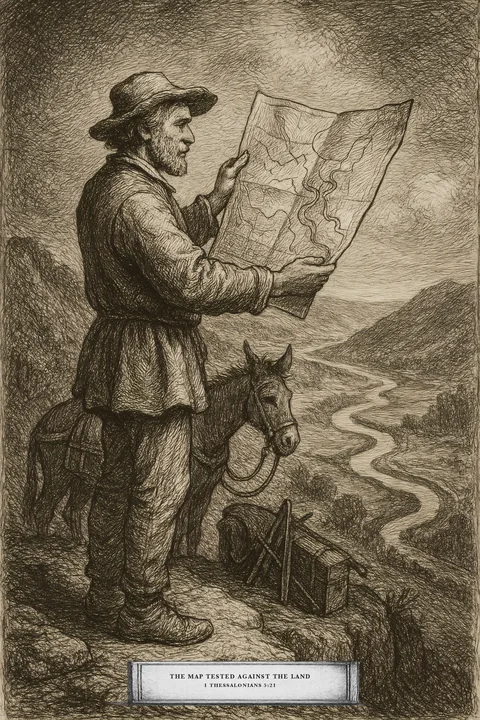
Map vs Territory
Before going forward, we must get a clear understanding of the difference between the map and the territory, or actual land, because this distinction is what allows us to test claims without falling into circular reasoning. There are an infinite number of maps, but only one territory or physical reality. Proving that a map existed 2,000 years ago does not prove that it was accurate or even that it was in use. We can prove that many different maps existed, and they all disagree with each other.
A calendar is a map of time, and the physical reality is the LORD’s appointed times. If you want to test a map, you must go out into the physical world and see if the map accurately directs you to your destination.
If you want to test a calendar, you must know with near certainty that a particular point in time was one of the LORD’s appointed times, and you must know this without a direct or indirect circular reference back to an assumed calendar. Just because your map says the treasure is buried under the X doesn’t mean the X is in the right place. Instead, you must first find some treasure, then see which maps have an X in the right place.
Scripture & the Calendar
The first thing you will discover when searching for the scriptural evidence that the month starts with the dark or sliver moon is that everyone references books outside the canon. The books of Enoch, Jubilees, and Sirach are examples. This opens up a broader debate about whether these books are indeed “flawless Scripture,” merely commentary on Scripture, or even writings of false prophets. However, if they contradict the canonical Scriptures, then they cannot be trusted for doctrine. In other words, these extra-biblical books could be just another source documenting the tradition of men we were warned to avoid.
If canonical Scripture didn’t say anything about the moon, then we would have no basis for judging or testing these extra-biblical books to determine whether their additions are consistent with known Scripture. But if the Scriptures do provide even a hint of evidence in a different direction, then we begin to have an argument that these noncanonical books are clearly not Scripture. So while extra-biblical books can provide useful confirmation of concepts proven by canonical Scripture, they cannot be relied upon to introduce new doctrines, such as calendars.
It is my contention that the calendar is such a critical key to understanding prophecy, knowing Him, and knowing his laws and statutes that His calendar will be embedded implicitly throughout the canonical text in a way that is hard to corrupt.
Consider for a moment: If the Scriptures were too overt in describing the calendar, then the enemy would have a very easy target to corrupt by changing a word or two. But if the Scriptures capture evidence of the calendar indirectly, then it wouldn’t be an obvious target to corrupt.
So those advocating the sliver or dark moon who admit right out of the gate that they have little to no canonical evidence have already conceded the point. In later chapters, I am going to present an abundance of verses from the canon that support a full moon. This leaves a high burden for Enoch, Jubilees, and Sirach to overcome if they are to be considered Scripture that doesn’t contradict the canon.
All of that said, because dark- and sliver-moon advocates rely on tradition and other works, it might simply be that they haven’t dug deep enough to find the evidence in the canon. This is a wake-up call to stop relying on tradition, start looking for real evidence, and avoid logical fallacies.
Summary of Principles
Here are the broad, standalone criteria derived from the highest principles that can test any proposed calendar system for biblical fidelity.
-
Commands Are Accessible to All: God’s instructions, including appointed times, are straightforward and within reach for ordinary people, so the calendar must be simple enough for anyone—including children—to understand and follow without specialized knowledge.
-
Universal Personal Accountability: Holy days apply to every individual, with serious consequences for non-observance; everyone must be able to reliably identify the correct dates.
-
Connected to Sun, Moon, and Stars: The Bible explicitly states that the sun, moon, and stars are for signs, appointed times, days, and years. These lights are the hands on God’s celestial clock; therefore, any calendar must remain synchronized with the heavens.
-
Objective, Unchangeable Holy Times: Appointed times are fixed and holy by divine decree; human failure to discern them does not alter their sanctity, and no process is given for man to modify them; instead, we must seek and discover them like other natural laws of physics.
-
Implicit Demonstration in Narrative: Scripture reveals truth through lived examples, not just explicit written rules.
-
Agricultural/Seasonal Alignment: Ensures calendars maintain harmony with natural cycles, preventing holy days from drifting out of commanded seasons for decades, centuries, and millennia.
-
Practical Global Decentralized Observation: Assesses whether a calendar supports biblical unity while allowing practical accessibility over all time periods.
It is with these principles that this book will dive deep and test everything so that we can hold to that which is good. But before we go further, we must address alleged rabbinic authority.
Some may immediately object that these principles are biased against a calculated calendar and fail to account for authority given to elders. They may claim calendar chaos if a centralized authority is removed and elevate unity over perfection. I ask you to consider that, to a secular audience, all lunar calendars are pure chaos, with their months drifting relative to the familiar Gregorian calendar. The chaos is not related to the calendar, but to the conversion from one calendar to another. If the lunar calendar were the sole calendar, then no one would experience any chaos.
The true source of chaos is human authorities abusing authority to interpret the signs in the sun, moon, and stars. When their opinion is binding regardless of the objective reality, they have used it for political means. The Julian and Gregorian calendars solved this by removing almost all subjective interpretation except the exact location of the international dateline, which remains subject to political manipulation.
There is nothing wrong with using calculation, so long as the calculation does not produce a different result than the observation would. The heavens are the ground truth—the means by which God has declared his times and speaks his calendar to us.
He made the moon to mark the seasons; the sun knows its time for setting.
ESV
The heavens declare the glory of God, and the sky above proclaims his handiwork. Day to day pours forth speech, and night to night reveals knowledge. There is no speech, nor are there words, whose voice is not heard. Yet their voice goes out through all the earth, and their words to the end of the world.
ESV
Let God be found true, though every man be found a liar, as it is written: “That You may be justified in Your words, And prevail when You are judged.”
Regardless of what calculations we make or what opinions those who claim authority pronounce, God’s word spoken through the stars reveals the truth, and in light of this truth, all contrary opinions are lies and all men liars. We are all accountable to God’s truth regardless of the lies told by men.