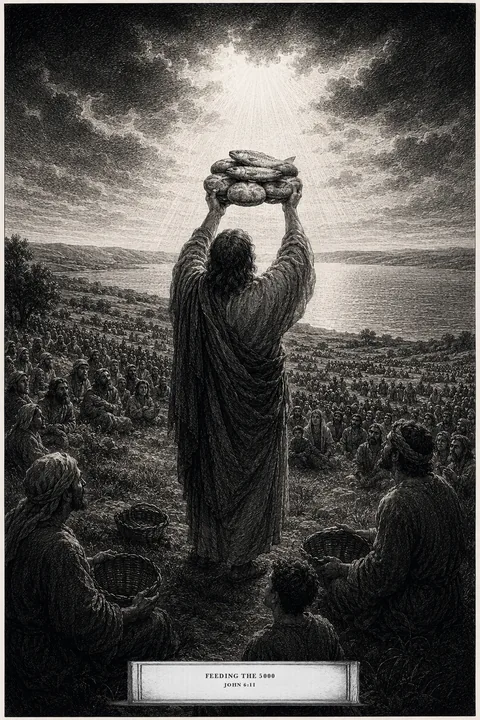
For my flesh is meat indeed, and my blood is drink indeed.
— John 6:55
Introduction
Shortly after feeding the five thousand, Jesus gave a hard teaching in the synagogue at Capernaum (John 6:59): “Except ye eat the flesh of the Son of man, and drink his blood, ye have no life in you… He that eateth my flesh, and drinketh my blood, dwelleth in me, and I in him” (John 6:53, 56). After He said this, many of His disciples murmured — “This is an hard saying; who can hear it?” — and “from that time many of his disciples went back, and walked no more with him” (John 6:60, 66). It was so bad that Jesus turned to the twelve and asked whether they would also go away.
It was a hard saying because those who heard it did not know the symbolic language of the Scriptures, and took it over-literally, saying: “How can this man give us his flesh to eat?” (John 6:52). Which prompts the question: why would Jesus speak in a manner that drives people away? Why not speak plainly?
He did it to fulfill the Scriptures, which prophesied that He would speak in parables. When he spoke publicly he always used parables — “without a parable spake he not unto them” (Matthew 13:34) — and only with his closest disciples did he explain their meaning. Even so, when he gave the parables of the kingdom his own disciples did not understand, and Jesus rebuked them for it. The rebuke was fair because the keys were already in the Old Testament: the “dark sayings of old” that the psalm said he would utter (Mark 4:13; Psalm 78:2-3; Matthew 13:35). That exam waits a chapter ahead: The Parables of the Kingdom.[1]
In other words, Scripture prophesied that the message would be encrypted in parables and decoded with the Old Testament. If you think you can read the New Testament without an intimate understanding of the Old, chances are you will walk away like the masses — either by interpreting it in a way you reject, or by misinterpreting it in a way you can accept, and facing the same consequences either way.
The first hearers of the apostles knew better. When Paul preached in Berea, Luke recorded how the hearers received him — and graded them for it:
These were more noble than those in Thessalonica, in that they received the word with all readiness of mind, and searched the scriptures daily, whether those things were so.
They tested Paul against the Old Testament, and Scripture calls that nobility. How many today search the Old Testament to see whether their understanding of Paul is true? The order has quietly reversed: Paul, as we understand him, has become the judge of the very Scriptures he was judged by. And the test is not for Paul only — your understanding of any verse must be tested against every other verse, for “at the mouth of two witnesses, or at the mouth of three witnesses, shall the matter be established” (Deuteronomy 19:15): one verse cannot make a doctrine.
The Bible provides two symbolic words, meat and milk, to describe its teachings, and if you do not do the work to churn the milk into meat, you will remain immature at best — and at worst turn away entirely, like the crowds in Jesus’ day.
The purpose of this book is to teach you how I learned to chew the word of God and test everything. It is a repeatable, reproducible process that has yielded more pearls of wisdom — and more appreciation for the supernatural structure of the word of God — than I could possibly fit in one book. We will go through the process systematically and apply it to dozens of symbolic words, starting with meat and milk. But first we must prepare the ground by explaining the difference between a word and a symbol.
What Is a Symbolic Word?
When you read Scripture, you bring your own private dictionary and personal associations to its words. Those associations include not just the Webster’s meaning but the slang meaning — and, for many who grew up in church, the taught “seminary meaning.” None of these are the definitions Scripture provides.
A symbolic word is a word whose scriptural meaning differs from its dictionary meaning. When John cries, “Behold the Lamb of God, which taketh away the sin of the world” (John 1:29), no one reaches for a dictionary. A lamb is a young sheep; the Lamb is the Messiah — the atonement for sin that every Passover lamb pointed to — and every church on earth reads it so without being told. You already speak this language; the question is only how much of its vocabulary you were ever taught.
The symbol is the idea; the word is merely its label. And because the meaning lives in the relationships between passages rather than in the label, it survives translation: trade the English word for the Hebrew or the Greek and the pattern still points to the same idea. A word earns a place in this book’s glossary only when Scripture itself fixes its meaning — defined openly in one passage, used consistently in the rest, contradicted by none.
The subject of this book is the Bible’s language, and most of that language is symbolic — an image bearing a meaning. Scripture also defines ordinary words internally, almost literally, and those internal definitions — anointing, belief, cleanliness, covenant, faith, grace, hate, hell, holy, justification, love, mercy, sanctification, Tartarus, works, and works of the law — differ from the dictionary and from the common understanding just as sharply as any symbol does. No image stands for anything in them; the word’s own scriptural definition is the recovery, and the Glossary marks these 16 with a WORD badge.
The Glossary at the back gathers 152 symbolic entries and 16 recovered words. Some agree with familiar teaching, some sharpen it, and some challenge it outright; none stands on tradition, novelty, or an outside vote. Each must stand or fall by the Scriptures cited beneath it and by the chapter that develops its case.
Supernatural Design of Scripture
The meaning of words never sits still. Modern translations spare the reader from many obsolete English traps. The NKJV says the one who now restrains will restrain (2 Thessalonians 2:7), the living will not precede those who sleep (1 Thessalonians 4:15), God’s people are His “own special people” (1 Peter 2:9), and humanity is told to fill the earth (Genesis 1:28). Older English words such as let, prevent, peculiar, and replenish once carried those same meanings, but a modern reader can easily hear the opposite. The change is not harmless: the later sense of filling again has even been used to build a doctrine of a former world destroyed and repopulated that the Hebrew never required. Even meat has drifted: it meant any food at all. Semantic drift happens in every language, and it compounds in translation as each translator ratifies the drift of his own day into a new tongue.
Drift is the gentlest of the threats. The serpent’s first recorded words are an attack not on the text but on its meaning — “Yea, hath God said?” (Genesis 3:1) — and that has been the strategy ever since: what cannot be deleted can be re-glossed. Change the dictionary, change the context, change the emphasis, and the words stand untouched while the message dies. If Scripture stored its meaning in dictionary definitions, that attack would have succeeded centuries ago.
Meaning, however, is not carried by words; it is carried by the relationships among words. Modern AI is living proof of the principle: no one feeds a translation model a dictionary — it learns the meaning of every word in every language purely from how words relate to one another across mountains of text, and from those relationships alone it carries an idea faithfully between languages. Scripture’s symbols are built the same way: the meaning of a symbol is not stored in its label but established by every place the word is used and every word it stands beside, line upon line, across the whole of the text. (AI is only the proof of concept — never the judge, and never the proof of any particular interpretation; the gathering and testing remain fully in our own hands.)
A meaning stored that way is nearly indestructible. It survives translation: translation swaps every word, but it cannot swap the relationships among them — and the symbols live in the relationships. The New Testament has already passed through one layer of translation by the time it reaches English, and the symbols still hold.
It survives corruption: to re-gloss a meaning spread across every book, you must consistently rewrite every occurrence in every author across every century — corrupt one verse and a hundred witnesses convict the change. The very redundancy that hides the meaning from the careless guards it from the corrupter.
The grass withereth, the flower fadeth: but the word of our God shall stand for ever.
The word stands forever because neither translator nor corrupter can reach where its meaning lives.
The same redundancy is also a signature. Some forty writers, across some fifteen centuries, in multiple languages, hold one symbol grammar without a collision — as the chapters ahead will prove: the mountain is a kingdom from Moses to Daniel’s Babylon to John’s Patmos; the seed is the word in Isaiah’s field and in the boat on Galilee; the harlot, the vine, the shepherds, the wings keep their meanings across authors who never met. Beneath that runs a second layer — the Hebrew letters themselves, where wordplay binds symbol to symbol — that no committee spanning a millennium could have coordinated, and no forger could retrofit, even with the most advanced computational help.
The relationships are so consistent, and so unexpected, that one cannot help but conclude the book is supernatural. That consistency is also the claim this book stakes its method on — a fabricated system would break somewhere under the weight of every occurrence being gathered and tested; this one, tested, holds.
What Is Meat?
Jesus defines the symbol out loud, as Scripture defines so many of its symbols. At Jacob’s well in Samaria, the disciples came back from buying food and pressed him — “Master, eat” — and he answered, “I have meat to eat that ye know not of” (John 4:31-32). They took him literally, as the crowd at Capernaum would: “Hath any man brought him ought to eat?” Then he defined the word:
My meat is to do the will of him that sent me, and to finish his work.
Meat is not a harder topic or a deeper lecture, as is commonly taught; it is the will of the Father, done. And what is the will? Scripture answers by recording one moment twice. Jesus’ mother and brothers stood outside the crowded house asking for Him, and He answered.
Whosoever shall do the will of my Father which is in heaven, the same is my brother, and sister, and mother.
My mother and my brethren are these which hear the word of God, and do it.
Same scene, same sentence — one evangelist heard “do the will of my Father,” the other wrote it down as “hear the word of God, and do it.” And both evangelists wrote by the same Spirit — “all scripture is given by inspiration of God” (2 Timothy 3:16) — so this is no reporter’s paraphrase: it is a divine equation, established at the mouth of two witnesses. The will is the word, done — David sang the same equation a thousand years earlier:
I delight to do thy will, O my God: yea, thy law is within my heart.
Milk is “the sincere milk of the word” (1 Peter 2:2) — the word received. Scripture identifies who drinks it: babes, the “unskilful in the word of righteousness,” those “not able to bear” meat (Hebrews 5:13; 1 Corinthians 3:2). Nature supplies the picture. This step is an observation, not a verse: milk is food another body has already digested; the infant does no work, it swallows what was broken down for it, and grows. The scriptural marks agree with the picture — the milk-drinker has received without practicing, and his diet is good, and first, and meant to be outgrown.
Whom shall he teach knowledge? and whom shall he make to understand doctrine? them that are weaned from the milk, and drawn from the breasts.
Milk and meat, then, are not two doctrines; they are one substance in two states — the word received, and the word done. The bridge between them is work: “the churning of milk bringeth forth butter” (Proverbs 30:33) — the same milk, worked, sets solid. And Isaiah wrote the outcome of that diet seven centuries before Hebrews did.
Butter and honey shall he eat, that he may know to refuse the evil, and choose the good.
Hebrews describes the meat-eater in exactly those terms: “those who by reason of use have their senses exercised to discern both good and evil” (Hebrews 5:14). Not by reason of hearing. By reason of use.
How do you tell them apart at the table? Job gives the test: “the ear trieth words, as the mouth tasteth meat” (Job 34:3) — and tasting is testing; trieth is the assayer’s word. The test’s verdict is even written out in advance: “O taste and see that the LORD is good” (Psalm 34:8). And Paul gives the standing order in the assayer’s own word, dokimazō: to test.
Test all things; hold fast that which is good.
NKJV
The tongue’s verdict and the tester’s verdict are one word, good, and discerning “both good and evil” (Hebrews 5:14) is precisely what the meat diet trains. Scripture even sets a tasting after each: Peter follows the milk of the word with “if so be ye have tasted that the Lord is gracious” (1 Peter 2:2-3), and Hebrews follows strong meat with “tasted the good word of God” (Hebrews 6:5). “Test all things” turns out to be a dietary instruction — the taste-test, applied to every understanding of Scripture.
If a teaching can be swallowed without tasting — without checking, without doing — it is milk, whatever its subject. Jesus gives the other side of the test — and stakes His own teaching on it:
If any man will do his will, he shall know of the doctrine, whether it be of God, or whether I speak of myself.
If a teaching’s truth opens only to the one who obeys it, it is meat. Milk is fluid: it takes the shape of whatever container receives it. Poured into the truth, it takes meat’s own shape — which is why milk never contradicts meat. But poured into a false doctrine it sets just as agreeably, shaped to whatever the hearer wants to hear — “after their own lusts shall they heap to themselves teachers, having itching ears” (2 Timothy 4:3) — and that is why the babe stays “tossed to and fro, and carried about with every wind of doctrine” (Ephesians 4:14) until he is weaned.
The unpointed Hebrew sharpens the warning. Milk and fat are the same three letters — חלב, chalav or cheleb, divided only by vowel points added centuries later — and the fat belongs to the LORD alone: “all the fat is the LORD’s… ye eat neither fat nor blood” (Leviticus 3:16-17).
When Ezekiel indicts the false shepherds, the pointed text reads “Ye eat the fat… but ye feed not the flock” (Ezekiel 34:3) — and the Greek translation made before the points existed read the same letters as “Ye feed on the milk.” Both readings convict, and together they say everything: shepherds consuming what belongs to God, drinking down the babes’ first food, and feeding no one. It is Hebrews’ rebuke walking in the pastorate: “when for the time ye ought to be teachers… are become such as have need of milk, and not of strong meat” (Hebrews 5:12) — the shepherd still at the breast has nothing to set on the table.
The double reading is no parlor trick; it has teeth for anyone who intends to obey. The same three letters sit in a standing command — “ye eat neither fat nor blood” (Leviticus 3:17) — so which food a verse names can decide what a servant may put in his mouth. Where the letters permit two readings, this book prefers the witnesses older than the points: the Greek translation made centuries before them, the scrolls from the Dead Sea that carry the bare consonants, and the New Testament itself, whose authors — the writer of Hebrews above all — quote that older Greek as Scripture. The vowel points are a tradition of men, laid over the letters a thousand years and more after the prophets wrote; a chapter of its own — What Is the Point?, at the head of Part Three — makes the full case that they must not be treated as part of the infallible word when seeking the truth.
Now go back to the synagogue at Capernaum, where this book began — and notice that Jesus began with bread. Bread is the word: “man doth not live by bread only, but by every word that proceedeth out of the mouth of the LORD” (Deuteronomy 8:3; Matthew 4:4). In Hebrew the two foods overlap by design — lechem, bread, is rendered “meat” again and again in the King James, because both are the word served as food — “seed to the sower, and bread to the eater” (Isaiah 55:10).
Jesus therefore laid the word on the table first — “I am the bread of life” (John 6:35) — then named it the Word made flesh — “the bread that I will give is my flesh” (John 6:51; John 1:14) — and then finished the climb: “my flesh is meat indeed” (John 6:55). Bread, flesh, meat: the word, embodied, done.
Beneath the Greek, the Hebrew letters lock the climb in place: flesh is basar, and basar is also the verb of the good tidings — the gospel-word of “him that bringeth good tidings” (Isaiah 52:7); Strong’s derives the noun from the verb. The Word made flesh is the good tidings in person — which is why His flesh is “meat indeed.” The gospel is the meat.
The common teaching runs exactly opposite that distinction. Ask today, and you will be told the gospel is the milk — the starter message for new believers — and as commonly preached, it is, though not for the reason they think: it is offered as a message to accept, never a message to obey, and a teaching that asks nothing to be done is milk by this chapter’s own test, whatever its subject. That is not how Scripture speaks of it. When Jesus first preached the gospel, Mark records a command with two verbs:
The time is fulfilled, and the kingdom of God is at hand: repent ye, and believe the gospel.
When Paul grieves that Israel refused that message, the gospel not obeyed is in one breath the report not believed (Romans 10:16) — to Paul the two verbs are one.[2] So the gospel is one substance in the two states this chapter has already weighed: heard, it is milk; obeyed to completeness, it is meat.
Watch Paul serve both tables from one message. Writing to Corinth, he says he arrived determined “not to know any thing among you, save Jesus Christ, and him crucified” (1 Corinthians 2:2) — and a page later he tells the same congregation, “I have fed you with milk, and not with meat: for hitherto ye were not able to bear it” (1 Corinthians 3:2): Christ crucified, served as milk to babes. Yet in between he says, “Howbeit we speak wisdom among them that are perfect” (1 Corinthians 2:6) — the mature, the teleioi, Hebrews’ meat-eaters. Same letter, same Christ: milk to the babe, wisdom to the perfect — the difference was never the message; it was the state of the eater.
Even the foundation Hebrews lists — “repentance from dead works, and of faith toward God, of the doctrine of baptisms” (Hebrews 6:1-2) — is a foundation of doings, laid once and built upon. If your gospel asks nothing of you, you have it as milk; it becomes meat only in the doing.
“My flesh is meat indeed” emptied the room — but Jesus had handed out the key before they left:
It is the spirit that quickeneth; the flesh profiteth nothing: the words that I speak unto you, they are spirit, and they are life.
Eat my flesh meant take in my words and do them. Peter, asked whether he would leave too, answered flesh with words — “thou hast the words of eternal life” (John 6:68). The crowd that walked away had just been fed: full stomachs, no comprehension. That is milk’s danger, lived out — they received, and never chewed.
Hence, this book’s title: MEAT The Bible’s Symbolic Language. It does not hand you a closed set of conclusions to swallow; it teaches you to chew — to gather, to taste, to test, and to do. Say the title aloud, and you have the invitation on its back cover: come — meet the Bible’s symbolic language (pun intended, in the spirit of the awe-inspiring wordplay found throughout Scripture).