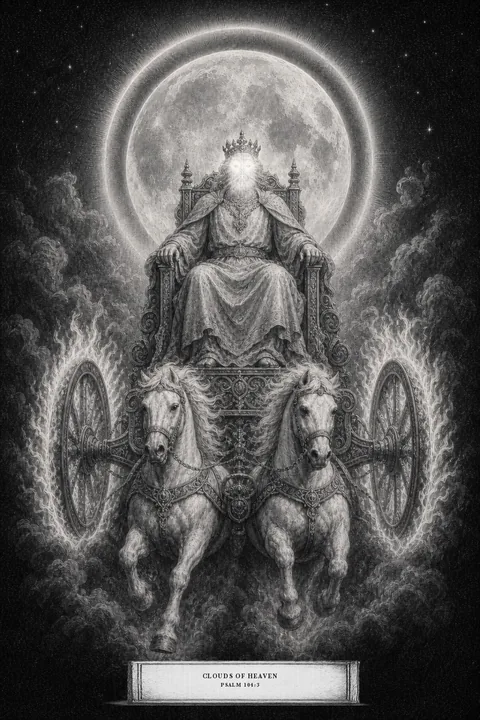
Who maketh the clouds his chariot: who walketh upon the wings of the wind.
— Psalm 104:3
Clouds of Heaven
Genesis places the covenant bow in the cloud, and it is almost universally understood as a rainbow. Yet the Bible’s symbolic language reveals a much deeper meaning that yields profound insight throughout Scripture. This chapter lets Scripture interpret Scripture, showing that the clouds of heaven are God’s chariot and are associated with the full moon, which serves as His throne and guides the steps of His people.
Noah states the connection directly:
I do set my bow in the cloud… And the bow shall be in the cloud; and I will look upon it, that I may remember the everlasting covenant.
16
The covenant bow is assigned a location.
Isaiah supplies the corresponding action:
Behold, the LORD rideth upon a swift cloud.
Israel’s cloud-pillar likewise governed the timing of the nation’s walk through the wilderness: when the cloud lifted they journeyed, and while it remained they camped (Exodus 40:36-37; Numbers 9:17-23).
Ezekiel then opens the chariot-cloud:
Behold, a whirlwind came out of the north, a great cloud, and a fire infolding itself, and a brightness was about it… Also out of the midst thereof came the likeness of four living creatures… and they had the likeness of a man.
The things moving within the cloud appear as fire and light:
As for the likeness of the living creatures, their appearance was like burning coals of fire, and like the appearance of lamps… and the fire was bright, and out of the fire went forth lightning. And the living creatures ran and returned as the appearance of a flash of lightning.
Ezekiel later says, “I knew that they were the cherubims” (Ezekiel 10:20). Chronicles names their office:
The chariot of the cherubims, that spread out their wings, and covered the ark of the covenant of the LORD.
The vision now rises above the cherubic chariot:
Then I looked, and, behold, in the firmament that was above the head of the cherubims there appeared over them as it were a sapphire stone, as the appearance of the likeness of a throne.
The linked symbol supplies the identification: Sapphire is the full moon in its enthroned form. Without the points beneath the throne-word, the final phrase may also be heard, “as the appearance of the likeness of a full moon.” Ezekiel then reveals the One seated there:
And above the firmament that was over their heads was the likeness of a throne, as the appearance of a sapphire stone: and upon the likeness of the throne was the likeness as the appearance of a man above upon it.
The vision closes by returning to Noah’s bow:
I saw as the colour of amber, as the appearance of fire round about within it… and it had brightness round about. As the appearance of the bow that is in the cloud in the day of rain, so was the appearance of the brightness round about. This was the appearance of the likeness of the glory of the LORD.
The Throne as the Moon
Scripture makes the throne–moon comparison directly:
His seed shall endure for ever, and his throne as the sun before me. It shall be established for ever as the moon, and as a faithful witness in heaven.
The word rendered “before me” is neged — before, in front of, facing, opposite. The full moon alone occupies that relation to the sun: the two lights face one another from opposite sides of the earth.

At the dark phase, the illuminated hemisphere faces away from the earth; at the full phase, the moon stands opposite the sun and the face visible from earth is covered with the sun’s light. The chariot psalm gives the same covering:
Who coverest thyself with light as with a garment… who maketh the clouds his chariot.
Daniel’s throne is fire, and Ezekiel’s cloud-borne throne shines with fire, brightness, and the bow round about it (Daniel 7:9; Ezekiel 1:26-28). The full moon is the faithful witness covered with the greater light and bearing it toward the earth.
Job then lays the cloud directly over the face of the throne (full moon):
He incloseth the face of his throne, and spreadeth his cloud upon it.
ASV
Above the cloud-borne chariot is the throne with its Rider: the full-moon seat with its Rider enthroned.
The Bow Around the Throne
John now sees the bow around the throne itself:
Behold, a throne was set in heaven, and one sat on the throne… and there was a rainbow round about the throne, in sight like unto an emerald.
Genesis places the bow in the cloud; Ezekiel reveals its brightness around the glory above the cloud-borne throne; Revelation places it around the throne itself. Ezekiel’s stated likeness is the bow “in the day of rain,” and within that same vision it surrounds the throne Scripture compares to the moon. Through most of its visible changing, the moon itself appears as a bow carried toward and away from fulness. The covenant reminder is thereby rehearsed across most of the month.
The Rider of the Clouds
Daniel gives the cloud its royal passenger:
One like the Son of man came with the clouds of heaven, and came to the Ancient of days… And there was given him dominion, and glory, and a kingdom.
Read as a title, He is the Venerable One whose throne is established of old. Read as calendar language, He is seated at the advancement of days—the beginning from which the month, year, and age proceed.
Jesus claims Daniel’s scene before the high priest:
Hereafter shall ye see the Son of man sitting on the right hand of power, and coming in the clouds of heaven.
At His ascension the cloud receives Him:
While they beheld, he was taken up; and a cloud received him out of their sight… this same Jesus… shall so come in like manner as ye have seen him go into heaven.
11
The cloud receives the Rider and carries Him from sight; the angels make that manner of departure the manner of return.
White Cloud, White Horse
John next sees the Rider upon a white cloud:
And I looked, and behold a white cloud, and upon the cloud one sat like unto the Son of man, having on his head a golden crown, and in his hand a sharp sickle.
The same rider-formula returns upon a white horse:
And I saw, and behold a white horse: and he that sat on him had a bow; and a crown was given unto him: and he went forth conquering, and to conquer.
Both visions place a seated, crowned figure upon something white; one is a cloud, the other a horse, and the horse-rider carries the bow Genesis placed in the cloud. John elsewhere sees Faithful and True seated upon a white horse when heaven opens (Revelation 19:11).
Zechariah completes the bridge:
In the third chariot white horses… These are the four spirits of the heavens, which go forth from standing before the Lord of all the earth.
5
In Revelation, the white cloud and white horse occupy the place beneath the seated figure; Psalms calls the cloud a chariot, and Zechariah joins white horses to a chariot.
The Definition
Cloud — the visible covering and mobile throne-chariot of heaven: it manifests and veils its Rider’s presence, bears the throne, and carries those received into it. In prophetic rider scenes, the white cloud occupies the same conveyance-position as the white horse.