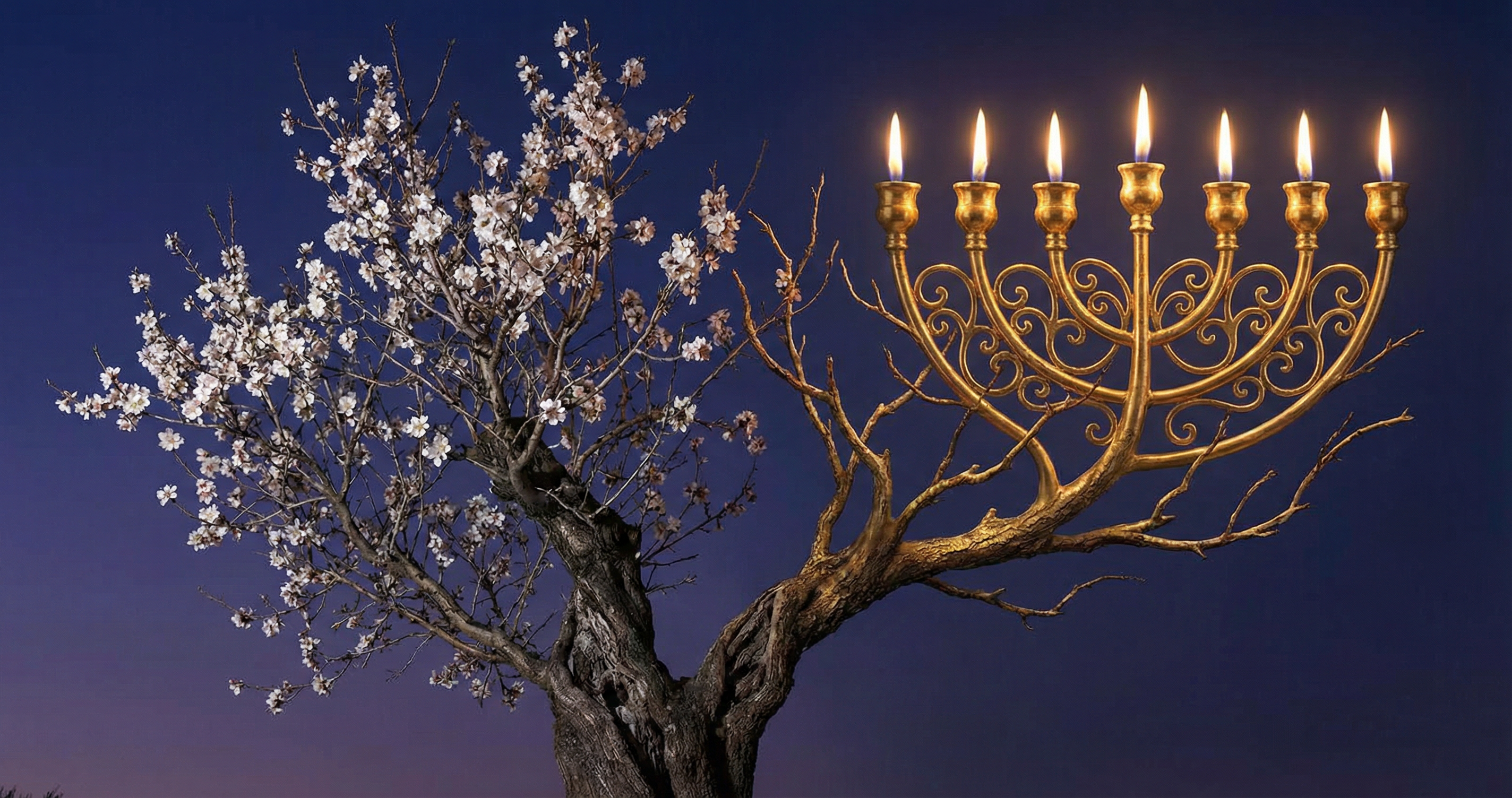
This is almond season. Right now, across Israel, the almond tree is blooming — white blossoms on bare branches while every other tree still sleeps through winter. Its Hebrew name tells you why it matters: the word for "almond" and the word for "watching" are the same word. The tree is literally named "the watcher." And what Scripture says about this tree, about the lampstand, about the 144,000, and about the command to "watch" — when read in Hebrew — forms a single, urgent message.
I. The Golden Almond Trees
The Watcher-Tree
The almond tree blooms in January and February — sometimes on bare wood with no leaves, while every other tree in the land still sleeps through winter. It appears to "wake up" first. And its Hebrew name tells you exactly that.
The word for almond — שָׁקֵד (H8247) — comes directly from the word for watching: שָׁקַד (H8245). Same letters. Without the vowel marks that scribes added centuries later, they are identical: שקד. The almond doesn't represent watching by metaphor. It IS watching. The tree is literally named "the watcher."
When God called the prophet Jeremiah, the very first thing He showed him was a branch of this tree:
The Hebrew pun is unmistakable: shaqed (almond) → shaqad (watching). God holds up the waker-tree and says: I am the Waker over my word.
Before any prophecy is delivered — before the prophecies of judgment, before the promises of gathering — God establishes the foundation: I do not sleep. What I speak, I stay awake to fulfill.
The Menorah Is an Almond Tree
Every single cup on every branch of the menorah — the golden lampstand that burned day and night in God's temple — was shaped like an almond blossom (H8246). Twenty-two almond cups forming the structure of the light that never went out.
The light that was never allowed to go out in God's house was shaped like the tree that wakes first. Light and watching, fused into one object.
The Churches Are Golden Almond Trees
The churches are golden lampstands. Lampstands are almond trees. The churches are golden almond trees. Watcher-trees. Each one supposed to be the first to wake, the first to shine light while others sleep.
But to one of those churches — Sardis — He says this. Read it three ways:
The AKJV:
From the Hebrew (hebrewgospels.com) — hover over the Hebrew below to highlight the corresponding English:
וּלְהַמַּלְאָךְ מֵהָעֵדָה שֶׁל זַארְדִּין כְּתוֹב כֹּה אָמַר זֶה שֶׁיֵּשׁ לוֹ הָרוּחוֹת יַהְוֶה וְהַשִּׁבְעָה כּוֹכָבִים אֲנִי יוֹדֵעַ אֶת מַעֲשֶׂיךָ כִּי שֵׁם יֵשׁ לְךָ שֶׁאַתָּה חַי וְאַתָּה מֵת
The word שֵׁם (H8034) means "name" — but in Scripture, $[name] = covenant. "You have a covenant — that you live — but you are dead." The covenant says you live. The reality says you're dead. And where the AKJV says "be watchful," the Hebrew says אַל תִּישַׁן — "do NOT sleep." Dead, sleeping, dying — three words from the same domain, spoken to a golden almond tree.
And then the threat: "I will remove your candlestick" (Rev 2:5). I will uproot your almond tree. A watcher-tree that stops watching gets removed from God's house.
Dead Wood That Wakes
And yet — there is hope in that. Because when God wanted to prove which priest He had chosen, He performed the almond's own story:
Twelve dead sticks. One night. One of them buds, blooms, and bears ripe almonds — three stages of life on dead wood, overnight. The watcher-tree's fruit on a dead rod. This is the resurrection pattern. And the fruit it produces is not olives or figs — it is almonds. The priesthood is validated by the watcher-tree.
We are called a royal priesthood (1 Peter 2:9). A kingdom of priests (Rev 5:10). The priestly tree is the almond. And dead wood can bear almonds again — if God wakes it.
II. The 144 Clans — A Nation Born in a Day
What the Hebrew Actually Says
Everyone argues about the 144,000 in Revelation 7 — literal or symbolic? But that argument assumes we know what the number says. There is a strong case that Revelation was originally written in Hebrew (hebrewgospels.com). The Hebrew text of Revelation 7:4 reads:
Hover over the Hebrew to see the English — and watch for the two key words:
וְשָׁמַעְתִּי הַמִּסְפָּר מֵאֵילּוּ שֶׁנֶּחְתְּמוּ הָיָה מֵאָה וְאַרְבַּע וְאַרְבָּעִים אֲלָפִים שֶׁנֶחְתְּמוּ מִמִּשְׁפְּחוֹת בְּנֵי יִשְׂרָאֵל
Two words sit side by side: alaphim and mishpechot. Both mean "clans" or "families." They reinforce each other — the way Hebrew poetry always works, saying the same thing in two parallel ways: 144 clans, from the families of the children of Israel.
144 Clans, Not 144,000 Individuals
The word alaphim (H505) has two well-known meanings in Hebrew. It can mean "thousands." But it also means "clans" — family units within a tribe. Same word. Same letters. And Strong's own concordance tells you which meaning is primary. Look up H505 and it says: "properly, the same as H504" — and H504 means family. The word properly means family. "Thousand" is the derived meaning — it developed later because the ox-head pictograph became the letter aleph, and the letter was eventually used as a numeral.
We know it means "clan" because Scripture uses it that way explicitly:
Bethlehem is too small to rank among Judah's clans — not literally "too small among thousands."
If alaphim means clans, then: 12 tribes × 12 clans = 144 clans. Not 144,000 individuals. The number 12 — the number of covenant completeness — multiplied by itself. Every tribe, every clan, fully represented. Not a headcount but a complete family structure.
When a Greek translator encountered this word, he would have defaulted to "thousands." And that's exactly what the Greek text has. But the clan meaning was lost in translation. You can go from Hebrew to Greek and lose "clans." You can never recover it going the other direction.
And here's what proves this isn't a back-translation: a translator converting Greek into Hebrew mechanically would use the standard word for "tribes" (שבטי). Instead, this text uses mishpechot — "families" — a word that echoes and reinforces the clan meaning of alaphim. That's natural Hebrew composition. A back-translator wouldn't produce that resonance by accident.
This is the same kind of Hebrew wordplay we saw with the almond. In Jeremiah 1:11–12, God shows a שקד (almond) and says He is שקד (watching) — a pun that only works in Hebrew. Here in Revelation 7:4, the word alaphim carries five layers at once: families, thousands, firsts, trained ones, chiefs. A Hebrew listener catches all of them. The Greek chiliades carries exactly one — thousands. The pun is invisible in Greek. So is the כסא wordplay — where "throne" and "full moon" are the same unpointed word (as shown in Blood Moon Over the Moon City). Three Hebrew puns in key Revelation passages — almond/watching, throne/full moon, families/firsts — all invisible once translated to Greek. That pattern points to a text composed in Hebrew, not translated into it.
The Firstfruits Who Learn the Song
The Hebrew of Revelation 14:3–4 reveals something the English hides. The 144 alaphim are described as the only ones who can learn the new song. And the root of their name — אלף (H502) — means "to learn, to teach, to become trained."
Without vowel marks, the word אלף simultaneously means: to learn, clan, thousand, chief, friend, ox, and — as the first letter of the alphabet — first. This is the same phenomenon as כסא meaning both "throne" and "full moon" (as shown in Blood Moon Over the Moon City). The original text holds all meanings; the vowel marks force you to pick one.
The alaphim — whose root means "to learn, to be trained" — are the only ones who can learn the song. And they are called firstfruits: the first portion of the harvest.
There's another layer in the word. Alaphim is the plural of aleph — the first letter of the Hebrew alphabet, whose numerical value is one. The firsts. And in the Torah, the firstborn belong to God: "Sanctify unto me all the firstborn... it is mine" (Exod 13:2). After the golden calf, when Moses said "Who is on the LORD's side?" — the sons of Levi stood with him (Exod 32:26). And God took the Levites instead of all the firstborn: "The Levites shall be mine" (Num 3:12). Those who stood with God at the crisis became His firstborn — His priests.
Now look at Revelation 14:1 — the 144 alaphim are standing with the Lamb on Mount Zion. Called up to Him. On the rock. At the crisis. Just like the Levites with Moses. And they are "bought as firstfruits" — the firstborn who belong to Him. The 144 families are the firstborn families. The alaphim carries both: families in its lexical meaning, firsts in its letter.
They are also described as those "who did not sin with women, and they are like virgins" (Rev 14:4, from the Hebrew). In Scripture, $[virgin] does not mean physical purity — it means exclusive covenant devotion: faithfulness to one master. The opposite of the $[virgin] is the $[harlot] — $[idolatry], self-rule, serving other gods. The 144 alaphim are the ones who did not go after other masters. They kept their allegiance undivided.
A Nation Born in a Day
Trees in Scripture represent nations (Daniel 4:20-22, Ezekiel 31:3-9). The almond is the first tree to wake — the first nation to rise. And Isaiah asks:
Aaron's dead rod bore almonds overnight. One night — bud, bloom, fruit. A nation born in a day.
And look at the second half of that verse: "for as soon as Zion travailed, she brought forth her children." The Hebrew word behind "as soon as" (H1571) properly means gathering, assemblage — from a root meaning "to gather." And "travailed" (H2342) is the word for labor pains — the same image Paul uses for the sudden destruction:
The travail is both the birth of the nation (Isaiah 66:8) and the sudden destruction on the world (1 Thess 5:3). Same word. Same moment. The gathering doesn't happen before the destruction or after it — gathered as Zion travailed. The extraction and the judgment are one event. The same day Lot went out, fire fell. The nation is born in the labor pains of judgment itself — gathered at one stroke, like the almond that bears fruit overnight on dead wood.
The 144 families are not a cap on who gets saved. They are the structure of a nation — a royal priesthood, a kingdom of priests — that wakes first, like the almond, while the rest of the forest still sleeps.
III. One From a City, Two From a Thousand
The Remnant Ratio
If the 144 clans describe the structure, how many people are in it?
This is Hebrew poetry — two parallel lines saying the same thing. A typical city in ancient Israel held about 500–1,000 people. A "thousand" — the other meaning of the same clan-word — is about a thousand. Both lines converge on the same number: about 1–2 people out of every thousand. Roughly 0.2%.
That's the remnant ratio. And it's consistent with everything else Scripture says:
- "Narrow is the way... few there be that find it" (Matt 7:14)
- "Many are called, but few are chosen" (Matt 22:14)
- "Lord, are there few that be saved?" (Luke 13:23)
The gathering doesn't just include people alive today. "The dead in Christ shall rise first — then we who are alive and remain shall be caught up together with them" (1 Thess 4:16–17). The multitude spans all generations.
About 117 billion people have ever been born. About 61 billion since the cross. At 0.2%, the total multitude across all time is roughly 60–230 million. The living at the time of gathering: roughly 8–16 million out of 8 billion. The raised dead make up 87–97% of the total. Paul emphasizes the order — the dead rise first — because they are the main event. The living are added to them.
One in every 500–1,000 people you pass on the street. A city of a million yields about 2,000. A town of 10,000 yields about 20. A village of 500 yields one. One from a city. Two from a thousand.
Put it another way: out of all the churches in your city — all the congregations, all the denominations, all the people who have a $[name] that they live — the ratio suggests about one congregation's worth from each city. The rest of the golden almond trees are asleep.
Some will object: surely more than 0.2% are saved. But consider where the saved actually go. The promise was never "heaven." It was always the land:
- "Blessed are the meek: for they shall inherit the earth" (Matt 5:5)
- "We shall reign on the earth" (Rev 5:10)
- "The tabernacle of God is with men, and he will dwell with them" (Rev 21:3) — God comes down. We don't go up.
- "They shall build houses, and inhabit them; and they shall plant vineyards, and eat the fruit of them" (Isa 65:21)
The inheritance is physical territory — the same land God promised Abraham from the Nile to the Euphrates (Gen 15:18), promised forever (Gen 13:15). It's roughly the size of France. The resurrection includes the dead from all generations. Everyone has to fit on that land.
- At 0.2% (~60–230 million) — density like France to the Netherlands. Comfortable. Farmable. A nation can live there.
- At 3% of Christians (~1 billion) — denser than Bangladesh across the entire territory. No room to farm.
- At 30% of Christians (~10 billion) — denser than any city on earth, sustained across all the land. Physically impossible.
The land itself testifies to the ratio. "Few" is not a spiritual platitude — it is a logistical reality. The territory God set apart can sustain a remnant. It cannot sustain billions.
Sodom Confirms the Formula
Four cities of the plain destroyed simultaneously: Sodom, Gomorrah, Admah, Zeboiim (Deut 29:23). Total population across the four: roughly 4,000. Only 4 people were extracted. Only 3 survived — Lot's wife looked back.
- Lot = one from a city
- Two daughters = two from a clan
- 1 + 2 = 3 survivors. The Jeremiah formula. Exactly.
Three out of roughly 4,000. That's 0.075% — right in the range. And from those three, Lot's daughters bore Moab and Ammon. From Moab came Ruth — who was grafted into Judah, into the lineage of David, into the lineage of the Messiah. The 0.2% remnant from one destroyed city eventually produced the ancestor of the King.
Abraham's Threshold
Abraham had established the principle: God will not destroy a city if 10 righteous remain in it (Gen 18:32). And the angel told Lot explicitly:
Not "I prefer not to." "I cannot." Extraction is a prerequisite for judgment, not a courtesy. God bound Himself by His own promise to Abraham.
At 0.2%, every modern city on earth has far more than 10 righteous scattered through it. God is covenantally bound to extract His people before destruction falls. "Come out of her, my people" (Rev 18:4) must happen before "she shall be burned with fire" (Rev 18:8).
Same pattern, every time. Lot out, then Sodom burns. Rahab out, then Jericho burns. "Come out," then Babylon burns. Never reversed. Never simultaneous. Jesus named it explicitly:
Two Views of One People
Revelation 7 shows the same group from two perspectives. John hears the number — 144 clans, structured, countable, a complete covenant architecture (Rev 7:4). Then he looks and sees:
Same group. The structured view: 144 complete clans. The demographic view: an innumerable multitude from every nation. A small percentage of a vast number — all who ever lived across all generations — is still genuinely uncountable. The ratio is few. The total is vast. Both are true.
IV. Be the Tree
Two Commands, Not One
When Jesus gave His final warning about the end — the Olivet Discourse in Mark 13 — English translations flatten it into a single word: "watch." But the Hebrew text (from hebrewgospels.com) reveals two distinct commands working together:
Two different Hebrew words:
- השמרו (H8104 shamar) — Be on guard. This is the watchman-on-the-wall word. It means: stay vigilant, don't be caught off guard, keep your post. "Watch, for you know not the hour" maps here — it's about alertness, not sleeping through the moment.
- עורו (H5782 ur) — Be awake. This is deeper. It means: rouse yourself, wake from sleep, rise. It's the same root used throughout the prophets for stirring up and for resurrection. This is not about what you do — it's about what you are.
Guard is about action — stay alert, don't be caught unaware. Awake is about state — but not merely "alive." Every tree in Israel is alive through winter. The almond is distinguished not by being alive, but by being the first to act — budding, blossoming, bearing fruit while the rest remain dormant. Scripture reveals three states, not two: dead (outside the covenant), asleep (holding the covenant but dormant — this is Sardis, who had a name that they lived but were dead), and awake (actively living it out, producing fruit, obeying). The command is aimed at the middle category — the covenantally alive who are functionally dormant.
Jesus commands both in the same breath. But when He gives the final, universal command — the last word of the discourse — He escalates to the deeper one:
AWAKE.
Not just "be vigilant" — be producing. Be the tree that acts first. In Greek, the connection is the same: the word translated "watch" (gregoreo) comes from the word for "raise from the dead" (egeiro). And Scripture makes the sleep/death equation explicit:
Awake → arise from the dead → Christ gives you light. And the light burns in almond-shaped cups.
Two commands. Guard your post — for you do not know the hour. And be awake — actively live out the covenant, not merely hold it. A soldier alive but sleeping at his post and a soldier alive and alert with weapon ready are both alive. Only one is awake. Both are needed. But the final word is the deeper one.
Holy Are Those Who Do Not Sleep
In the middle of the bowl judgments — Revelation 16:15 — the Hebrew text says something the English hides:
The Greek says "blessed is he that watcheth." The Hebrew says holy — קָדוֹשׁ — set apart, consecrated. Not merely fortunate. And not "watching" but "do not sleep." The faithful are defined not by being alive — everyone is alive — but by refusing to be dormant. The non-sleepers are the holy ones.
And the very next verse: a voice goes out from the כִּסֵּא — the throne, which is the same unpointed word as "full moon" — and says: "This is over."
Guard His Word — He Guards You
Revelation 3:10 contains a covenant promise. The Hebrew uses the same word — שָׁמַר (H8104) — twice:
You guard His word. He guards you from the hour. Same verb. Reciprocal. This is the mechanism of preservation through judgment.
And the remnant — the ones the dragon attacks after the woman escapes — are identified by exactly two things:
Not just knowing. Doing and believing.
And in Scripture, $[believe] IS obey. The Greek makes this explicit. In John 3:36, the opposite of "believes" is not "doubts" — it is G544 apeitheō: disobeys. If the opposite of believe is disobey, then believe itself means obey — to commit yourself in trusting action upon what God has said.
Paul swaps "obeyed" and "believed" as synonyms in the same sentence. To believe the gospel IS to obey it.
The remnant is not identified by what they know or what they feel. It is identified by what they do: perform the commandments and obey the testimony. That is what believing looks like when the dragon comes.
Come Out and Lead
In the fall-of-Babylon prophecy — Jeremiah 50 — the command is to come out and lead:
The word for "he goats" (H6260) comes from a root meaning prepared, ready (H6257). Without vowel marks, the same letters also mean the future, things to come, and treasures. The ones who go first out of Babylon are the prepared ones. The firstfruits. The future itself.
The almond is blooming. The golden lampstands are being tested. The watcher-tree's season is here.
You are a royal priesthood — and the priesthood is validated by the almond. You are a golden almond tree — and the question is whether your tree is awake or asleep. Dead wood — or bearing fruit overnight.
Wake up. Guard His word. Come out. Be the tree.
AWAKE.