Every parent wants to know their children are safe. And virtually every major Christian teacher in the last 150 years has said the same thing: yes, all children who die go to heaven. It's one of the most comforting teachings in modern Christianity. But is it what Scripture says? And is it what Christianity has always taught? The answer to both questions is more complex — and more important — than most people realize. Because it directly affects how we understand the resurrection, the rapture, and even the physical land promise to Abraham.
I. What the Modern Teachers Say
The popular consensus is overwhelming. Nearly every major evangelical voice of the last 150 years has taught the same thing:
Charles Spurgeon (sermon "Infant Salvation," Metropolitan Tabernacle, Sept 29, 1861): "I know of no exception, but we all hope and believe that all persons dying in infancy are elect." He also argued that the vast population of heaven requires infant souls as "the great majority."
John MacArthur (Safe in the Arms of God, 2003): All infants who die go to heaven. He uses a "condition of accountability" — those who "have not reached sufficient, mature understanding to comprehend convincingly the issues of sin and salvation."
Billy Graham: Children who die go to heaven. He cites David's confidence about his dead child: "I shall go to him, but he shall not return to me" (2 Sam 12:23).
John Piper (Desiring God, "What Happens to Infants Who Die?"): All infants who die are saved/elect.
B.B. Warfield: All who die in infancy are "unconditionally predestinated to salvation."
Charles Hodge: All who die in infancy are saved.
This is the view virtually every modern Christian has heard. It's preached at funerals. It's the assumed answer.
But it's not the only view — and it's not the oldest.
II. What the Older Confessions Actually Say
The original Reformed confessions were far more cautious. Look at what they actually wrote:
Westminster Confession of Faith (1646), Chapter 10, Section 3: "Elect infants, dying in infancy, are regenerated, and saved by Christ, through the Spirit." The word "elect" was deliberate. They did not write "all."
Canons of Dort (1619), Article 17: Specifically addresses "children of believers." The Synod fathers made no statement that ALL infants are saved. Many delegates privately held that some infants are reprobate.
R.C. Sproul (PCA): Children of BELIEVERS go to heaven. Children of unbelievers? "Left to the realm of mystery."
Loraine Boettner (Reformed Doctrine of Predestination): "The Scriptures seem to teach plainly enough that the children of believers are saved; but they are silent or practically so in regard to those of the heathens."
Francis Turretin (1623–1687): Covenant children possess "seminal faith" and are saved. Distinguished from non-covenant children.
Herman Hoeksema / Protestant Reformed Churches: Explicitly teach that NOT all children of believers are necessarily saved. "God chose Isaac; He rejected Ishmael. God chose Jacob; He rejected Esau." Election cuts through families.
Do you see the pattern? The older the source, the more careful the language. "Elect infants" — not "all infants." "Children of believers" — not "children of everyone."
III. The 1,500-Year Consensus
For the first 1,500 years of Christianity — Catholic, Orthodox, and early Protestant combined — the dominant teaching was that children's salvation was NOT automatic.
Augustine (354–430): The most influential Church Father taught that unbaptized infants face "the mildest condemnation of all." Not saved. Not in heaven. This dominated Western theology for over a thousand years.
Thomas Aquinas (1225–1274): Infants in limbo don't suffer but are NOT in heaven.
Council of Florence (1431): "All who die in original sin descend to hell" — includes unbaptized infants, though with lighter punishment.
Council of Trent (1545): "No other means of salvation for infants besides baptism."
Eastern Orthodox — Synod of Jerusalem (1672): Unbaptized infants "subject to eternal punishment." Constantinople (1815): excluded from the Kingdom.
Martin Luther: Maintained baptism is necessary for infant salvation.
John Calvin: ELECT infants are saved — but not all infants are elect. Infants bear original sin and are "damnable."
Ulrich Zwingli (1520s): The FIRST to teach universal infant salvation — ALL infants who die are saved, even pagan children. This was the new and minority position.
Read that again. The "all children saved" view was essentially invented by Zwingli in the 1520s. It remained a minority position for roughly 300 years. It only became the popular evangelical consensus in the mid-1800s through Spurgeon and Hodge.
The Catholic and Orthodox position — tied to baptism rather than covenant — represents the vast majority of Christian opinion for most of history. But here's the connection: Catholic baptism functions as the covenant entry rite, just as circumcision did in the Old Testament. The principle is the same as 1 Corinthians 7:14: the child's status depends on being brought into the covenant community, not on universal innocence.
Yet Scripture shows zero examples of infant baptism. Every baptism in Acts involves people who hear, believe, repent, or speak in tongues. The mechanism isn't ritual — it's covenant standing.
IV. The Household Model
The consistent biblical pattern is not "universal age of accountability" but household covering — children share the covenant status of the house they belong to. Let's walk through it.
The Passover (Exodus 12)
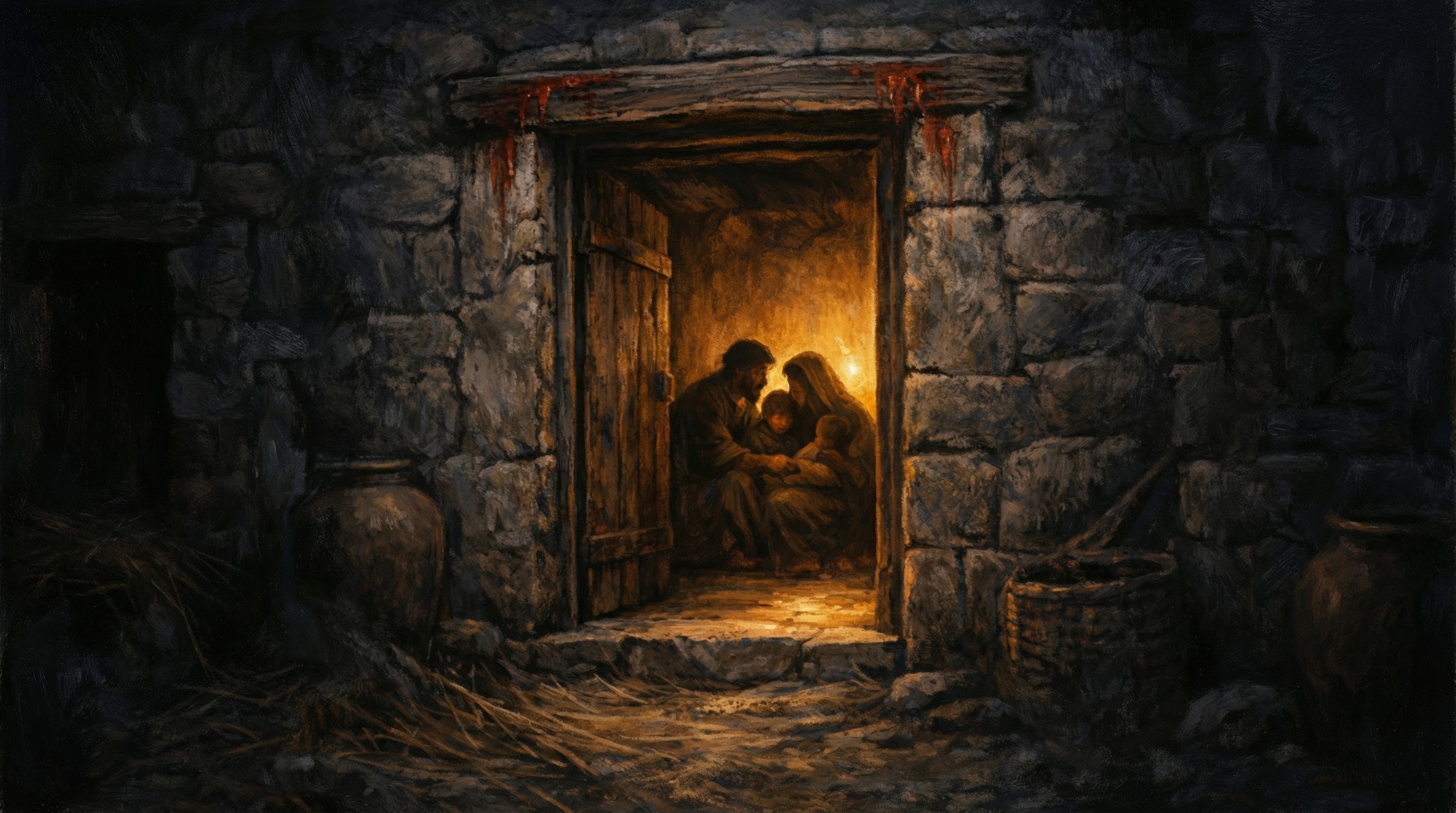
The lamb covers the HOUSE. Everyone inside — infants included — lives. Everyone outside — infants included — is exposed. No age exemption. The only exemption was the blood on the doorpost.
Every firstborn — from Pharaoh's heir to the prisoner's child. No age exemption. The only protection was the blood on the doorpost.
Noah's Ark (Genesis 7)
Noah is declared righteous. His family enters on his standing. Every other household on earth — including their infants — perished. Eight souls total (1 Pet 3:20). The world was full of families with babies and small children. The ark carried eight people.
Rahab (Joshua 2 and 6)
Her faith covers her whole household. Meanwhile:
Young and old. No age exemption. The only exemption was Rahab's household.
Korah's Rebellion (Numbers 16)
Little children explicitly present. Swallowed with the household. The text goes out of its way to mention the children standing there. They go down with the house.
Lot and Sodom (Genesis 19)
Lot's household was extracted. The children of Sodom were not. Abraham's principle (Gen 18:32) operates at the city level — not "spare the children individually," but "if 10 righteous are found, I will not destroy the city." The judgment falls on the whole city. The extraction is by household.
Five examples. Five times the same pattern. The protective unit is the household, not the individual child's age. The covering belongs to whoever is inside the house with the blood on the door.
V. The Verse That Changes Everything
One verse in the New Testament makes this explicit. And it's a verse most people skip over:
Look at Paul's logic. If at least one parent is a believer, the children are "holy" (G40 hagios — set apart, consecrated). The word "else" (G1893 epei — "since otherwise") means: if NEITHER parent were a believer, the children would be "unclean" (G169 akathartos — impure, ceremonially unclean).
If all children were universally safe regardless of parentage, Paul's argument collapses. There would be no "else" to worry about. Why would Paul need to reassure these believers that their children are holy if all children everywhere are holy by default? The "else" only makes sense if the alternative — children being unclean — is a real possibility for children outside a covenant household.
VI. Who the Household Model Actually Applies To
The household model does NOT restrict who can be saved. "Whosoever believeth" (John 3:16). The door is open to anyone who chooses — spouse, stranger, child of pagans. The household model answers only one question: what is the status of those who die before they can choose?
Sanctification vs. Salvation
Paul draws a careful distinction in 1 Corinthians 7:
- The unbelieving spouse IS sanctified (v.14) — stated as fact
- The children ARE holy (v.14) — stated as fact
- But saving the spouse is only a possibility: "What knowest thou, O wife, WHETHER thou shalt save thy husband?" (v.16) — uncertainty, not promise
Peter says the unbelieving spouse "may be won" (1 Pet 3:1) — possibility, not certainty. The sanctification is functional (makes the children clean), not salvific (doesn't save the spouse). The spouse still needs to believe personally — same as anyone.
The Covenant-Keeper, Not the "Head"
The covering flows from whoever carries the covenant — husband OR wife. First Corinthians 7:14 works both directions: the believing wife sanctifies the husband, and the believing husband sanctifies the wife.
Rahab wasn't the head of her father's household, but HER faith covered her father, mother, and brothers (Josh 6:23–25). A believing wife submits to her husband's authority (1 Pet 3:1) while carrying the spiritual covering. Authority structure and covenant standing are two different things.
The Door You Must Stay Inside
The blood covers those who stay inside. Leave the house, and the covering breaks.
Young children can't leave — they're covered by default (Deut 1:39, "no knowledge between good and evil"). Grown children can — Esau sold his birthright, Absalom rebelled, the prodigal left the father's house. Once they can choose, Ezekiel 18 applies:
Because the son is now personally accountable. This explains why not all children of believers end up saved (Hoeksema's point): not because the covering fails, but because grown children can walk out from under it.
The Bottom Line
The only people whose eternal status depends on the household model are those who die before they can choose — infants, young children, the unborn. For everyone else, the same door is open regardless of parentage. "Whosoever believeth."
VII. What About the Proof Texts?
Every time universal infant salvation is taught, the same verses come up. Let's look at each one carefully.
David's Child (2 Samuel 12:23)
David's confidence. But David was a covenant man — the anointed king of Israel. His child was under household covering. This verse tells you about the status of a covenant child. It says nothing about children of non-covenant households.
Deuteronomy 1:39
These are children of ISRAEL — covenant people. "Your" children. Meanwhile, the children of the Canaanites received no such promise:
Same chapter, same context. Covenant children go in. Non-covenant children are destroyed. Both statements sit in the same book.
Matthew 18:14, 19:14
But verse 6 of chapter 18 qualifies it: "these little ones which believe in me." And "of such" describes the QUALITY of childlike faith — humility, dependence, trust — not a categorical promise that all children everywhere are saved. Yeshua is speaking to the families of Israel — covenant households.
Isaiah 7:15–16
This acknowledges a pre-accountability stage — a time before children can choose. But it doesn't say whose children benefit from it. It describes a developmental fact, not a universal salvation promise. The household model tells you who benefits during that stage: children inside a covenant house.
Every proof text, when read in context, turns out to describe covenant children — not all children universally.
VIII. Malachi's Warning
If children's status depends on the covenant household, then breaking the household has consequences. And that's exactly what Malachi says:
God made the marriage "one" FOR THE PURPOSE of seeking a "godly seed" (H430 elohim + H2233 zera — literally "a seed of God"). Break the union, and you threaten the godly seed.
The garment/covering language connects directly to the nakedness/covenant framework. In Ezekiel 16:8, covering nakedness = entering covenant:
If the believing spouse departs or the household breaks (1 Cor 7:15), the children's status follows whichever parent they're with. The covering follows the covenant-keeper, not the household structure.
IX. The Hardest Question
This is the section most people won't want to read. But the text says what it says.
The Molech prohibition sits inside the Leviticus 18 "uncover nakedness" chapter (Lev 18:21) — categorized as a covenant boundary violation.
Child sacrifice is called "whoredom" — harlotry, covenant-breaking. The judgment falls on the family.
And God claims the children:
The children were covenant children — "borne unto me," "MY children." The parents' act of sacrifice breaks the covering.
The children's blood is "innocent." But the parents "went a whoring." Innocence and covering are separate things. The children are innocent in the sense that they didn't choose evil. But the parents, by their act, removed the covering from the house.
The act of abortion is itself covenant-breaking. You cannot simultaneously break covenant and provide covenant covering. The parent who aborts has, by that act, walked away from the doorpost.
X. The "Heaven" Problem
Before we look at the numbers, we need to address the assumption hiding behind every modern teacher's answer. When they say "all children who die go to heaven," what exactly is "heaven"? And does Scripture ever promise anyone will go there?
The Phrase That Doesn't Exist
Search the entire Bible. The phrase "go to heaven" does not appear — not once, in any form. No one "goes to heaven," "went to heaven," or is told they will "go to heaven." The phrase that defines the hope of modern Christianity is absent from its own text.
What does appear is the opposite direction:
David — the very man whose confidence about his dead child (2 Sam 12:23) is used as the proof text for children going to heaven — has not himself gone to heaven. Peter says so explicitly, after the resurrection, speaking under the power of the Holy Spirit at Pentecost.
What "Heaven" Actually Means
The Hebrew word is שָׁמַיִם (H8064 shamayim) — from a root meaning "to be lofty." It means the sky: the visible arch where clouds move and the higher expanse where celestial bodies revolve. It appears 395 times in the Old Testament — overwhelmingly referring to the physical sky, the cosmic heavens, or as a metonym for God's domain.
The Greek word is οὐρανός (G3772 ouranos). Its derivation is revealing: Strong's notes it is "perhaps from the same as G3735 (oros) through the idea of elevation." And G3735 means mountain — "a mountain, as lifting itself above the plain." The word for "heaven" may come from the word for mountain.
This is not incidental. In Scripture, mountain = kingdom — an established ruling authority. "The seven heads ARE seven mountains" (Rev 17:9). "The mountain of the LORD's house shall be established in the top of the mountains" (Isa 2:2) — His kingdom above all kingdoms. The word for "heaven" may derive from the word for "mountain" — and both point to the same concept: an elevated seat of authority. Hebrews calls it "mount Sion, the city of the living God, the heavenly Jerusalem" (Heb 12:22). The "heavenly" city is a kingdom-city — and it comes down.
The Direction Is Wrong
Modern theology says: people go up to heaven. Scripture says:
The inheritance is not in heaven. It is from heaven:
"Reign in heaven" — zero occurrences. "Reign on the earth" — Revelation 5:10.
What About "Treasure in Heaven"?
The strongest counter-texts are "treasure in heaven" (Matt 6:20), "reward in heaven" (Matt 5:12), and the inheritance "reserved in heaven for you" (1 Pet 1:4). But notice the preposition: the treasure is in heaven — stored there, held there, safe there. Not: "you will go to heaven to collect it." A bank in London can hold your inheritance; that doesn't mean you live in the vault. The inheritance is reserved in heaven — and then the city that holds it comes down (Rev 21:2).
"Our conversation [citizenship] is in heaven" (Phil 3:20) — but the very next phrase says "from whence also we look for the Saviour." He is coming FROM there TO us. Citizenship is registered in the capital; you don't have to live in the capital to be a citizen.
The Kingdom OF Heaven
"Kingdom of heaven" appears 32 times — all in Matthew. Mark and Luke, describing the same events, write "kingdom of God." The phrases are interchangeable. "Kingdom of heaven" does not mean "a kingdom located in heaven" any more than "kingdom of England" means "a kingdom inside England." It is the kingdom that originates from heaven — and it comes to earth: "Thy kingdom come, thy will be done, on earth as it is in heaven" (Matt 6:10).
Why This Matters for Children
When a modern teacher says "all children who die go to heaven," the entire statement rests on a destination Scripture never describes. The Bible doesn't say the saved "go to heaven." It says the dead await resurrection (1 Thess 4:16), the meek inherit the earth (Matt 5:5), the saints reign on the earth (Rev 5:10), and the city of God comes down to a renewed earth (Rev 21:2). The destination is physical. The inheritance is land. And that makes the population question inescapable.
Full Word Study: Heaven (H8064 / G3772) →
XI. The Resurrection Math
Here's where it gets testable. If the household model is right, the numbers should work. If universal infant salvation is right, the numbers should work too. Let's check.
About 117 billion people have ever been born (Population Reference Bureau). Pre-industrial child mortality was devastating — roughly 40–50% of all births died before age 5. That's about 50–55 billion children who died across human history.
If ALL Children Are Automatically Saved
~55 billion children + ~124 million saved adults (0.2% per Jer 3:14) ≈ 55 billion total. That's 47% of all humans ever born.
But Jesus said:
47% is not "few." Spurgeon's argument actually backfires: he said heaven must include infants to explain the "vast" population. But "vast" and "few" cannot both be true.
The Land Test
Now consider the inheritance. The promise was never "heaven." It was always the land:
The traditional reading maps this as the Levant corridor — modern Israel, Lebanon, western Syria to the Euphrates bend — roughly 300,000 square miles. Given to Abraham, confirmed to Isaac, confirmed to Jacob, mapped in Ezekiel 47–48.
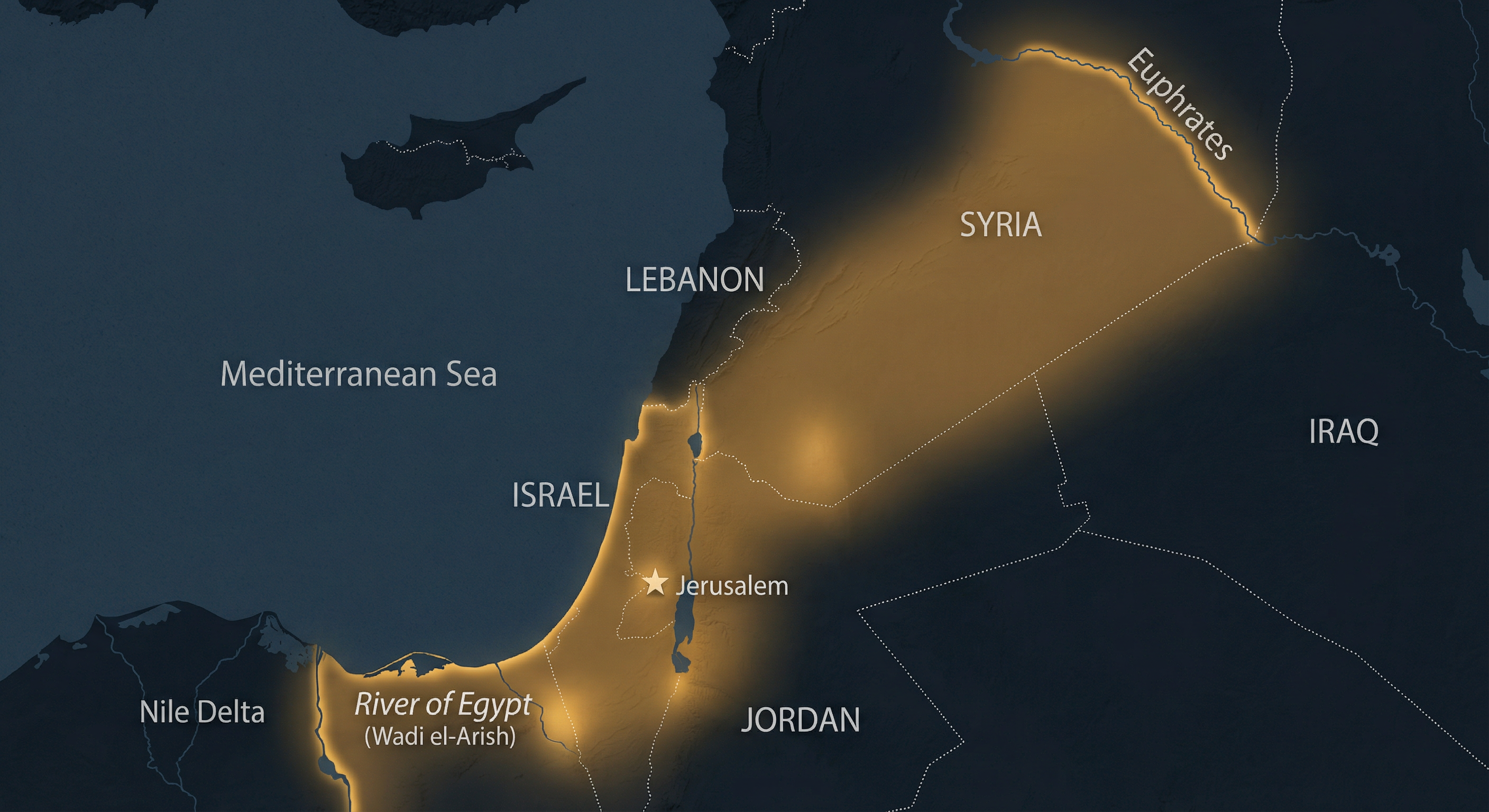
The Promised Land — traditional boundaries (~300,000 sq mi)
But there's a broader reading. If "the river of Egypt" means the Nile watershed, and the Euphrates boundary extends to the Persian Gulf, and the Arabian territory through which Israel actually traveled is included — the territory grows to roughly 900,000 square miles. Even using this more generous boundary, the density test is devastating to the all-children model.
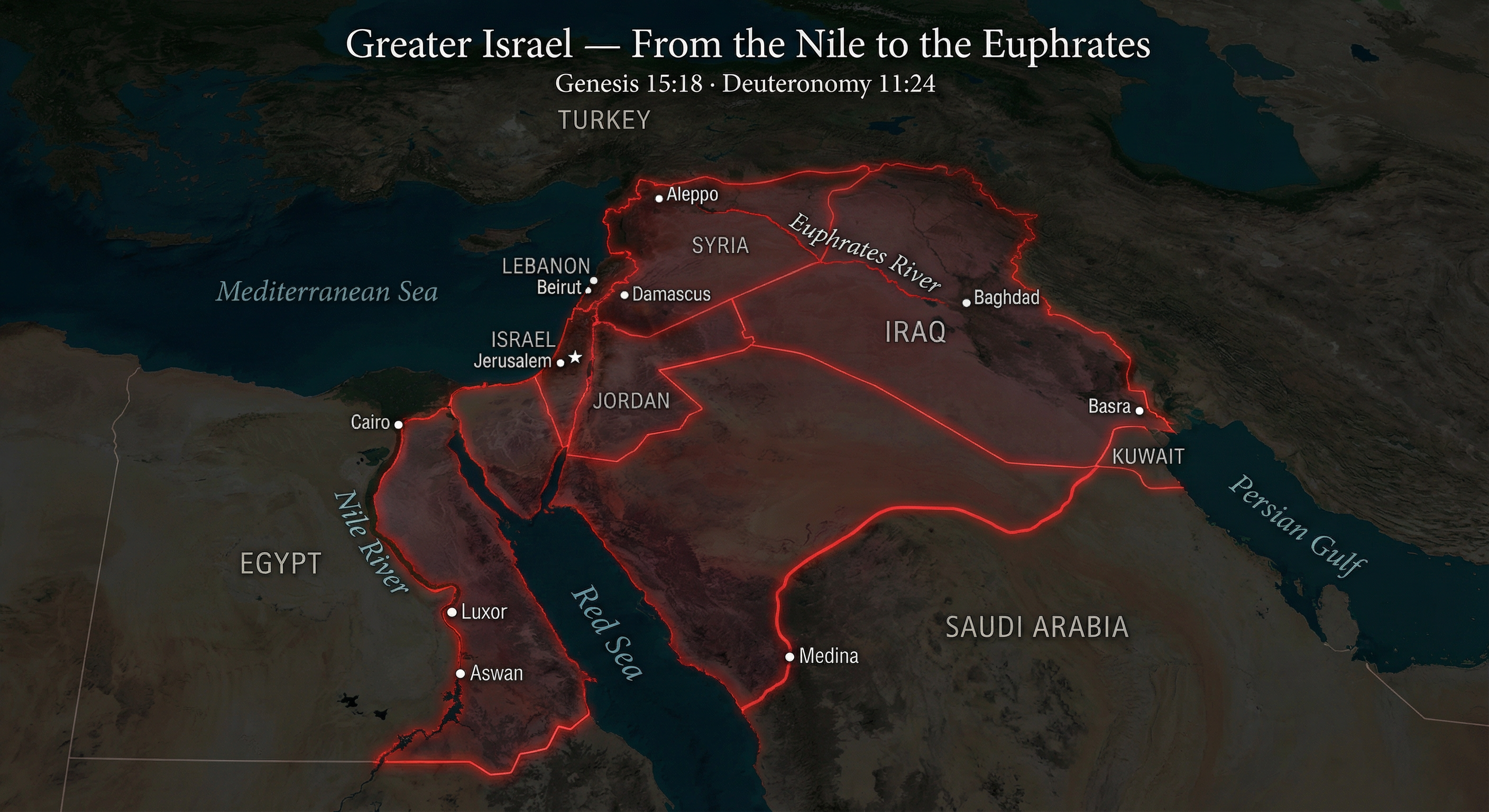
Greater Israel — broader reading (~900,000 sq mi)
| Scenario | Total Saved | Traditional (~300K sq mi) | Greater Israel (~900K sq mi) |
|---|---|---|---|
| All children saved | ~55 billion | ~183,000/sq mi (2× Manhattan) | ~61,000/sq mi (denser than Manhattan) |
| Household model | ~200–500 million | ~667–1,667/sq mi (like England) | ~222–556/sq mi (like rural France) |
Under the household model: comfortable, livable, a real inheritance. People building houses and planting vineyards, just as Isaiah 65:21 promises. Under the all-children model: denser than Manhattan even with the most generous land reading. Farms become physically impossible. A "physical inheritance" becomes meaningless.
The New Jerusalem — Grave-Plots of the Field
The Hebrew text of Revelation 21:16 reveals something far more interesting than a size comparison. Where the Greek says "stadia," the Hebrew says something else entirely — hover over the Hebrew to highlight the corresponding English:
וּמָדַד הָעִיר עִם הַקָּנֶה שְׁנֵים עָשָׂר אֶלֶף קִבְרוֹת הַשָּׂדֶה וְאָרְכָּהּ וְרָחְבָּהּ וְגָבוֹהַּ מֵהָעִיר הֵמָּה שָׁוִים
Three dimensions — length (אֹרֶךְ), width (רֹחַב), and height (גָבוֹהַּ, gavoah) — declared equal (שָׁוִים). The word גָבוֹהַּ is unambiguous in Hebrew: it always means vertical height (Deut 3:5 high walls, 1 Sam 9:2 Saul's height, Ezek 40:2 high mountain). Since Zion is always described as a mountain (Isa 2:2, Ezek 40:2), a mountain-shaped city is the more natural reading than a cube.
The unit: קִבְרוֹת הַשָּׂדֶה — "grave-plots of the field"
The Hebrew does not use the Greek loanword "stadia." It uses קִבְרוֹת הַשָּׂדֶה (kivrot ha-sadeh) — literally "grave-plots of the field." The word קֶבֶר (H6913 qever) means "grave, burial plot." The word שָׂדֶה (H7704 sadeh) means "field." Together they echo Genesis 23 — the foundational land transaction of the Promised Land narrative, where Abraham purchases a field (שָׂדֶה) as a burial possession (אֲחֻזַּת קֶבֶר):
The New Jerusalem is measured in the vocabulary of Abraham's first land deed — the first piece of the Promised Land ever legally owned. The city of the resurrection is dimensioned in the language of burial and inheritance.
Additionally, שָׂדֶה (field) carries symbolic weight throughout Scripture as representing people:
- "All flesh is grass... the flower of the field" (Isa 40:6–8)
- "As for man, his days are as grass: as a flower of the field" (Ps 103:15)
- "The field is the world" (Matt 13:38)
So קִבְרוֹת הַשָּׂדֶה — "grave-plots of the field" — resonates as: burial places within the field of humanity. The graves of the people.
Two readings of שְׁנֵים עָשָׂר אֶלֶף — and both produce 144
The measurement per side is שְׁנֵים עָשָׂר אֶלֶף (shneim asar elef). As established in The Tree That Wakes First, אֶלֶף means both "thousand" and "clan." This yields two readings:
Reading 1 — 12,000 individual resurrection plots per side:
- Base: 12,000 × 12,000 = 144 million plots
- 144 million ÷ ~117 billion ever born = ~0.12%
- 144 million ÷ ~61 billion since the cross = ~0.24%
- The Jeremiah 3:14 ratio ("one from a city, two from a thousand") = ~0.2%
- The numbers converge independently.
Reading 2 — 12 clans of resurrection plots per side:
- If אֶלֶף = clan, each side is "12 clans of grave-plots"
- Base: 12 × 12 = 144 clan-territories
- This maps directly onto the 144 clans of Rev 7:4 (12 tribes × 12 clans)
- The city is architecturally divided into 144 clan-sections
Both readings produce the covenant number: 144.
The 12 gates confirm the tribal structure (Rev 21:12–13) — three on each side, each named for a tribe of Israel. This is the same layout as the wilderness camp (Numbers 2) and Ezekiel's eschatological city (Ezek 48:30–34). Each tribe enters through its gate into its section. Inside: 12 × 12 = 144 clan-territories. The wall = 144 cubits (Rev 21:17) — one cubit per clan, using "the measure of man" (כְּמִדַּת אָדָם). The wilderness camp becomes the eternal mountain. The tent becomes stone and gold.
The height problem dissolves under the clan reading:
If the dimensions describe covenant architecture rather than physical distance, then "height equals length equals width" means the city is as fully organized vertically as it is horizontally — 12 clan-divisions in every dimension. The mountain rises to whatever physical height God makes it; the equal dimensions describe symmetry of structure, not a literal altitude.
| Reading | Height Implication | Problem? |
|---|---|---|
| Greek stadia | ~1,380 miles (outer space) | Absurd |
| Physical grave-plots (~3–7 ft) | ~7–16 miles (1–3× Everest) | Still extreme |
| Clan-structure (12 × 12) | Physical height unspecified | No problem — it describes organization, not altitude |

A literal stadia-scale New Jerusalem shown to scale from space — the peak reaches 1,380 miles, far past the atmosphere (~60 mi) and the ISS (~250 mi)
The image makes the problem visceral. A structure one-third of Earth's radius, rising from the Levant into outer space. But the absurdity goes beyond appearance. A mass that size would shift Earth's center of gravity, causing the planet to reorient its spin axis until the mountain sat at the equator — a phenomenon geophysicists call true polar wander. Global sea levels, tidal patterns, and climate zones would be catastrophically rearranged. The mountain's peak, well above the ISS, would be in hard vacuum with no atmosphere, no pressure, and temperatures swinging between solar radiation and the cold of space. Whatever the New Jerusalem is, the stadia reading turns it into a physics problem, not an inheritance.
Scripture uses mountain as a symbol for kingdom — a ruling authority. "The seven heads ARE seven mountains" (Rev 17:9). The stone that strikes the image "became a great mountain, and filled the whole earth" (Dan 2:35) — and Daniel identifies it: "the God of heaven shall set up a kingdom" (Dan 2:44). When Isaiah 2:2 says the mountain of the LORD's house "shall be exalted above the hills" with "all nations" flowing to it, it means this kingdom will be established above all other ruling authorities — not that a physical spike will protrude into orbit. The text isn't measuring feet. It's measuring covenant completeness. Twelve tribes, twelve clans, twelve gates, 144 sections, 144-cubit wall. The city IS the covenant structure made architectural — the kingdom of God given visible, governmental form.
The dead who were planted in the field like grass (Isa 40:6) rise and take their allotment in the city of the living God (Heb 12:22). Death is the unit; resurrection is the meaning.
Steel-Man Test
Give the opposing view every advantage. Abandon the Promised Land boundaries entirely. Use the stadia reading of the New Jerusalem — roughly 1.9 million square miles, a city larger than its own country, extending into outer space:
| Scenario | Total Saved | New Jerusalem at stadia scale (~1.9M sq mi) |
|---|---|---|
| All children saved | ~55 billion | ~28,900/sq mi (Manhattan density) |
| Household model | ~200–500 million | ~105–263/sq mi (like Vermont) |
Even granting a continent-sized city that extends into outer space, 55 billion people still pack it to Manhattan density — in a city described as having golden streets, a river, orchards of twelve fruits, and open gates. The household model yields Vermont-level spaciousness.
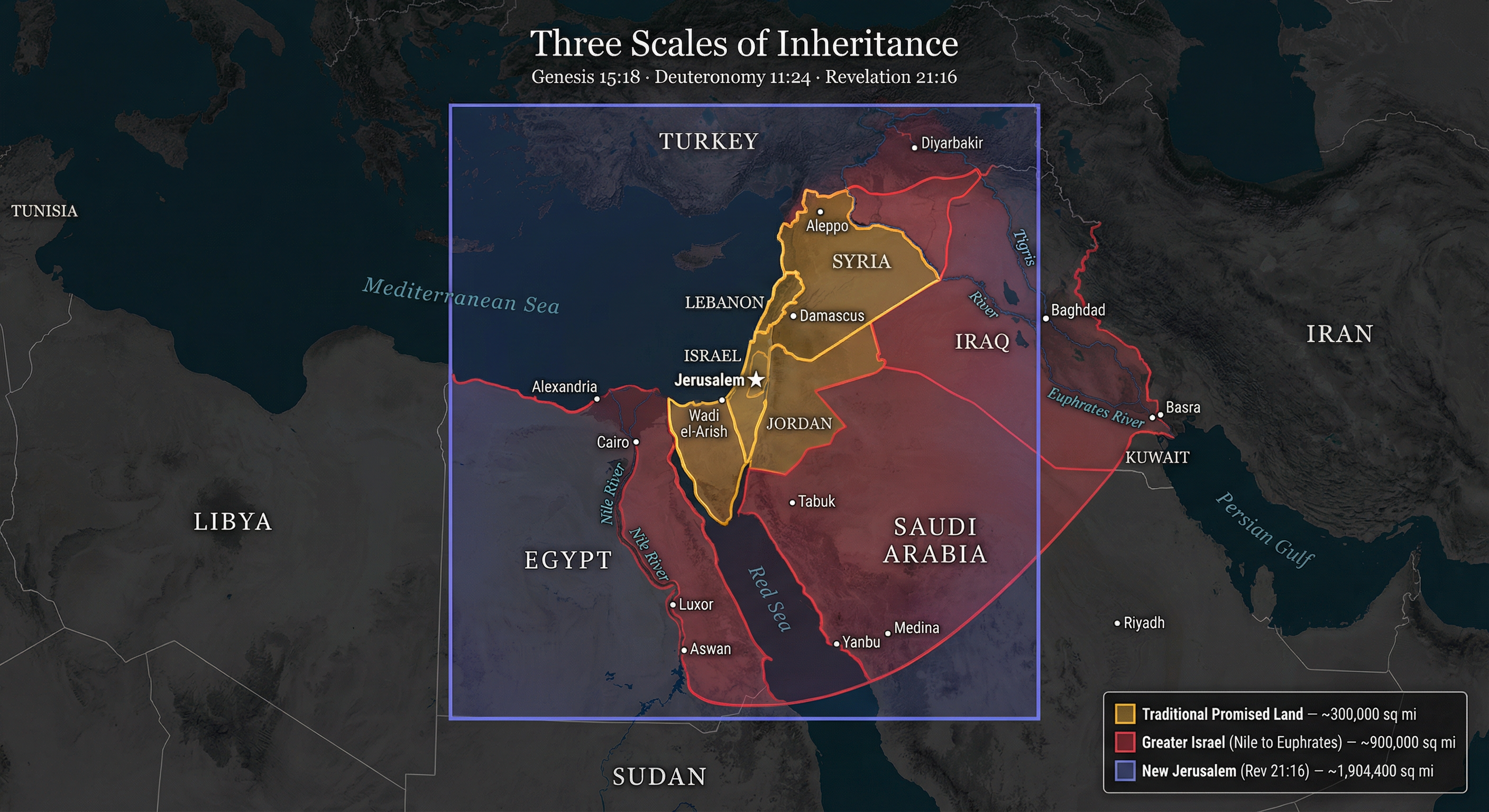
Three scales compared — traditional Promised Land, Greater Israel, and the stadia-scale New Jerusalem
The conclusion holds at every scale: the traditional Promised Land (~300K sq mi), the Greater Israel reading (~900K sq mi), or even an impossibly oversized New Jerusalem (~1.9M sq mi). "Few" has to mean few for the physical promises to be physically meaningful.
Why This Can't Be Back-Translation
This follows the same pattern as the אֲלָפִים / מִשְׁפְּחוֹת argument (Rev 7:4): the Hebrew contains information that the Greek loses in translation, and no reverse translator would produce the Hebrew phrasing from the Greek.
A translator working from Greek into Hebrew has well-known options for σταδίων (stadia):
- רִיס (ris) — the standard rabbinic Hebrew equivalent of a stadion. Used throughout the Mishnah and Talmud. The obvious, default choice.
- סטדיון (stadion) — borrow the Greek word directly as a loanword, just as rabbinic Hebrew does with σανχεδρίν → סנהדרין and παράκλητος → פרקליט.
- מִיל (mil) — the rabbinic "mile," with a number adjustment.
- A descriptive phrase — naturally מִדּוֹת הַשָּׂדֶה ("measures of the field") or אָרְכוֹת הַשָּׂדֶה ("lengths of the field"), using standard measurement vocabulary.
No back-translator would write קִבְרוֹת הַשָּׂדֶה. To produce this phrase from σταδίων, a translator would have to ignore רִיס (the standard equivalent), ignore direct borrowing (the simplest option), ignore every standard Hebrew measurement term, and coin a novel compound using קִבְרוֹת — "graves" — from a completely different semantic domain. Translators simplify. They use known equivalents. They do not invent cryptic novel compounds when a standard word exists.
The directionality is one-way:
- Hebrew → Greek (natural): A Hebrew author writes קִבְרוֹת הַשָּׂדֶה — a Hebrew agricultural idiom. The Greek translator sees שָׂדֶה (field), recognizes the field-measurement concept, reaches for σταδιον — the closest Greek field-length measurement. Clean, motivated, reasonable.
- Greek → Hebrew (unnatural): A translator sees σταδίων, bypasses רִיס, bypasses direct borrowing, bypasses every descriptive option, and invents "graves of the field." This requires authorial creativity, not translation behavior.
| Passage | Hebrew | Greek | What Greek Loses |
|---|---|---|---|
| Rev 7:4 | אֲלָפִים + מִשְׁפְּחוֹת (clans + families) | χιλιάδες (thousands) | The clan meaning; the Hebrew parallelism |
| Rev 21:16 | קִבְרוֹת הַשָּׂדֶה (grave-plots of the field) | σταδίων (stadia) | The burial/inheritance vocabulary; the Genesis 23 echo |
Each case follows the same logic: the Hebrew contains a specifically Hebrew construction that no translator working from Greek would produce, because simpler and standard options exist. The Greek is a reasonable rendering of the Hebrew. The Hebrew is not a reasonable reverse-rendering of the Greek. The translation arrow points one direction: Hebrew → Greek.
XII. What This Means
The protective unit in Scripture is the HOUSEHOLD, not the individual child's age. Children of covenant households are covered (1 Cor 7:14). Children of non-covenant households are not automatically covered. And the population math confirms it: "few" means few, and a physical inheritance requires physical numbers.
This is a hard teaching. But it's what the text says. And it's what Christianity taught for 1,500 years before the modern softening.
Here is what it means for you: your covenant standing matters more than you thought. Not just for you — for your children. Your faithfulness is the doorpost with blood on it. Your children are inside the house. If you walk away from the covenant, you take the blood off the door.
The door to salvation is open to anyone. But for those who can't yet walk through it themselves — the infants, the unborn, the little ones — everything depends on whose house they're in.
Guard the door.